
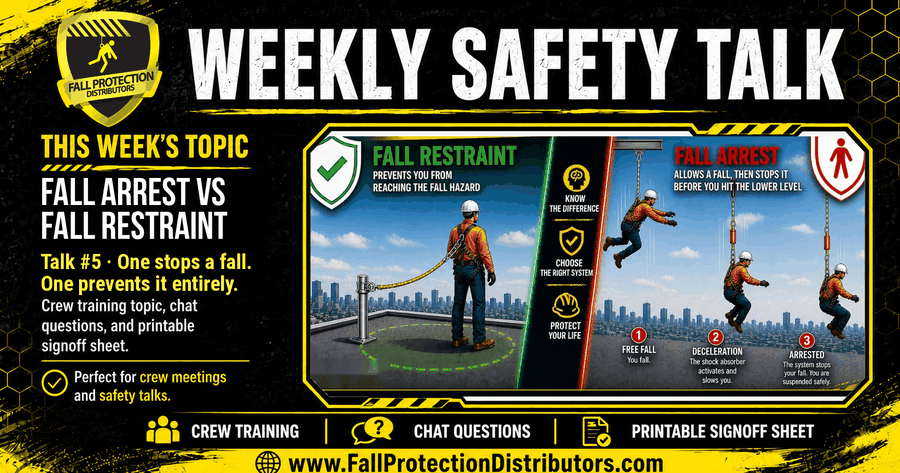
Arrest vs Restraint (Talk #5)
Posted by Howie Scarboro - COO- Fall Protection Distributors, LLC on Aug 21, 2026
By Howie Scarboro, COO, Fall Protection Distributors, LLC · Last verified against the eCFR, OSHA.gov letters of interpretation, and WAC 296-880: July 29, 2026
For information purposes only. This page supports your safety planning; it does not replace professional judgment. All safety plans and fall protection decisions for the task must be reviewed and approved by a Competent Person or a Qualified Person before work begins, as required by OSHA.
Fall Arrest vs. Fall Restraint: Which Is The Best Option For My Project?
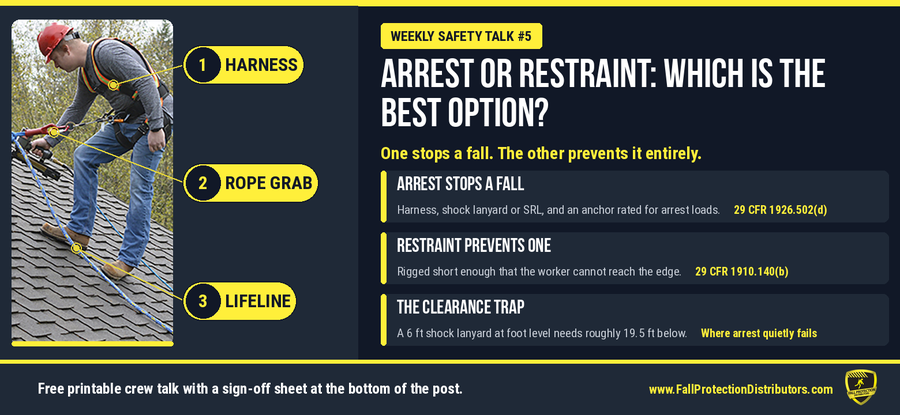
Fall arrest allows for more worker movement because it can stop a potential fall. The harness, shock-absorbing lanyard, or self-retracting lifeline, and an anchor must be rated for arrest loads under 29 CFR 1926.502(d).
Fall restraint never lets the worker access a potentially hazardous area: the line is rigged short enough that the worker physically cannot reach the edge. OSHA accepts properly rigged restraint in place of arrest, and general industry defines it outright as a travel restraint system in 29 CFR 1910.140(b). On low eaves, a fall arrest system can be physically incapable of saving you, because a 6-foot shock-absorbing lanyard anchored at your feet needs roughly 19.5 feet of clearance below the anchor to finish stopping a fall. On a single-story house, that clearance is not available. In situations like this, restraint is not the budget option; it is the only working option.
This is Talk #5 of our Weekly Safety Talk series. Talk #1 covered fall protection trigger heights in all 50 states, and Talk #4 covered what counts as a compliant anchor point. This week we are discussing which type of system to deploy to protect your crew.
The Two PFAS Strategies, According To The Law
General industry gives the clearest definitions. A personal fall arrest system is "a system used to arrest an employee in a fall from a walking-working surface," built from a body harness, anchorage, and connector (29 CFR 1910.140(b)). A travel restraint system is "a combination of an anchorage, anchorage connector, lanyard (or other means of connection), and body support that an employer uses to eliminate the possibility of an employee going over the edge of a walking-working surface" (same section). One system stops a fall in progress, and the other eliminates the possibility of a fall.
The construction standard, 1926 Subpart M, never defines restraint by name, which is why some crews think it does not exist on a construction site. OSHA clarified that question decades ago in a letter of interpretation: "we do accept properly utilized fall restraint systems in lieu of fall arrest systems when the restraint system is rigged in such a way that the employee cannot get to the fall hazard." Therefore, restraint is legal in construction.
Everything about arrest is built around what happens during the fall. The system must limit free fall to 6 feet, limit the arresting force on the worker to 1,800 pounds with a full-body harness, and bring them to a stop within 3.5 feet of deceleration distance (29 CFR 1926.502(d)(16)). Restraint has no catch to engineer, which is why its load ratings are generally lower: no construction standard sets a figure, and OSHA's guidance suggests restraint anchorages withstand at least 3,000 pounds, or twice the maximum expected force, versus the 5,000 pounds, or the engineered two-to-one requirement that arrest anchors carry under 1926.502(d)(15).
Where Restraint and Arrest Fit in OSHA's Hierarchy of Controls
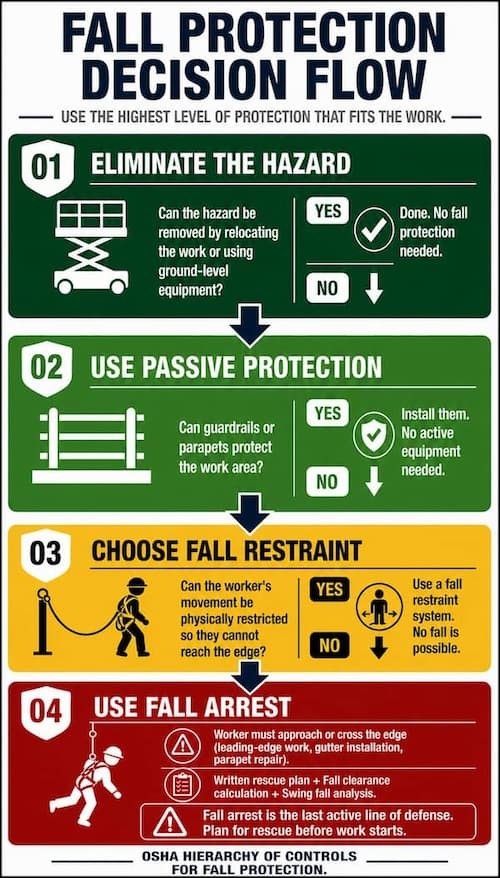
Fall protection is a ladder of preferences, and these two systems sit on its bottom half. Eliminate the hazard first, such as relocating the work or staging it from ground-level equipment. Use passive protection second: guardrails or parapets protect everyone without any gear. When the work still exposes a worker to the edge, choose fall restraint before fall arrest, because restraint makes the fall impossible. Fall arrest is the last active line of defense, reserved for work that must approach or cross the edge, and it brings the written rescue plan, the fall clearance calculation, and the swing fall analysis with it. Plan for rescue before work starts.
The Fall Clearance Problem: A Challenge For Fall Arrest Systems
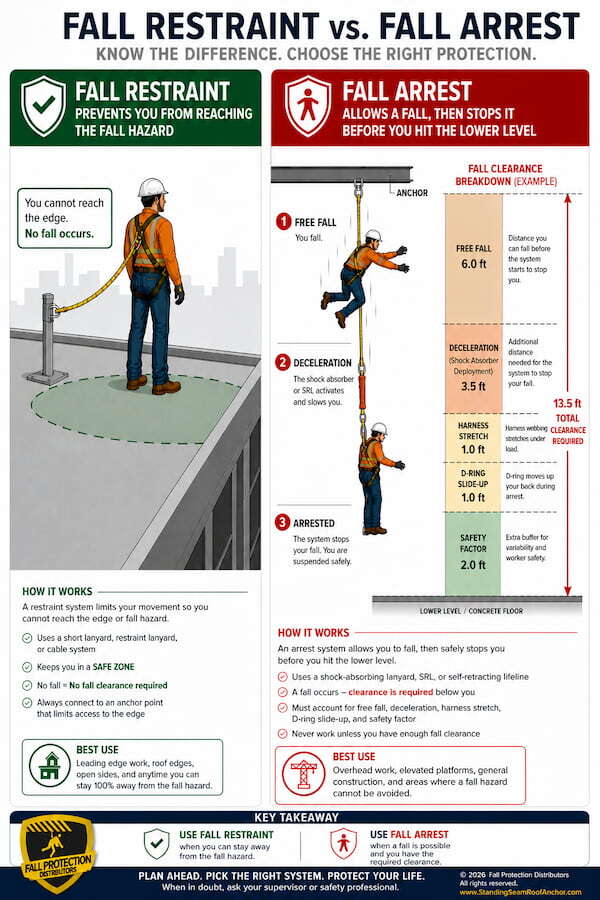
A fall arrest system needs room to decelerate a falling worker. With a 6-foot shock-absorbing lanyard anchored at your feet, the fall clearance math looks like this: the free fall until the lanyard comes taut, up to 3.5 feet of shock absorber deployment, about a foot of harness stretch, another foot of D-ring slide, and a safety factor. The total fall clearance is roughly 19.5 feet below a foot-level anchor. Raise the anchor to D-ring height, and the number drops to about 13.5 feet; put it overhead, and it is about 12.5 feet.
Run your project in our free fall clearance calculator, because lanyard length, anchor height, and worker height all affect the total fall clearance requirement.
| Work location | Typical height to ground | Roughly 19.5 ft clearance available? | What actually works |
|---|---|---|---|
| Single-story eave | 10 to 12 ft | No | Restraint, or an SRL with a high anchor and verified clearance |
| Two-story eave | 18 to 20 ft | No with a foot-level anchor; borderline with a ridge anchor above the work | Run the calculator before trusting it |
| Two-story ridge anchor, working mid-roof | 20 ft and up from anchor to ground | Usually yes | Arrest works; restraint may still be simpler |
| Commercial roof, 25 ft and up | 25 ft and up | Yes | Arrest or restraint by task |
How to Rig For Fall Restraint
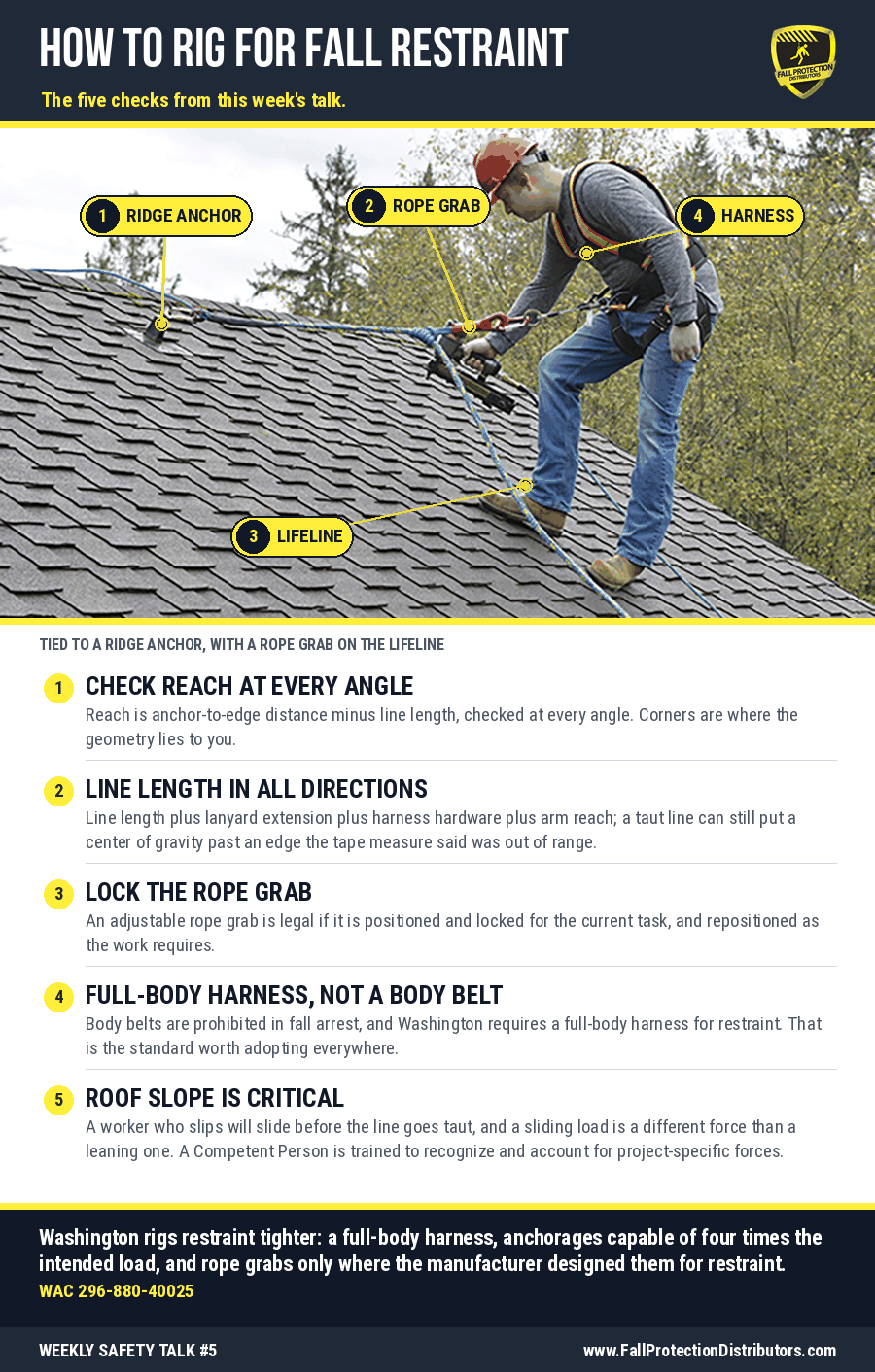
The worker's reach is anchor-to-edge distance minus line length, checked at every angle. A line that keeps you off the eave straight downslope may let you reach the corner on the diagonal, and corners are where the geometry lies to you.
Account for the line length in all directions of work. Calculate the line length plus lanyard extension plus harness hardware plus your arm reach; a worker leaning against a taut line can still get their center of gravity past an edge that the tape measure said was out of range.
An adjustable rope grab is legal if it is positioned and locked for the current task, and repositioned as the work requires. Washington prohibits the use of rope grabs in restraint unless they are specifically designed for restraint (WAC 296-880-40025).
Full-body harness, not a body belt. Body belts are prohibited in fall arrest systems (1926.502(d) and 1910.140(d)(3)). While federal rules leave restraint less specified, Washington requires a full-body harness for restraint, and that is the standard worth adopting everywhere.
Roof slope is critical. On a steep roof, a worker who slips will slide before the line goes taut, and a sliding load is a different force than a leaning one. OSHA's restraint guidance says to account for site-specific forces like a person "walking, leaning, or sliding down the work surface." A Competent Person is trained to recognize and account for project-specific forces.
The anchor side is the same discipline as Talk #4: a manufactured anchor installed per its instructions. On a standing seam roof, the SSRA1 clamp anchor covers arrest loads with published test data, so the same anchor serves both strategies.
| Component | Fall arrest | Fall restraint |
|---|---|---|
| What it does | Stops a fall in progress within set force and distance limits | Eliminates the possibility of reaching the fall hazard |
| Body support | Full-body harness only; body belts prohibited | Full-body harness (required in Washington; best practice everywhere) |
| Connecting device | Shock-absorbing lanyard or self-retracting lifeline | Fixed-length lanyard or locked adjustable line, no shock pack needed |
| Anchor strength | 5,000 lbs per worker, or engineered two-to-one under a Qualified Person (1926.502(d)(15)) | No construction standard sets a number; OSHA's 1995 letter suggests 3,000 lbs or twice the maximum expected force; Washington requires four times the intended load |
| Clearance below | Must be calculated and available, roughly 19.5 ft with a 6-ft shock lanyard on a foot-level anchor | None required; the fall never starts |
| Rescue plan | Required; prompt rescue provision under 1926.502(d)(20) | No arrested fall to rescue from, per OSHA's 1999 interpretation |
Fall Arrest Requires Rescue Planning
The moment your plan includes an arrested fall, 1926.502(d)(20) requires you to "provide for prompt rescue." Suspension trauma becomes the immediate challenge as soon as the worker's fall is successfully arrested. OSHA's 1999 letter explains the major advantage of working in restraint: "there is no need to provide for prompt rescue under §1926.502(d)(20), since there would not be an arrested fall." When choosing restraint, the safety plan omits the rescue plan, rescue gear, and rescue training. We will cover rescue and suspension trauma in a dedicated talk later in this series.
State Regulations Worth Knowing
OSHA addresses restraint through interpretation letters, but several state plans write it directly into their codes, and the details are important. Washington is the standout: WAC 296-880-40025 requires restraint systems to use a full-body harness, rigs them "to allow the movement of employees only as far as the unprotected sides and edges," requires anchorages capable of four times the intended load, and restricts rope grabs to models the manufacturer designed for restraint. That four-times figure is a different formula than federal guidance, so a rig that satisfies an OSHA letter may still fall short in Seattle. California and Oregon run their own fall protection chapters with their own trigger heights, which we covered in Talk #1. Before you standardize a restraint setup across state lines, check your state in our fall protection regulations database; it covers all 50 states plus the Canadian provinces.
Penalties For Non-Compliance
In 2026, a serious violation can run up to $16,550, and a willful or repeat violation up to $165,514 (OSHA penalties).
Frequently Asked Questions
What is the difference between fall arrest and fall restraint?
Fall arrest stops a fall that has already started, using a full-body harness, an energy-absorbing connector, and an arrest-rated anchor, within OSHA's force and distance limits. Fall restraint prevents the fall entirely by rigging the line short enough that the worker cannot reach the edge. Arrest manages a fall; restraint eliminates it.
Is fall restraint OSHA compliant on construction sites?
Yes. Although 1926 Subpart M does not define restraint, OSHA's letters of interpretation accept properly rigged fall restraint instead of fall arrest when the worker cannot get to the fall hazard from any position. General industry defines travel restraint systems directly in 29 CFR 1910.140(b).
How strong does a fall restraint anchor need to be?
No construction standard sets a restraint anchorage number. OSHA's November 2, 1995 letter of interpretation suggests, as a minimum, the capacity to withstand at least 3,000 pounds of force or twice the maximum expected force needed to restrain the worker from the fall hazard. Washington state requires four times the intended load under WAC 296-880-40025. Arrest anchors carry heavier requirements: 5,000 pounds per worker or an engineered two-to-one system under 29 CFR 1926.502(d)(15).
How much clearance does a fall arrest system need?
With a 6-foot shock-absorbing lanyard on a foot-level anchor, roughly 19.5 feet below the anchor. Move the anchor to D-ring height, and it drops to about 13.5 feet; overhead, it drops to about 12.5 feet. Self-retracting lifelines need far less. If the clearance isn't there, arrest can't complete the catch, and restraint is the working answer.
Can I use a body belt for fall restraint?
Body belts are prohibited in fall arrest systems under both 1926.502(d) and 1910.140(d)(3). For restraint, federal rules are less specific. Still, Washington requires a full-body harness.
Does fall restraint require a rescue plan?
No. OSHA's 1999 interpretation states that with a restraint system, you don't need to provide for prompt rescue under 1926.502(d)(20) because there is no arrested fall. Choosing arrest brings the rescue requirement, the equipment, and the suspension trauma risk.
When should a roofer use restraint instead of arrest?
Whenever the task allows working without reaching the edge. Restraint needs no clearance below, lighter anchor loads, and no rescue plan. Arrest earns its place when the work requires reaching the edge or the fall exposure cannot be rigged away.
Can the same roof anchor be used for both arrest and restraint?
Often yes, if it is rated for the more demanding arrest application. A standing seam clamp anchor like the SSRA1, installed per its instructions and supported by published test data, covers arrest loads, so a crew can run restraint from the same anchor with margin to spare. The connecting device and rigging length are what change between the two strategies.
Is there a roof pitch limit for fall restraint?
No. Neither federal OSHA nor Washington's restraint rule sets a maximum roof pitch for fall restraint. The 4:12 limit crews remember belongs to other systems: warning lines and safety monitors are restricted to low-slope roofs under 1926 Subpart M, and Washington scopes warning lines to roofs pitched four in 12 or less under WAC 296-880-40040. What limits restraint on a steep roof is the definition itself. The rig only counts as restraint if the worker cannot reach the fall hazard from any position, and on a steep pitch that includes sliding downslope after a slip, with the system sized for the larger forces a sliding worker creates. Some manufacturers also cap restraint use at a stated pitch in their product instructions, and those instructions govern. On a steep roof, a Competent Person makes the call.
Toolbox Quiz: Test Your Crew
Five questions from this week's talk. Discuss these at the safety meeting, let the crew argue, then score it. The one-page printable decision guide has the arrest-or-restraint decision card and a crew sign-off table for your training records (29 CFR 1926.503(b) requires written certification). It's free, and you don't have to give us an email address to get it.
Fall arrest manages a fall with stronger anchors, calculated clearances, and a timely rescue plan; restraint spends the same planning effort making the fall impossible. If you have a question about your setup or a roof that doesn't fit the table, send it through our contact page; we read every one, and answers may become future talks.
Work safe up there.