


12-Pack of 4-foot Malta Dynamics A6401 Concrete Anchor Straps – D-Ringless Web Loop Anchorage
The Malta Dynamics A6401 Concrete Anchor Straps in this 12-pack bundle feature a specialized strap-to-strap design, providing reliable anchorage without a metal D-ring. Built with a durable polyester web inner core and protected by a heavy-duty polyester sheath, these straps are engineered to withstand extreme abrasion and wear. For situations requiring a galvanized steel D-ring interface, check out the Malta Dynamics A6400 Concrete Anchor Strap Bundle.
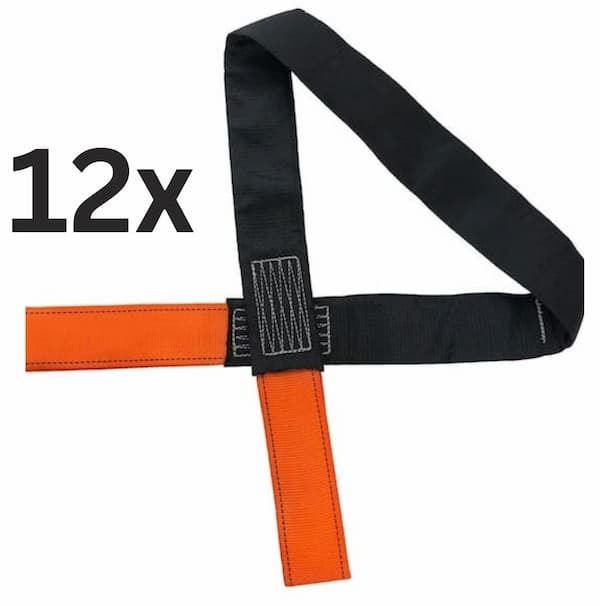
Lightweight. All-Web Connection for Concrete.
Watch this technical overview to understand the pour-in-place installation method and how the A6401 strap-to-strap loop creates a secure 5,000-lb rated anchorage point without metallic components.
Heavy-Duty Anchor Sheath for Long-Lasting Masonry Performance
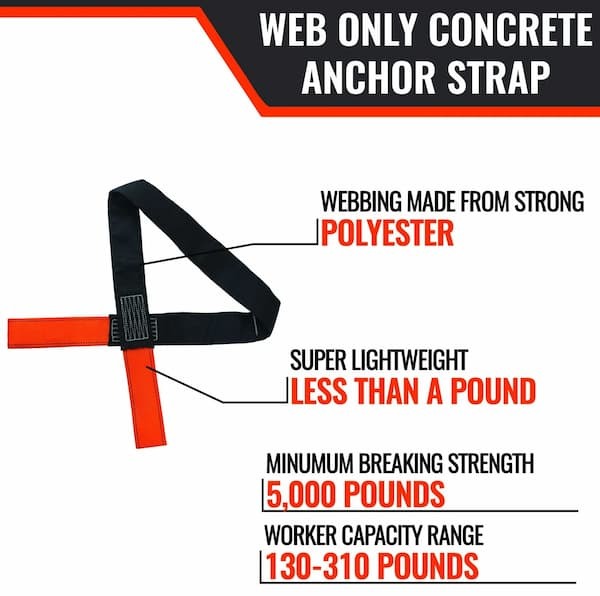
The premium outer sheath reinforces the inner webbing core, ensuring these anchor straps maintain their structural integrity even in highly abrasive concrete and rebar environments. With a minimum breaking strength of 5,000 lbs, the A6401 straps offer robust performance for both permanent and temporary anchoring needs. The A6401 straps meet OSHA 1910 and OSHA 1926 Subpart M requirements and comply with ANSI Z359.18-2017 and ANSI A10.32-12 standards. They are rated for a single user (130–310 lbs including tools).
Versatile D-Ringless Design for Complex Job Sites
These straps are ideal for securing an anchor point during construction or providing a temporary solution for rebar work, wood framework, or pipe racking. The strap-to-strap design eliminates the weight and potential snag hazard of a metal D-ring, making them exceptionally lightweight (only 0.4 lbs each) and easy to handle in bulk. Like the A6400, these are intended for pour-in-place use, where the web loop remains exposed for fall-arrest attachment after the concrete cures.
Malta Dynamics A6401 Technical Submittal Data & Compliance Docs:
Download the official engineering specs and safety certifications for the 4-foot D-Ringless Concrete Strap:
- Malta Dynamics A6401 Technical Spec Sheet – Dimensional data and substrate requirements.
- Malta Dynamics A6401 Declaration of Conformity – Safety standards and certifications.
- Malta Dynamics A6401 Owner's Manual – Detailed installation and placement instructions.
Malta Dynamics A6401 Concrete Anchor Strap FAQ
1. Why should I choose the D-Ringless A6401 over the A6400?
The A6401 is significantly lighter (0.4 lbs vs 1.5 lbs) and eliminates the metal D-ring entirely. This is preferred in environments where you want to minimize metallic components, reduce weight when carrying dozens of anchors, or prevent the D-ring from clattering against forms or finished surfaces.
2. How do I connect my lanyard or SRL to a web loop?
You connect a compatible ANSI-rated carabiner or snap hook directly to the exposed webbing loop. Ensure your connector is compatible with synthetic webbing and has no sharp burrs that could damage the loop.
3. Is the web loop as strong as a steel D-ring?
Yes. The A6401 is tested and certified to a minimum tensile strength of 5,000 lb, meeting the same OSHA and ANSI requirements as anchors with steel rings. The strength comes from the high-tenacity polyester core. Refer to the Malta Dynamics A6401 Owner's Manual above for more details.
4. Can I reuse these straps after the job is done?
No. These are "disposable" anchors. Once the concrete is poured around the structural loop, the strap is permanent. When fall protection is no longer required, the exposed loop is cut off, and the remainder is left embedded in the concrete.
5. Does this anchor work with "Vertical Lifelines"?
Yes. The A6401 serves as a secure anchorage point for any compliant PFAS, including vertical lifelines, shock-absorbing lanyards, and self-retracting lifelines (SRLs).
6. What is the most critical step during installation?
You must secure the internal loop to a structural member (like rebar or a reinforced mat) before pouring. Nailing the strap to a wooden form or simply dropping it into wet concrete is a dangerous error that will not support a fall.
7. How do I avoid common mistakes during pour-in-place use?
- 1. Improper Embedment: The loop must be deep enough in the pour to reach structural rebar.
- 2. Loop Contamination: Ensure the exposed loop stays clean and free of excessive concrete splatter, which can harden and make the webbing brittle or difficult to attach to.
- 3. Inspection Failure: Always inspect the exposed webbing before use. If the outer sheath is torn or the internal fibers are visible, the anchor must be retired.

