
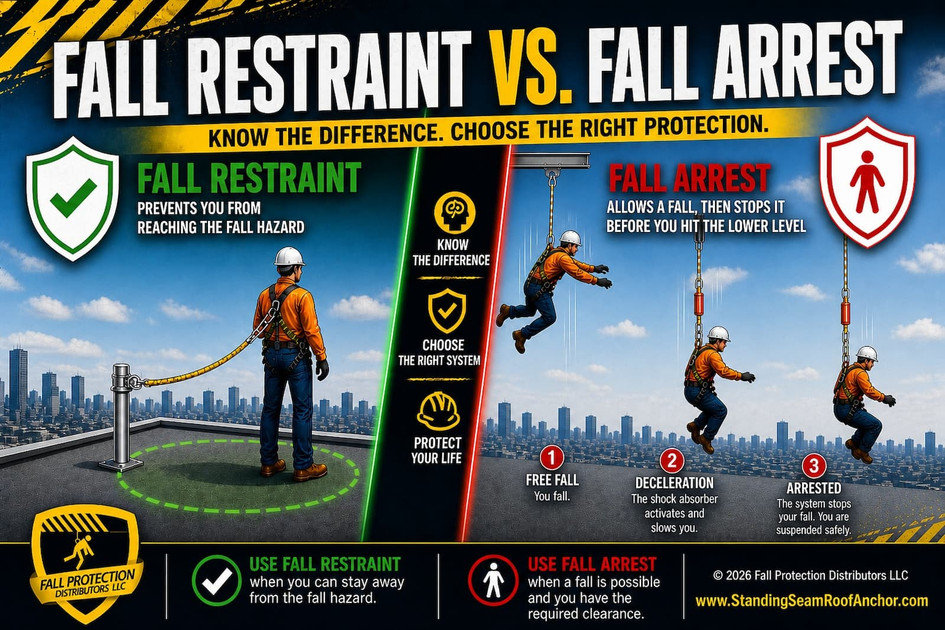
Arrest VS Restraint
Posted by Howie Scarboro - CEO Fall Protection Distributors, LLC on Mar 2nd 2023
Fall Arrest vs. Fall Restraint: A Complete OSHA Guide
This guide covers the definitions, OSHA citations (29 CFR 1910.140 and 29 CFR 1926.502), anchor strength requirements, fall clearance math, when each system is preferred, common myths, and special considerations for standing-seam metal roofs. Last updated May 8, 2026.
Where Restraint and Arrest Fit in OSHA's Hierarchy of Controls
Before comparing the two systems, it helps to see where each one sits inside OSHA's broader fall-protection hierarchy. From most effective to least effective, the levels are:
- Elimination. Remove the hazard entirely (move the HVAC unit to grade so no one has to go on the roof).
- Substitution. Replace the task with a safer one (use a mobile elevated work platform instead of a ladder).
- Engineering controls (passive). Guardrails, parapets, safety nets. Workers don't have to do anything for these to work.
- Engineering controls (active). Fall restraint systems. The worker is tied to an anchor, but the system is rigged so a fall is physically impossible.
- Engineering controls (active, last resort). Fall arrest systems. The worker can fall, but the system catches them.
- Administrative controls and PPE-only measures. Warning lines, safety monitors, training. These are the weakest layer because they rely on human attention.
Two ideas emerge from this hierarchy. First, OSHA prefers restraint over arrest whenever it is feasible, because preventing a fall is always safer than catching one. Second, both restraint and arrest are active systems because they only protect the worker if the worker is correctly tied off every time.
What Is a Fall Restraint System?
A fall restraint system uses a body harness, a fixed-length lanyard, and an anchor point positioned and rigged so that the worker cannot physically reach the unprotected edge. Think of it as a leash. As long as the lanyard is shorter than the distance from the anchor to the fall hazard, no fall is possible.
OSHA recognizes this approach in writing. In its November 2, 1995, standard interpretation letter, OSHA stated: "The use of a fall restraint system to prevent an employee from falling at all is acceptable provided the system is rigged in such a manner that the employee cannot fall any distance."
Components of a fall restraint system
- Anchorage point rated for the application. Under OSHA's general guidance, repeated in interpretation letters and incorporated into 29 CFR 1910.140, a restraint anchor must withstand at least 3,000 lb or twice the maximum expected force needed to keep the worker away from the hazard, whichever is greater. Many safety engineers default to the 5,000-lb arrest threshold anyway, either to keep the option to convert to arrest later or to build in a margin for misuse. That's defensible practice, just not strictly required.
- Full-body harness built to ANSI Z359.11, typically rated for workers between 130 and 310 lb. The dorsal (back) D-ring is the primary attachment for fall arrest; side or front D-rings are reserved for restraint or work positioning. Body belts have been prohibited for fall arrest since 1998 under 29 CFR 1926.502(d)(16), because concentrated arrest force on the abdomen can cause severe internal injury or death. Belts remain acceptable for work positioning and some general-industry restraint setups. Inspect harnesses before each use; reject any with cuts, burns, chemical damage, frayed webbing, or distorted hardware.
- Fixed-length, non-shock-absorbing lanyard, sized so the worker cannot reach the edge at full extension.
- Connectors (snap hooks and carabiners) meeting OSHA 1910.140(c)(8) and ANSI Z359.12: minimum 5,000 lb major-axis strength, 3,600 lb minor-axis strength, and 3,600 lb gate-face strength to prevent rollout. Connectors must be self-closing and self-locking with a double-action gate.
Never tie a knot in a vertical lifeline to shorten it for restraint use. Knots reduce rope strength by 30 to 50%, cannot be reliably inspected, and violate the equipment-modification rules under 1926.502 and every manufacturer's instructions. If a worker needs a shorter tether, issue a properly sized fixed-length lanyard or use a rope grab on the unmodified lifeline.
When restraint is the right choice
Fall restraint is the right call any time the work can be performed away from the edge: rooftop HVAC service, skylight inspections, solar panel cleaning on the field of the roof, exhaust fan maintenance, drone landings, snow removal in interior zones, or any task with a defined work area set well back from a leading edge.
The operational advantage is significant. Because no fall is possible, restraint eliminates three of the biggest compliance burdens of fall arrest: the written rescue plan, the fall clearance calculation, and the swing fall analysis.
What Is a Fall Arrest System?
Fall arrest is governed primarily by two OSHA standards: 29 CFR 1926.502 for construction and 29 CFR 1910.140 for general industry. Both spell out detailed criteria for harnesses, connectors, anchorages, and arresting forces. Under 1926.502(d)(15), anchorages used for personal fall arrest equipment must support at least 5,000 pounds per attached worker, or be designed and installed under the supervision of a qualified person with a safety factor of at least two.
Components of a fall arrest system (the "ABCDs")
- A. Anchorage capable of supporting at least 5,000 lb per attached worker, or designed by a qualified person with a safety factor of two.
- B. Body wear: a full-body harness. Body belts are explicitly prohibited for use in arrests under 1926.502(d)(16).
- C. Connector: a shock-absorbing lanyard or self-retracting lifeline (SRL). The connector is what limits the arrest forces on the worker's body.
- D. Deceleration device: the energy-absorbing element built into the lanyard or SRL.
A useful fifth letter, R for Rescue, reminds you that any fall arrest system requires a written, practiced rescue plan. OSHA 1926.502(d)(20) and ANSI Z359.2 both require that the employer plan for prompt rescue before work starts, not after a fall occurs.
Rescue is the most overlooked part of fall protection, and it's where compliance programs most often fail. Suspension trauma can incapacitate a worker in as little as 5 to 15 minutes from venous pooling in the legs and reduced blood return to the heart. "Call 911" is not a rescue plan, since typical EMS response times run 8 to 12 minutes in urban areas and considerably longer in rural areas. By the time the ambulance arrives, the suspended worker may already be unconscious.
Building a compliant rescue plan in five steps
- Assess the rescue scenario before work begins. Walk the site. Identify where each worker will be tied off, the height of each anchor, the surface below, and any obstructions in the swing arc. Document the answer to a single question: if a fall happens at this exact location, how does the worker get to the ground?
- Choose a rescue method that matches the site. Self-rescue with a descent device or trauma straps is the first option, because the worker controls their own outcome. Assisted rescue with a rescue ladder, pole, or pre-rigged descent kit is the fallback. Aerial rescue with a lift or ladder truck is the last option. Plan for all methods, equip the site, and don't assume 911 alone will work.
- Equip the site with the right gear. At minimum: trauma straps integrated into every harness, a rescue ladder or descent device matched to the work height, a fully charged communication tool for every crew member, and a certified retrieval anchor if assisted descent is planned. Inspect the rescue gear with the same rigor as the fall arrest gear.
- Train every worker in their role. Paperwork is not training. Each worker on the site needs to know who to call for rescue, who performs each task, what equipment to grab, and how much time they have. Run the practice drills physically, not just in a meeting room. ANSI Z359.2 specifies competent rescuer training that includes the actual rescue maneuver, not just classroom hours.
- Document, drill, and review. The plan must be written and physically on-site, not buried in a filing cabinet at the office. Practice it before each new project, after any change in personnel or equipment, and at least annually. Update the plan whenever the work area, anchor configuration, or rescue equipment changes.
Fall arrest performance limits (from 1926.502)
OSHA caps several forces and distances inside an arrest event. The system must "limit maximum arresting force on an employee to 1,800 pounds"
when used with a body harness, and must "bring an employee to a complete stop and limit maximum deceleration distance an employee travels to 3.5 feet (1.07 m)."
- Maximum arresting force on the worker: 1,800 lb when using a full-body harness, per 1926.502(d)(16)(iii). ANSI Z359.7 caps the average arresting force across the event at roughly 900 lb, with 1,800 lb as the absolute peak that the harness and the human body can tolerate.
- Maximum free-fall distance: 6 ft, or whatever the system's design permits, whichever is less. Free fall is measured from the worker's starting position to the point where the deceleration device begins to activate.
- Maximum deceleration distance: 3.5 ft. That is the additional distance traveled while the shock absorber or SRL brake is bringing the worker to a stop.
- Minimum tensile strength: 5,000 lb on lanyards, lifelines, and self-retracting devices used for arrest, per 1926.502(d).
- SRL leading-edge rating: ANSI Z359.14 distinguishes SRLs rated only for overhead anchorage from those rated for leading-edge work, where the lifeline can pass over a sharp metal edge. A standard overhead SRL used at a leading edge can be cut on contact. Match the device to the application.
- Single-worker rule: only one worker may be attached to a single vertical lifeline at a time, per 1926.502(d)(10).
- Post-fall product disposal: Any harness, lanyard, or SRL that has arrested a fall must be removed from service immediately. Once a shock pack deploys or webbing stretches under load, the product cannot be reused, regardless of its appearance.
- The worker must come to a complete stop before contacting any lower level. Total fall clearance below the anchor must account for free fall, deceleration, harness stretch, D-ring slide, and a safety factor (calculated in the next section).
Every one of those numbers is a hard limit, not a target. Exceed any single threshold, and the system is non-compliant under 1926.502, even if the worker walks away unharmed. OSHA judges the system by whether it stayed within design parameters, not by the outcome of any individual fall. A worker surviving a fall that produced 7 ft of free fall or 2,000 lb of arresting force does not validate the equipment. It just means the worker got lucky.
Fall Arrest vs. Fall Restraint: Side-by-Side
Every attribute OSHA cares about, presented side by side. The system on the left is OSHA's first choice when the work allows it. The system on the right is what you reach for when the worker must approach a fall hazard.
Free Tool: Fall Protection Game Plan Calculator
Not sure how to calculate fall clearances or whether fall restraint or fall arrest is best? It can be overwhelming, but our free interactive calculator walks you through the entire process. Just answer a handful of project questions, and the tool returns a recommendation backed by OSHA and ANSI standards.
Three tools in one. The first picks your system. The second runs the fall clearance math, including horizontal lifeline deflection. The third option generates a printable, OSHA-compliant fall protection plan that you can save as a PDF for your project safety file. Built around 29 CFR 1910.140, 1926.502, and ANSI Z359. Free, no signup required.
The calculator is a planning aid based on OSHA 29 CFR 1910.140, 29 CFR 1926.502, and ANSI Z359 standards. It does not replace a site-specific fall protection plan reviewed by a qualified person. Always verify equipment manufacturer specifications.
The Anchor Strength Question, Demystified
This is the single most-misquoted topic in fall protection.
OSHA does not require that every anchor be rated 5,000 lb. The 5,000 lb figure is one of two compliance paths under 1926.502(d)(15):
- Path 1, Prescriptive: the anchorage must be capable of supporting at least 5,000 lb per attached worker.
- Path 2, Engineered: the anchorage is designed, installed, and used as part of a complete personal fall arrest system maintained under the supervision of a qualified person, with a safety factor of at least two.
Most certified roof anchors take the engineered path. They're tested to a documented design load, often 5,000 lb at proof, but the compliance argument rests on the qualified-person engineering, not on the round number itself.
For restraint, the anchor only needs to handle the load it could realistically see, with a 2× margin or 3,000 lb minimum. That is why restraint anchors can sometimes be smaller, lighter, or located in places that wouldn't qualify for arrest.
Fall Arrest Clearance: The Math That Saves Lives
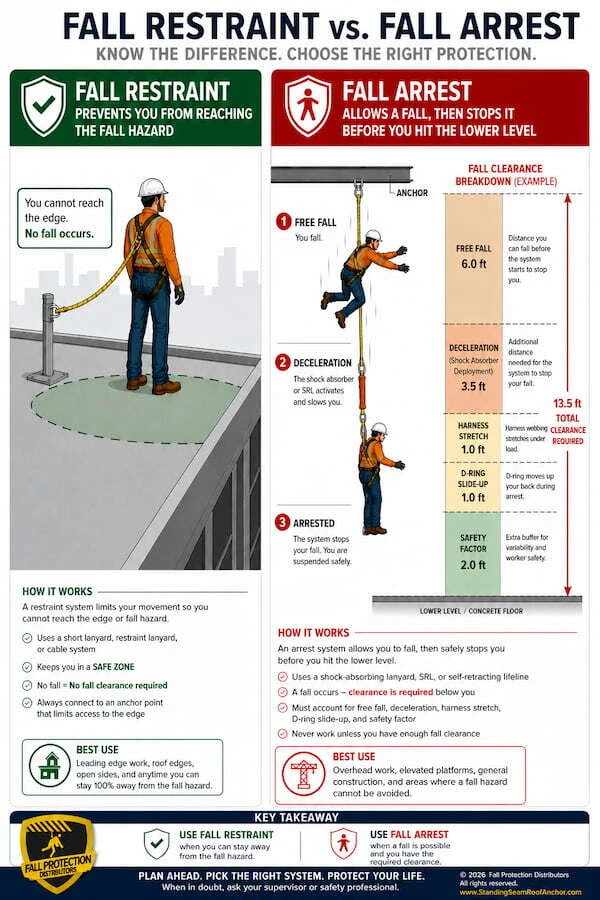
If you choose to work in fall arrest, you must demonstrate sufficient clearance below the worker for the system to function. The shorthand equation is:
A typical example using a 6-ft shock-absorbing lanyard breaks down like this:
If the platform is shorter than 13.5 ft, the system fails, even if the worker is harnessed correctly. Self-retracting lifelines (SRLs) reduce the free-fall component to roughly 2 ft, shrinking the total to about 8.5 to 9 ft, which is why they are often the right answer when overhead anchorage is limited or fall clearance is tight.
This math doesn't apply to restraint. If the worker can't fall, there is nothing to clear.
Swing Falls: The Hidden Hazard
Swing falls happen when a worker tied to a fixed anchor point moves laterally away from the anchor and then falls. Instead of dropping straight down, the worker pendulums sideways toward whatever is in the arc, such as a structure, equipment, or the ground at a lower elevation.
Two rules of thumb:
- Keep the worker within roughly a 30° cone of the anchor point. Beyond that, swing fall risk grows quickly.
- Add a horizontal lifeline or a closer anchor when the work area extends beyond that cone.
Rope abrasion deserves its own warning on metal roofs. Standing seam panels, hemmed eaves, and metal flashings can cut a synthetic rope or even a steel cable in fractions of a second under arrest loads. During a swing fall, the lifeline drags laterally across whatever edge is in its path, often loaded with the full arresting force. OSHA 1926.502(d)(8) requires that "lifelines shall be protected against being cut or abraded," and the agency's leading-edge interpretation guidance treats sharp metal as a known hazard the system must be designed around.
Three rules for rope use on metal roofs:
- Match the device to the edge. Only ANSI Z359.14 Class 2 SRLs are tested for leading-edge contact with sharp metal. A standard overhead SRL becomes non-compliant the moment its lifeline can touch the edge.
- Position the anchor so the lifeline cannot drag across any metal edge during a fall, even with maximum lateral movement and swing. If the geometry forces edge contact, the anchor is in the wrong place.
- Use edge protection or rope sleeves at every contact point. Purpose-built edge guards or panel-edge shields are required anywhere the lifeline could touch metal under load.
A swing fall is exclusively an arrest-system problem. It does not exist in restraint systems.
Rescue Response: The First Five Minutes
The safety plan you built before the work started gets executed here, in real time, with the clock running and a worker's life on the line (literally). Suspension trauma is the result of a failed Rescue Plan. Let's get this right so everyone goes home safe.
- Confirm the worker is conscious and communicating. Make voice contact. If the worker can respond, instruct them to deploy their trauma straps, pump their legs, and keep weight off the femoral arteries. If they cannot respond, treat it as a medical emergency and execute the rescue immediately.
- Trigger the rescue plan. The designated rescuer grabs the equipment specified in the written plan and moves immediately. Do not wait on EMS. Have someone call 911, but the goal is to have the worker on the ground before the first responders arrive.
- Bring the worker down without sudden positional changes. Lower the worker in a controlled descent. Once on the ground, do not lay the worker flat immediately if they have been suspended for more than a few minutes. Sudden horizontal positioning can trigger "reflow syndrome", where deoxygenated blood returns to the heart in a surge. Instead, sit the worker up at roughly 30 to 45 degrees with knees bent, then transition to flat as they stabilize.
- Monitor for shock, hand off to EMS. Watch breathing, skin color, and consciousness. Have water and a blanket ready. EMS makes the call on hospital transport regardless of how the worker looks, because suspension trauma damage can present hours later.
- Document everything. Time of fall, time of rescue, equipment used, worker condition, witnesses. The OSHA recordable assessment and any internal review depend on this paper trail.
- Isolate the worker's PFAS for complete inspection as part of the accident investigation. Any device involved in the accident should be removed from service.
Restraint eliminates the entire scenario above. The 5-minute clock for suspension trauma doesn't apply to restraint systems. The trauma straps, descent kits, and rescue drills sit unused. The post-incident documentation, OSHA recordable filing, and workers' comp claim never happened because no one fell. Same crew, same workday, zero rescue obligation.
When Should You Use Fall Restraint vs. Fall Arrest?
Use this quick decision flow to determine the right system for the job:
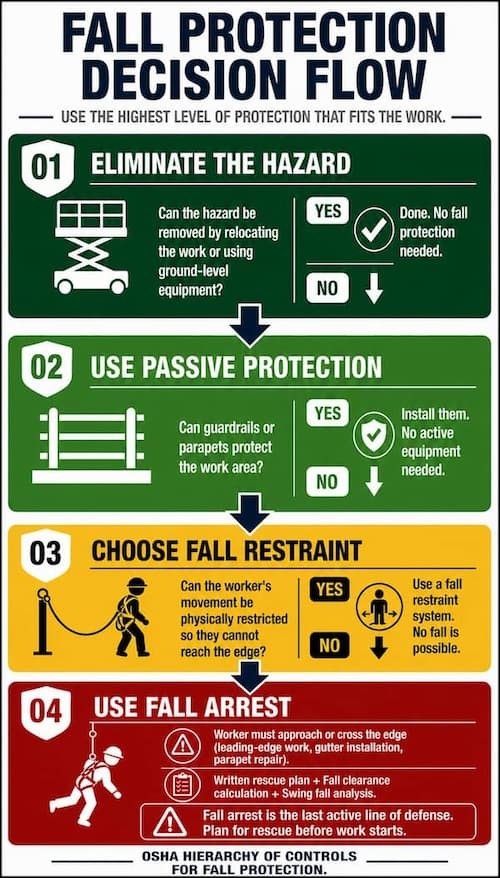
- Eliminate the hazard if possible. Can the hazard be removed by relocating the work or using ground-level equipment? If yes, do that.
- Use passive protection next. Can guardrails or parapets protect the work area? If yes, install them.
- Choose fall restraint when possible. Can the work be performed entirely away from the edge with the worker's movement physically restricted? If yes, use fall restraint.
- Use fall arrest when restraint isn't feasible. Does the work require the worker to approach or cross the edge (leading-edge work, gutter installation, parapet repair)? If yes, you need a fall-arrest system, complete with a written rescue plan, a fall-clearance calculation, and a swing-fall analysis.
A few real-world examples:
- Rooftop HVAC service in the field of the roof, 15+ ft from the edge: restraint.
- Replacing a flashing detail at the eave: arrest.
- Solar panel installs across most of a low-slope roof, with edge work at the perimeter: restraint for the field, arrest for the perimeter (often the same harness, different lanyard, sometimes the same anchor).
- Snow guard installation on a standing seam roof: typically arrests, because the work is along the panels and seams that run all the way to the eave.
Special Considerations for Standing Seam Metal Roofs
Standing-seam roofs introduce three wrinkles that flat-roof guides usually ignore.
1. You can't just screw down anchors
Penetrating the roof voids most standing-seam manufacturer warranties and can create hidden leaks. The right answer is a non-penetrating seam clamp that mechanically grips the standing seam profile. A properly engineered clamp can be used as a single-point anchor for either restraint or arrest, depending on rating.
2. Roof Pitch changes the fall protection strategy
On a sloped standing seam roof, "6 ft from the edge" is not the same restraint distance you'd calculate on a flat roof. Sloped surfaces, slip potential, and lanyard swing-fall potential all reduce your effective working zone. When in doubt, treat the system as arrest and design accordingly.
3. Seam profiles vary
A clamp designed for a 1-inch mechanically-seamed profile is not interchangeable with one designed for a snap-lock profile. Always match the clamp to the documented seam profile, and confirm the manufacturer has tested the clamp for both restraint loads (3,000 lb / 2× expected) and arrest loads (5,000 lb or engineered SF=2) if you intend to use it for both purposes.
The SSRA1 standing seam roof anchor from Fall Protection Distributors is one example of a single-point, non-penetrating clamp engineered to serve as either a restraint anchor or an arrest anchor on standing seam profiles. The same hardware can support a worker tied off in restraint at a rooftop unit and then be re-rigged for arrest when the same worker walks the seam to the eave.
Common Myths About Fall Arrest and Fall Restraint
Myth 1: "Restraint just means a short lanyard."
A short lanyard alone isn't a restraint system. The system is the combination of anchor location, lanyard length, and worker travel path that proves the worker can't reach the hazard. Move the anchor, and a "restraint lanyard" can suddenly let a worker fall.
Myth 2: "Any 5,000 lb anchor is OSHA compliant."
Not necessarily. The anchor must be 5,000 lb per attached worker, installed to deliver that capacity in the actual loaded direction, and free of corrosion or mounting defects. A welded eye on a corroded structural beam is not the same as a tested, certified anchor.
Myth 3: "SRLs can be used for fall restraint."
SRLs cannot reliably prevent a worker from reaching an edge because they pay out as the worker moves. They are an arrest device, not a restraint device. Use a fixed-length lanyard for restraint.
Myth 4: "If I use restraint, I don't need any documentation."
You still need anchor certification, harness inspection records, a competent person on site, and worker training. You just don't need a rescue plan.
Myth 5: "Body belts are fine because we used them for years."
Body belts have been prohibited for fall arrest since 1998. They're allowed only for restraint or work positioning, and most modern programs avoid them entirely.
Frequently Asked Questions
Is fall restraint better than fall arrest?
Yes, when the work allows it. Fall restraint ranks higher in OSHA's hierarchy of controls because it prevents falls instead of catching them. It also eliminates the need for a rescue plan, swing-fall analysis, and fall-clearance calculation. Use arrest only when restraint is not feasible.
What OSHA standards cover fall arrest and fall restraint?
The two main standards are 29 CFR 1910.140 (General Industry) and 29 CFR 1926.502 (Construction). OSHA has also issued multiple standard interpretation letters, including the November 1995 letter, clarifying when restraint may be used in lieu of arrest.
How strong does my anchor have to be?
Fall arrest anchors must support 5,000 lb per worker, or be engineered with a safety factor of at least two. Fall restraint anchors must support 3,000 lb or twice the maximum expected force, whichever is greater.
Do I need a rescue plan for fall restraint?
No. Because no fall is possible in a properly rigged restraint system, OSHA's rescue requirement under 1926.502(d)(20) does not apply. You still need a written fall protection plan and worker training.
Can the same anchor be used for both arrest and restraint?
Yes, if the anchor is rated for arrest loads. An arrest-rated anchor exceeds the restraint requirement by definition. The reverse is not true. A restraint-only anchor cannot be casually upgraded to arrest service.
What's the difference between fall arrest and fall protection?
Fall protection is the umbrella term; fall arrest is one specific type. Fall protection covers everything that protects workers from falls: guardrails, nets, restraint, arrest, training, and administrative controls. Fall arrest catches a worker after a fall begins.
Are SRLs allowed for fall restraint?
No. Self-retracting lifelines pay out as the worker moves and cannot be relied on to prevent access to the edge. SRLs are arrest devices only. Fall restraint requires a fixed-length, non-shock-absorbing lanyard.
What about standing seam metal roofs specifically?
Use a non-penetrating seam clamp rated for your seam profile. Do not penetrate the roof to install an anchor, since that voids most manufacturer warranties. Verify the clamp is rated for restraint, arrest, or both, depending on the work.
The Bottom Line
Fall restraint and fall arrest are not two flavors of the same thing. Restraint prevents falls; arrest catches them. Restraint sits higher on the hierarchy of controls, requires less anchor strength, and skips the rescue plan, the clearance math, and the swing fall analysis. Arrest is only used when the work absolutely requires the worker to approach or cross the edge.
Choose restraint when you can, choose arrest when you must, and on a standing-seam metal roof, choose hardware that can do both jobs without ever penetrating the roof. The right anchor, engineered, certified, and matched to your seam profile, is the foundation of any compliant program, regardless of which system you end up using.
Authoritative References
- 29 CFR 1926.502: Fall protection systems criteria and practices
- 29 CFR 1910.140: Personal fall protection systems
- OSHA Standard Interpretation: Fall restraint in lieu of fall arrest (1995-11-02)
- 29 CFR 1926 Subpart M App C: Personal Fall Arrest Systems
- OSHA: Reducing Falls When Installing Standing Seam Metal Roofs (PDF)