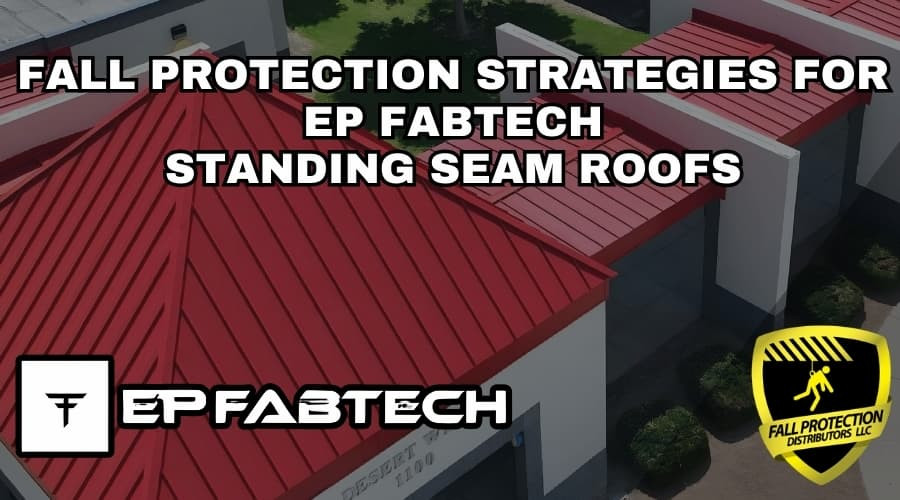
Fall Protection Advice For EP Fabtech Standing Seam Roofs
Posted by Howie Scarboro - CEO Fall Protection Distributors, LLC on Apr 20th 2026
EP Fabtech: Fall Protection Quick Summary
SSRA1 Approved Systems: SSQ675, SS150, SSQ200, and TRQ250 (22/24 gauge steel only).
Critical Installation Torque: 90 inch-pounds (Cupped Tip) | 180-200 inch-pounds (Nylon-Tipped).
Certified Performance: 5,000-pound single-point tie-off capacity via American-made, non-penetrating SSRA1 anchors.
OSHA Compliance: Systems meet or exceed OSHA 1926.502 and 1910.140 standards, including 2025 gear fit updates.
Substrate Validation: Always verify gauge thickness before seaming; replace nylon tips every 3 to 5 uses to maintain grip.
Restricted Materials: Do NOT clamp to FF100 Nailstrip, 26/28 ga. steel, or Curved/Radius Panels, without expert inspection.
Prohibition: Never use impact guns; use calibrated torque wrenches only to prevent structural panel damage.
See the Roof Anchor Compatibility Chart for EP Fabtech Standing Seam Panels.

Who Is EP Fabtech?
EP Fabtech is a metal fabrication company based in El Paso, Texas, serving contractors and builders throughout the Southwest and beyond.
What started as a focused fabrication operation has grown into a full-scale manufacturer of architectural metal products, including standing-seam roof panels, wall panels, trim, flashings, and custom CNC-cut components. The company built its reputation by combining skilled craftsmanship with modern equipment to produce panels that perform in demanding climates while maintaining a clean, architectural appearance.
Today, EP Fabtech continues to expand its reach while staying grounded in hands-on fabrication. Their team understands how metal panels behave under real-world conditions, as evidenced by the durability, fit, and finish of their standing-seam roof systems. That practical experience, paired with responsive service, has made EP Fabtech a trusted source for metal roofing solutions that balance performance with appearance.
Compatible Fall Protection for EP Fabtech Standing Seam Roofs
EP Fabtech standing-seam roof systems require non-penetrating fall protection that safeguards workers without compromising roof performance. Architectural panels manufactured by EP Fabtech deliver long-term durability and weather resistance. Traditional anchors that rely on drilling or through-panel fasteners can damage roof panels, restrict thermal movement, and introduce hidden water leaks. For steel 22-gauge and 24-gauge standing seam profiles that accept seam-mounted anchorage, the following products provide a complete safety solution:
- SSRA1 Standing Seam Roof Anchor: A universal non-penetrating anchor providing a 5,000-pound certified tie-off point by gripping the seam without drilling.
- SSRA2 Adjustable Roof Jack Adapters: Brackets that mount to SSRA1 anchors to support 2x10 walkboards, providing a level working surface on sloped metal.
- SSRA3 Anchor Plate: A heavy-duty plate that spans two SSRA1 anchors to create an attachment point for horizontal lifelines.
- SSRA HLL 100-foot Temporary Horizontal Lifeline Kit: A portable lifeline system for up to two workers, allowing lateral movement across wide roof sections.
- Super Anchor 120-foot Permanent Horizontal Lifeline Kit: A long-term safety solution with galvanized steel cables and non-penetrating riser posts for recurring maintenance access.
- Ridge Pro Steep Assist Anchor: A ridge-mounted anchorage device that hooks over the peak to provide safe vertical lifeline access on pitches from 6:12 to 12:12.
Proper Attachment: Set-Screws and Torque Requirements
- Cupped-Tip Stainless Steel Set-Screws: Use these screws exclusively on 22-gauge steel panels. Torque these screws to 90 inch-pounds.
- Nylon-Tipped Set-Screws: Apply these tips to 22-gauge or 24-gauge steel panels to achieve certified holding power without marking the finish. Torque these screws to 180-200 inch-pounds.
- Maintenance: Treat nylon tips as consumables. Replace these tips every 3 to 5 uses to maintain maximum grip strength.
CRITICAL WARNING: NO IMPACT GUNS
Warning: Always use a calibrated torque wrench for final installation. Never use an impact gun to install set-screws. The aggressive force of an impact driver crushes the standing-seam rib, causing permanent panel deformation and compromising the anchor's certified holding power. This error damages the anchor hardware and voids the manufacturer's warranty.
EP Fabtech SSQ675 Snap Lock Panel (SSRA Compatible 22/24 ga. Steel)
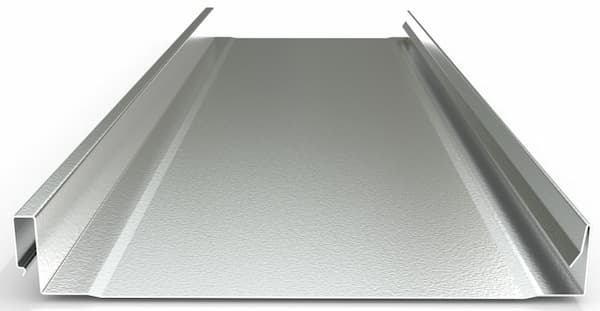
The SSQ675 Snap Lock Panels have widths ranging from 12 to 20 inches and use a 1.75-inch snap-lock seam paired with concealed clips.
Manufactured in 26- and 24-gauge steel, with 22-gauge available by request, the panel uses an AZ50 Galvalume substrate and PVDF-resin-based finishes. A minimum roof slope of 3:12 keeps water moving efficiently across the panel surface. See the Roof Anchor Compatibility Chart for EP Fabtech SSQ675 Snap Lock 22 Gauge and 24 Gauge Standing Seam Panel.
Fall Protection for SSQ675 1.75-Inch Snap Lock Panels
- SSRA1 Standing Seam Roof Anchor: Clamps directly to the snap-lock seam using 12 non-penetrating set screws. This provides a dependable tie-off point while allowing thermal movement.
- SSRA2 Adjustable Roof Jack Adapter: Mount on top of SSRA1 anchors to support 2x10 walkboards without penetrating the panel itself.
- SSRA3 Anchor Plates: Installed over SSRA1 anchors to create attachment points for horizontal lifelines, adjusting to fit panels between 12 and 24 inches wide.
- Horizontal Lifelines: Compatible with 100-foot SSRA HLL temporary kits and 120-foot Super Anchor Permanent lifeline kits.
- Ridge Pro Steep Assist: The required option for steel panels other than 22 or 24-gauge, allowing workers to establish peak-mounted tie-offs without seam loading.
EP Fabtech SS150 Mechanical Seam Panel (SSRA Compatible 22/24 ga. Steel)
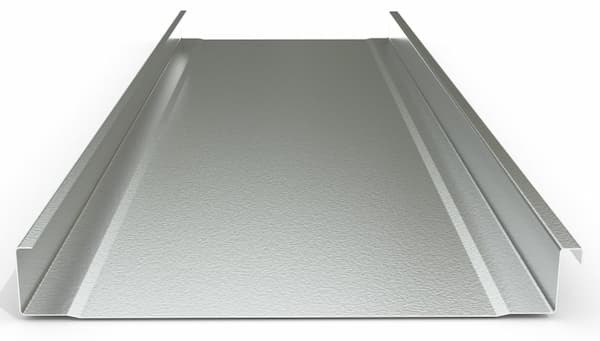
The SS150 Mechanical Seam Panel gives EP Fabtech a strong option for projects that require a tighter seam profile with long-term performance built in.
With a 1.5-inch mechanically seamed rib, this panel fits comfortably in residential and commercial settings where durability matters just as much as appearance. This panel accommodates a wide range of substrates, including steel in 22-, 24-, 26-, and 28-gauge, as well as aluminum and copper. Class 4 hail resistance, fire performance ratings, and wind resistance testing back up its real-world durability, while a 30-year limited paint warranty helps protect the finish over time. See the Roof Anchor Compatibility Chart for EP Fabtech SS150 Mechanical Seam 22 Gauge and 24 Gauge Standing Seam Panel.
Fall Protection for SS150 Mechanical Seam Panels
- SSRA1 Standing Seam Roof Anchor: Certified only for 22 and 24-gauge steel substrates. Secures to the 1.5-inch rib using twelve non-penetrating set screws.
- SSRA2 Adjustable Roof Jack Adapters: Install on top of SSRA1 anchors and provide level walkboard platforms.
- SSRA3 Anchor Plates: Serve as connection points for temporary or permanent horizontal lifelines.
- Exclusion Warning: For aluminum, copper, or lighter-gauge steel (26/28 ga.), seam-mounted anchors are not compatible. Use the Ridge Pro Steep Assist for slopes between 6:12 and 12:12.
EP Fabtech SSQ200 Mechanical Seam Panel (SSRA Compatible 22/24 ga. Steel)
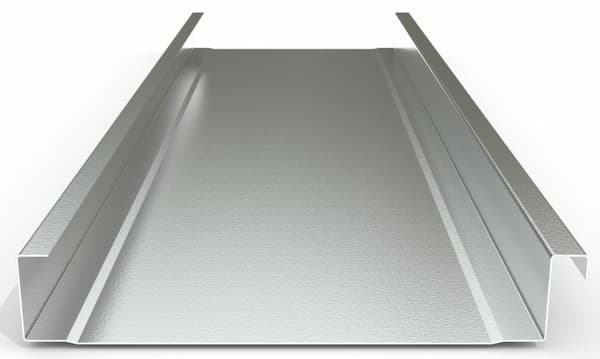
The SSQ200 Mechanical Seam Panel sits at the top end of EP Fabtech's standing seam lineup, built for projects where performance margins are tight.
A defining feature of this panel is its 2-inch mechanically seamed rib, available in single-lock or double-lock configurations. EP Fabtech manufactures the SSQ200 in 26- and 24-gauge steel, all using AZ50 Galvalume or Zincalume substrates. Its double-lock seam provides industry-leading resistance to wind-driven rain and uplift. See the Roof Anchor Compatibility Chart for EP Fabtech SSQ200 Mechanical Seam 22 Gauge and 24 Gauge Standing Seam Panel.
Fall Protection for SSQ200 2-Inch Mechanical Seam Panels
- SSRA1 Standing Seam Roof Anchor: Secures to the mechanical seam without rib distortion on 22 and 24-gauge steel panels.
- SSRA2 Adjustable Roof Jack Adapters: Mount on top of SSRA1 anchors to support staging for tools and workers on sloped roofs.
- SSRA3 Anchor Plates: Installed over SSRA1 anchors to provide tie-off paths for lateral worker mobility.
- Lighter Gauges: For 26-gauge steel, utilize the Ridge Pro Steep Assist to maintain 100 percent tie-off without loading the panel seams.
EP Fabtech TRQ250 Mechanical Seam Panel (SSRA Compatible 22/24 ga. Steel)
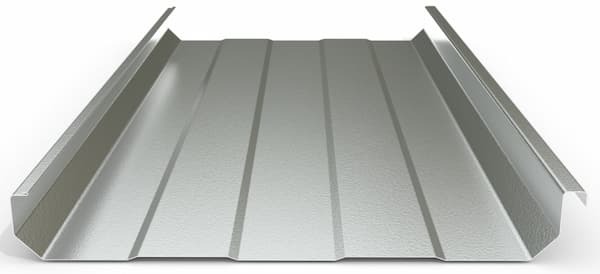
The TRQ250 Mechanical Seam Panel is available in 22-, 24-, and 26-gauge steel, as well as aluminum options.
With its taller 2.5-inch seam, this panel creates strong vertical definition that works exceptionally well on larger architectural roof planes. Beyond appearance, the taller seam adds structural confidence. TRQ250 panels perform well under high wind loads, heavy rain, or seasonal hail. See the Roof Anchor Compatibility Chart for EP Fabtech TRQ250 Mechanical Seam 22 Gauge and 24 Gauge Standing Seam Panel.
Fall Protection for TRQ250 2.5-Inch Mechanical Seam Panels
- SSRA1 Standing Seam Roof Anchor: Clamps securely to the 2.5-inch mechanical seam using 12 non-penetrating set screws.
- SSRA2 Adjustable Roof Jack Adapters: Supports 2x10 walkboards to keep workers stable on steep structural sections.
- SSRA3 Anchor Plates: Provide connection points for lateral lifeline systems across wide spans.
- Aluminum/26-Gauge Warning: Seam-mounted anchorage is not approved for these substrates. Utilize the Ridge Pro Steep Assist on roof slopes between 6:12 and 12:12.
EP Fabtech FF100 1-Inch Snap Lock Nailstrip Panel (Ridge Pro Only)
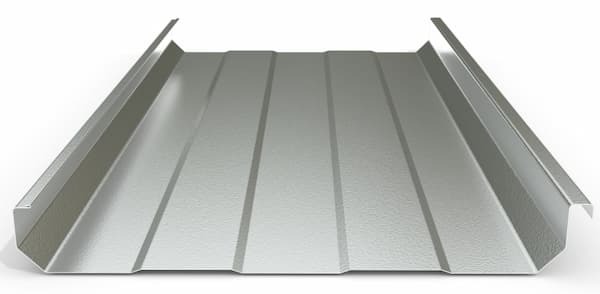
The FF100 Snap Lock Nailstrip Panel uses a nailstrip attachment method, fastening directly through the panel into the substrate.
EP Fabtech manufactures the FF100 in 26- and 24-gauge steel. The AZ50 Galvalume substrate and PVDF-resin-based finishes protect against corrosion. A recommended minimum roof slope of 3:12 and a maximum panel length of 30 feet keep the system operating within its intended performance range. See the Roof Anchor Compatibility Chart for EP Fabtech FF100 1-Inch Snap Lock Nailstrip Standing Seam Panels.
Fall Protection for FF100 1-Inch Snap Lock Nailstrip Panels
Critical Compatibility Warning: Because FF100 panels attach directly to the substrate rather than floating on clips, seam-mounted anchors are incompatible. Utilizing seam clamps on nailstrip panels can cause structural failure and panel damage.
- Ridge Pro Steep Assist: Provides the safest solution for slopes between 6:12 and 12:12. It hooks over the peak, allowing workers to tie off before stepping onto the roof surface without loading the nailstrip fasteners.
EP Fabtech Radius Panel (Expert Inspection Required)
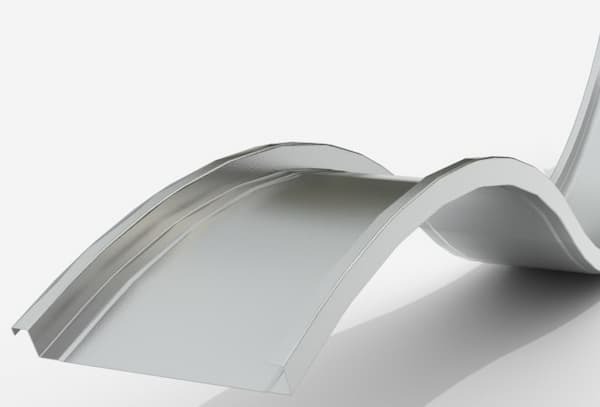
EP Fabtech's Radius Panels allow architects to introduce smooth curves and flowing rooflines.
Designed for low-slope conditions, Radius Panels can be installed on roof pitches as low as 1:12. The mechanically fastened seams, available in single-lock or double-lock configurations, create a tight joint that performs under prolonged exposure. EP Fabtech manufactures Radius Panels from AZ50 Galvalume or Zincalume substrates. See the Roof Anchor Compatibility Chart for EP Fabtech Radius Standing Seam Panels.
CRITICAL WARNING: RADIUS PANELS REQUIRE EXPERT INSPECTION
Standard seam-mounted and ridge-mounted anchors are incompatible with curved roof layouts. Radius roof systems curve continuously, altering the structural geometry and clamping mechanics required for safe anchorage. Radius projects require a mandatory on-site evaluation by a trained fall protection professional to assess curvature and establish a custom safe-access plan before any work begins.
The Risk of Traceability Gaps in Bargain Safety Hardware
When securing a crew on an EP Fabtech roof, the allure of unbranded or low-cost safety hardware can be high. However, these low-cost imported alternatives often lack the essential engineering pedigree required for life-saving equipment. Unlike untested imitations, the American-made SSRA1 system is rigorously validated at independent ISO 17025-accredited laboratories. While industry benchmarks require a 5,000-pound breaking strength, our components have withstood ultimate loads exceeding 14,500 pounds without structural collapse. Choosing professional-grade hardware replaces high-risk guesswork with verifiable security.
Review our full technical evidence by visiting our SSRA independent laboratory test reports.
Standing Seam Metal Roof Anchor Panel Compatibility For 22 Ga. EP Fabtech
| SSQ675 (22 Ga.) | SS150 (22 Ga.) | SSQ200 (22 Ga.) | TRQ250 (22 Ga.) | |
|---|---|---|---|---|
SSRA 1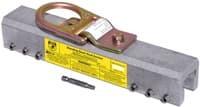 |
YES | YES | YES | YES |
SSRA1 Nylon Tip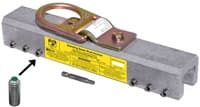 |
YES | YES | YES | YES |
SSRA2 Roof Jack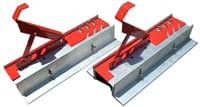 |
YES | YES | YES | YES |
SSRA3 Anchor Plate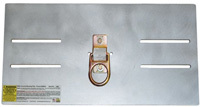 |
YES | YES | YES | YES |
The Ridge Pro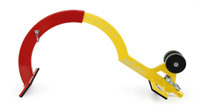 |
YES | YES | YES | YES |
Standing Seam Metal Roof Anchor Panel Compatibility For EP Fabtech Cont.
| SSQ675 (24 Ga.) | SS150 (24 Ga.) | SSQ200 (24 Ga.) | TRQ250 (24 Ga.) | FF100 NailStrip | Radius Panel | |
|---|---|---|---|---|---|---|
| SSRA 1 |
NO | NO | NO | NO | NO | NO |
| SSRA1 Nylon Tip |
YES | YES | YES | YES | NO | NO |
| SSRA2 Roof Jack |
YES | YES | YES | YES | NO | NO |
| SSRA3 Anchor Plate |
YES | YES | YES | YES | NO | NO |
| The Ridge Pro |
YES | YES | YES | YES | YES | NO |
Frequently Asked Questions: EP Fabtech Standing Seam Roofs
1. What is the difference between EP Fabtech snap lock and mechanical seam panels?
The SSQ675 Snap Lock utilizes a snap-together seam with concealed clips for architectural projects, whereas the SSQ200 Mechanical Panel requires a seaming tool to lock the rib, providing superior resistance to wind-driven rain and uplift. The snaplock installation requires less labor, but the mechanically-seamed panels are more durable. Each of these panels is featured above for easy identification.
2. Can fall protection anchors be used on the FF100 Nailstrip panel?
No. Because FF100 panels are fastened directly through the nailstrip rather than floating on clips, seam-mounted anchors are incompatible. The Ridge Pro Steep Assist is the only safe peak-mounted option.
3. Is the SSRA1 compatible with EP Fabtech aluminum or copper panels?
Seam-mounted anchorage is certified only for 22- and 24-gauge steel. Lighter gauges or softer metals, such as aluminum and copper, cannot withstand clamping forces and require specialized peak-mounted fall protection from Ridge Pro.
4. Are EP Fabtech roofs compatible with permanent lifeline systems?
Yes. The Super Anchor 120-foot Permanent Horizontal Lifeline Kit linked above is compatible with EP Fabtech steel standing seam profiles, providing a long-term, non-penetrating solution for recurring maintenance. This permanent kit features Super Anchor 1207 non-penetrating mounting plates.
5. How does the TRQ250 panel accommodate thermal expansion?
The TRQ250 system utilizes concealed-fastener clips that allow the metal panels to "float" during temperature changes, preventing stress on fasteners and eliminating oil canning.
6. Can I use a single SSRA1 anchor for multiple workers?
No. The SSRA1 anchor is certified as a 5,000-pound single-user tie-off point. For multiple workers, you must install additional anchors or utilize an SSRA3 Anchor Plate system for a horizontal lifeline.
7. How can I avoid common problems with standing seam fall protection?
To avoid common technical issues, follow these three essential tips:
- Always utilize a calibrated torque wrench: This is the only way to ensure certified holding power without crushing the mechanical seam or deforming the rib.
- Treat nylon set-screw tips as consumables: Replace them every 3 to 5 uses to maintain maximum grip strength and prevent damage to the panel finish.
- Verify the specific panel gauge before installation: Confirming your substrate thickness (22 ga. vs 24 ga.) is critical to ensuring your anchor system operates within its tested structural limits.
Safety Tips For Standing Seam Roofs
- Promote a Proactive Culture of Safety: A safety mindset starts with open crew conversations. Short pre-task discussions about wind conditions, roof layout, access points, and tie-off locations help crews spot hazards before they become problems.
- Develop Comprehensive OSHA-Compliant Safety Plans: Large EP Fabtech roof systems often involve multiple elevations. A written safety plan establishes where anchors belong, how crews move, and rescue protocols.
- Ensure High-Traction Footwear for Surface Stability: Metal roofing surfaces rarely stay consistent. Dew, dust, and temperature changes reduce traction. Boots with deep tread and non-slip soles are essential for worker stability.
- Prioritize Rigorous Ladder Safety Training: Enforce the 4-to-1 ladder ratio and ensure the ladder is secured at the top. The transition from the ladder to the roof remains a high-risk phase that requires three points of contact.
- Equip Personnel with Certified, High-Quality Safety Gear: In 2025, OSHA updated its enforcement to emphasize that employers must provide appropriately sized harnesses for every worker to ensure effectiveness. Use Self-Retracting Lifelines (SRLs) for smooth mobility.
- Utilize Specialized Non-Penetrating Anchor Systems: Non-penetrating anchors that lock securely to the seam protect workers without interfering with thermal expansion. This prevents long-term issues such as seam deformation and hidden leaks.
- Encourage the Deployment of Trauma Straps: Integrated trauma straps allow a suspended worker to stand in their harness after a fall, maintaining circulation until rescue procedures are completed.
- Implement Passive Guardrail Barriers for Work Zones: Place guardrails around skylights, roof edges, and equipment clusters. Guardrails establish boundaries that crews instinctively avoid, allowing focus on the task.
- Install Permanent Horizontal Lifeline Systems: For facilities requiring ongoing access, permanent horizontal lifelines provide consistent tie-off paths and reduce setup time for future service contractors.
- Consult Specialists for Curved Architectural Panels: Curved standing-seam systems present unique challenges. A fall protection professional should evaluate the design to recommend appropriate safety measures before work begins.
Disclaimer: The views, recommendations, and information presented in this blog are solely those of the author and do not necessarily reflect the opinions or positions of the featured panel manufacturer, its brands, subsidiaries, or parent companies. Customers are strongly encouraged to contact the roof panel manufacturer directly for inquiries about fall-protection compatibility with their products and to address any potential warranty issues that may arise after installing our products.