Fall Protection Strategy For ASC Building Products Roofs
Posted by Howie Scarboro - CEO Fall Protection Distributors, LLC on Apr 22nd 2026

See the Roof Anchor Compatibility Chart for ASC Building Products Standing Seam Panels.
Who Is ASC Building Products?
ASC Building Products is a recognized leader in the metal roofing and siding industry, delivering high-quality, durable solutions to residential, agricultural, and light commercial projects across the Western United States. Headquartered in West Sacramento, California, with major manufacturing hubs in Salem, Oregon, and Kalama, Washington, they have anchored the West Coast construction industry since 1971. As a division of ASC Profiles LLC, they benefit from over 50 years of expertise in manufacturing premium Zincalume steel roofing systems.
Their commitment to local craftsmanship and engineering innovation makes them the top choice for durable roofing in the Pacific Northwest and beyond. ASC Building Products provides homeowners and contractors throughout California, Oregon, Washington, and Idaho with roofing solutions that blend architectural aesthetics with industrial-grade durability. Under the global leadership of BlueScope and Nippon Steel, every panel undergoes rigorous third-party testing for structural integrity and fire resistance. Whether you are managing a residential remodel in Sacramento or a commercial property in Seattle, these roofing systems are precision-engineered to withstand the region's diverse environments.
Why Non-Penetrating Fall Protection Is Critical For ASC Building Products' Roofs
Fall protection on floating standing seam metal roofs can get complicated. ASC Building Products' standing seam systems can last for over 50 years, but using traditional penetrating anchors that "pin" the metal in place fights against natural movement, leading to oil-canning and hidden leaks. Using penetrating anchors on a new installation will likely void the weathertightness warranty. To maintain the roof's seal while ensuring 100% tie-off, we suggest using the following non-penetrating products:
- SSRA1 Seam Anchor: The primary modular component. It features a one-piece body and a 12-point set screw system that fits 95% of today's profiles without disassembly or clip hunting.
- SSRA2 Adjustable Roof Jack Adapters: Mount directly to the SSRA1 to support 10-foot wooden walk-boards, creating a level walking surface and staging area on steep slopes.
- SSRA3 Anchor Plates: High-strength aluminum plates that bridge two SSRA1 anchors to convert tie-off points into endpoints for horizontal lifelines.
- 100-foot SSRA HLL Kit: A temporary mobility solution utilizing kernmantle rope, allowing two workers to move across large roof areas safely.
- 120-foot Super Anchor Permanent HLL: A long-term solution utilizing 5-inch riser posts and steel cable that accommodates the roof's natural thermal movement.
- Ridge Pro Steep Assist: The "first-man-up" tool for pitches between 6:12 and 12:12, ensuring tie-off compliance before the worker leaves the ladder.
Keep in mind that OSHA 1926.501(b)(11) limits horizontal lifeline systems to a maximum pitch of 4:12. OSHA recognizes that workers can lose their footing and slide on steeper roofs, leading to dangerous swing falls and increased fall arrest loads that are not suitable for horizontal lifeline setups.
Proper Attachment: Set-Screws and Torque Requirements
To ensure certified holding power without compromising the Zincalume steel or PVDF finish, installers must use the appropriate set-screws and calibrated torque settings:
- Cupped-Tip Stainless Steel Set Screws: Use these for standard 22-gauge steel panels. Torque these screws to 90 inch-pounds.
- Nylon-Tipped Set Screws: For use with 22-gauge or 24-gauge steel panels. Torque these fasteners to 180-200 inch-pounds.
- Maintenance: Treat nylon tips as consumables. Replace these tips every 3 to 5 installations to maintain maximum grip strength.
CRITICAL WARNING: NO IMPACT GUNS
Warning: Always use a calibrated torque wrench for final installation. Never use an impact gun to install set-screws. Impact guns can quickly over-tighten the screws, resulting in permanent damage to the standing seam panel or the anchor itself. This error compromises the anchor's certified holding power and voids the hardware warranty.
Design Span hp Snaplock Panels (SSRA Compatible 22/24 ga. Steel)
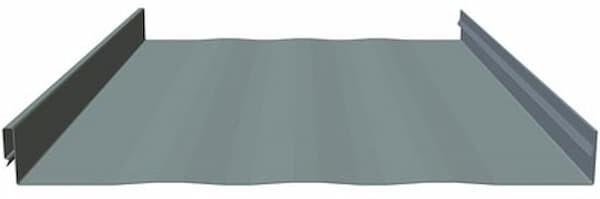
Design Span hp is a performance-rated, structural standing seam roofing panel ideal for residential and commercial applications. Manufactured from high-quality 22 or 24-gauge Zincalume steel, these panels are available in 12-inch, 16-inch, 17-inch, and 18-inch widths with a substantial 1.75-inch seam height. They offer outstanding weather resistance on slopes as low as 2:12 and feature the premium Dura Tech 5000 PVDF paint system. Curving is not available for this specific profile. See the Roof Anchor Compatibility Chart for ASC Building Products Standing Seam Panels.
Fall Protection for Design Span hp
- The SSRA1 Seam Anchor provides a perfect, non-penetrating fit. Combine it with SSRA2 Roof Jacks to create stable walk-board platforms across the variable panel widths.
- For wide-span mobility, utilize SSRA3 Anchor Plates and the 100-foot SSRA HLL Kit for two workers. For regular facility maintenance, the 120-foot Super Anchor Permanent HLL is suitable for roofs with a pitch up to 4:12.
- Ridge Pro Recommendation: If you are working on steeper slopes between 6:12 and 12:12, you can use The Ridge Pro to ensure a 100% tie-off from the second you leave the ladder.
Skyline Roofing hp Nailstrip Panels (Ridge Pro Only 24 ga. Steel)
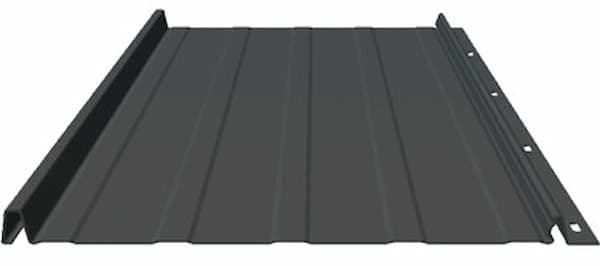
Skyline Roofing hp is a high-performance, 24-gauge steel standing seam panel designed for residential and light commercial applications. This 16-inch wide panel features a 1-inch seam height and an integrated fastener flange that eliminates the need for separate clips. While it offers superior wind uplift resistance and Dura Tech PVDF finishes, the roll-forming process for the nail-strip flange can create compatibility issues for seam-mounted anchors. See the Roof Anchor Compatibility Chart for ASC Building Products Skyline Roofing hp Nailstrip Standing Seam Panels.
Fall Protection for Skyline Roofing hp
- Due to the variations in nail-strip fastener-flange profiles, we do not recommend using seam-mounted anchors for fall arrest on the Skyline hp panel.
- Ridge Pro Recommendation: The Ridge Pro Steep Assist is the primary fall protection strategy for this profile. It hooks securely over the peak, providing a 5,000-pound certified anchor point that does not rely on the fastener flange for strength. This is essential for pitches between 6:12 and 12:12.
Skyline Roofing Nailstrip Panels (Ridge Pro Only)
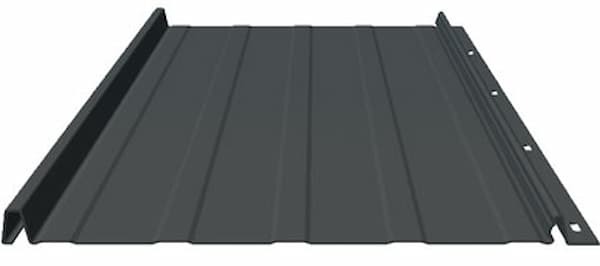
The standard Skyline Roofing panel is an economical 26-gauge steel standing seam solution available in 12-inch and 16-inch widths. Like the HP version, it features a 1-inch seam height and an integrated fastener flange for efficient residential installation. It requires a minimum slope of 3:12 and utilizes the Dura Tech xl SMP paint system. See the Roof Anchor Compatibility Chart for ASC Building Products Skyline Roofing Nailstrip Standing Seam Panels.
Fall Protection for Skyline Roofing
- The 26-gauge steel and nail-strip design make this profile incompatible with standard seam-mounted anchors.
- Ridge Pro Recommendation: The Ridge Pro Steep Assist is the necessary solution for safe roof navigation on standard Skyline panels. This peak-mounted system provides a reliable tie-off point without the risk of seam deformation or fastener stress.
Standing Seam Metal Roof Anchor Panel Compatibility Chart For ASC Building Products
| Design Span hp (22 Ga.) | Design Span hp (24 Ga.) | Skyline Roofing hp Nailstrip | Skyline Roofing Nailstrip | |
|---|---|---|---|---|
SSRA 1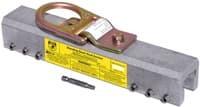 |
YES | NO | NO | NO |
SSRA1 Nylon Tip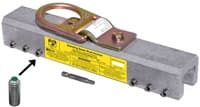 |
YES | YES | NO | NO |
SSRA2 Roof Jack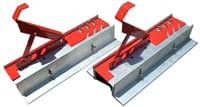 |
YES | YES | NO | NO |
SSRA3 Anchor Plate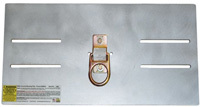 |
YES | YES | NO | NO |
The Ridge Pro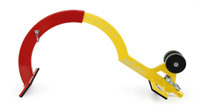 |
YES | YES | YES | YES |
Insider Pro Tip: The Liability Exposure Of Unbranded Fall Protection
Before you send a crew onto an ASC Building Products roof, verify that your anchors come with a documented paper trail. In the Western United States construction market, a cheap deal on safety hardware can quickly become a devastating liability. OSHA inspectors are increasingly cracking down on unbranded and imported seam anchors that lack verifiable testing or metallurgical certifications. If a violation results in an injury and you cannot provide a 3rd-party OSHA or ANSI test report, the financial and legal consequences can be devastating.
In contrast, the American-made SSRA1 is machined from solid 6061-T6 aluminum and validated at independent laboratories. It has withstood test loads exceeding 14,500 pounds—nearly triple the OSHA 5,000-lb requirement. Choosing domestic, certified hardware protects your crew and eliminates high-stakes uncertainty. Review our results in our independent laboratory test reports.
Contact Us For More Information
For further details on roofing solutions and fall protection systems, contact us today at 863-703-4522 or visit www.StandingSeamRoofAnchor.com. Let's work together to make your next Western US metal roofing project safe, compliant, and built to last. For continued learning, download OSHA's 48-page Fall Protection Manual and our free Anchor Inspection Form once you've selected the ideal anchors for your roof system.
10 Essential Safety Guidelines for ASC Building Products Projects
Staying safe on an ASC roof requires more than just the proper anchors; it requires total commitment to safety culture. Here are ten essential strategies to keep your team protected while preserving the integrity of high-performance systems.
1. Prioritize Non-Penetrating Seam Anchors
To protect ASC Building Products panels, avoid any anchor that requires drilling. Non-penetrating clamps like the SSRA1 use 12 stainless steel set screws to secure the worker without breaching the Zincalume's protective coating, ensuring the roof remains weathertight.
2. Transition to Personal Fall Arrest Systems at 4:12
OSHA standards are clear: once a roof exceeds a 4:12 pitch, it is a "Steep Roof." Conventional fall protection, such as the Ridge Pro or SSRA1 devices, must be used to account for the increased momentum of a slide hazard on a metal surface.
3. Use Nylon-Tipped Set Screws on 24-Gauge Steel Panels
When installing anchors on Snap Star or Design Span hp profiles, always use nylon-tipped set screws. These provide a 5,000-lb certified grip without scratching the high-performance Dura Tech finishes.
4. Secure "First-Man-Up" Protection with the Ridge Pro
Moving from the ladder to the roof is a high-risk transition. Utilizing the Ridge Pro Steep Assist with an extension pole allows your lead installer to secure a tie-off point at the ridge before their feet leave the ladder, satisfying OSHA ladder-to-roof transition safety standards.
5. Calculate Dynamic Sag on Fall Distance Calculations
Per ANSI Z359.6, you must account for "Dynamic Sag" when deploying horizontal lifelines. Always calculate the total fall distance (Free Fall + Deceleration + Sag + Safety Factor) to prevent workers from striking lower levels. Limit HLL systems to 4:12-pitch roofs.
6. Prevent Galvanic Corrosion on Architectural Finishes
ASC utilizes premium Zincalume and PVDF coatings. You must use 100% stainless steel set screws, as found on the SSRA1, to prevent galvanic reactions and premature roof corrosion.
7. Respect Thermal Expansion & Contraction
Standing seam roofs "float" to manage temperature changes. You must only use non-penetrating clamps to allow this movement without stressing the seams or voiding warranties.
8. Implement Daily Torque Verification
Extreme temperature swings in the Western US can affect fastener tension. As part of your mandatory daily inspection, use a torque wrench to verify all set screws remain at their proper settings.
9. Prevent Suspension Trauma with Trauma Straps
Suspension trauma can set in within 5 to 10 minutes after a fall arrest. Equip every harness with Suspension Trauma Straps so a fallen worker can stand and relieve pressure on their femoral arteries while waiting for rescue.
10. Eliminate the "Pendulum Effect"
Avoid swing fall hazards by keeping your work zone within a 30-degree arc of your anchor point. If you find yourself moving too far laterally, stop and relocate your anchor to ensure a centered tie-off.
Disclaimer: The views, recommendations, and information presented in this blog are solely those of the author and do not necessarily reflect the opinions or positions of the featured panel manufacturer, its brands, subsidiaries, or parent companies. Customers are strongly encouraged to contact the roof panel manufacturer directly for inquiries about fall-protection compatibility with their products and to address any potential warranty issues that may arise after installing our products.