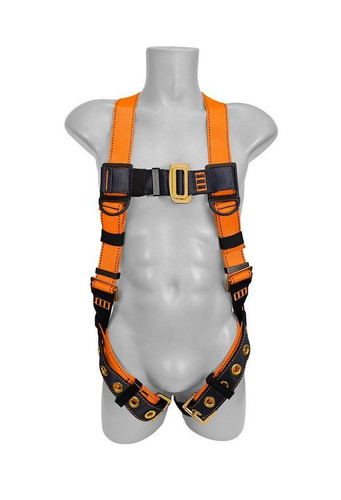


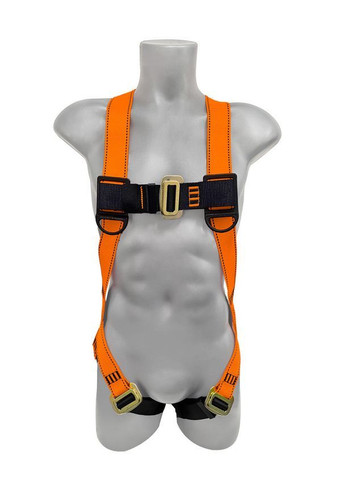
Combat Economy Full Body Harness
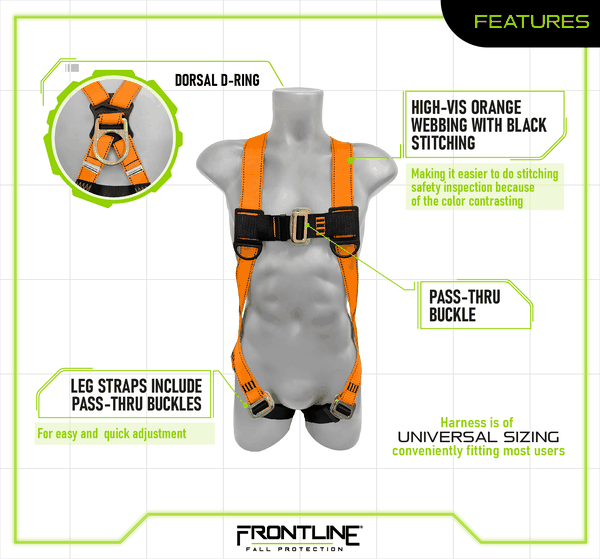
Frontline's Combat Series harness is the economy go-to that crews keep stocking: safety-orange polyester webbing, universal sizing that fits most users, and the OSHA and ANSI compliance every site walk verifies. The 100VMB is the minimalist configuration - a single dorsal fall-arrest D-ring, adjustable leg straps, and a pass-through mating buckle - at just 2.25 lb, the lightest economy harness in the lineup.
Safety orange polyester with alloy steel (golden yellow / silver galvanized finish) hardware. Rated to a 310 lb capacity and 5,000 lb breaking strength. Compliant with ANSI Z359.11-2014 and A10.32-2004 and OSHA 29 CFR 1910 and 1926. Sold as a 3-pack — three complete harnesses ship together for $119.
Who Needs This Product
This product is a personal fall protection full body harness. It is used as the wearer-side component of a personal fall arrest system (PFAS), a work positioning system, or a fall restraint system. Pair it with a compatible energy-absorbing lanyard or self-retracting lifeline (SRL) and a certified anchor rated to 5,000 lb. The harness is not a complete fall arrest system on its own.
Features
Minimalist single-dorsal design
Stripped to the essentials - one dorsal fall-arrest D-ring - for the lightest economy build.
Just 2.25 lb
Lightest harness in the Combat economy lineup; easy to keep on through a full shift.
Safety orange polyester webbing
High-visibility color helps the harness stand out on the site walk and during pre-shift inspection.
Pass-through mating buckle
Simple, secure chest connection; adjustable leg straps for a quick fit.
Fall indicator
Visual indicator shows whether the harness has been subject to a fall event.
Universal sizing fits most users
One SKU covers most of the crew, which simplifies the storeroom rotation.
Technical Specifications
| Series | Combat |
|---|---|
| SKU | 100VMB |
| Rated user capacity | 310 lb (worker, clothing, tools, and harness combined) |
| Breaking strength | 5,000 lb |
| Webbing material | Safety orange polyester |
| Webbing width | 1.75 in |
| Stitching | High-tenacity polyester |
| Hardware | Alloy steel (golden yellow / silver galvanized finish) |
| D-rings | Dorsal (single dorsal fall arrest d-ring between the shoulder blades) |
| Weight | 2.25 lbs |
| Available sizes | UN (Universal - fits most users) |
| ANSI standard | Z359.11-2014; A10.32-2004 |
| OSHA alignment | 29 CFR 1910 Subpart I; 29 CFR 1926 Subpart M |
Capacity and free fall. The 310 lb capacity includes the worker plus clothing, tools, and harness combined. Maximum free fall for a personal fall arrest system is 6 ft per OSHA 1926.502 when anchored at the dorsal D-ring. Calculate fall clearance for every setup before tying off.
Compliance Standards
ANSI Z359.11-2014
American National Standards Institute fall protection standard for this product class.
ANSI/ASSP A10.32 A10.32-2004
Fall protection systems for construction and demolition operations.
OSHA 29 CFR 1926
Subpart M construction industry fall protection (1926.500-503).
OSHA 29 CFR 1910
Subpart I general industry walking-working surfaces and PPE.
Typical Applications
Donning Overview
Single-operator donning per the Frontline user manual. Always refer to the manual for the full procedure.
- Inspect. Run the harness through a pre-use inspection: webbing, hardware, stitching, labels, fall indicators.
- Orient. Hold the harness up by the dorsal D-ring. Shake the leg straps free so they hang clean.
- Shoulders. Slip both arms through the shoulder straps with the dorsal D-ring centered between the shoulder blades.
- Chest. Connect the chest buckle. Adjust so the strap sits 6 to 8 inches below the collarbone.
- Legs. Pass each leg strap under the thigh and connect at the leg buckle. Tighten until two fingers fit between strap and thigh.
- Tighten. Adjust shoulders, chest, and legs evenly. The dorsal D-ring should rest between the shoulder blades, not riding up the neck or down the lower back.
Inspection and Retirement
Inspect every component before each use. A competent person inspects formally on a documented interval, typically every 6 months under ANSI Z359.2. Pull the equipment out of service for any of the conditions below.
- Webbing: cuts, burns, abrasion, chemical attack, broken threads, loose stitching.
- Hardware: cracks, deformation, sharp edges, corrosion, improper function of buckles and D-rings.
- Stitching: cut, broken, or loose stitches; pulled threads at any load point.
- Labels: legible and intact. Date of first use recorded.
- Fall indicators: any deployed or stretched indicator pulls the equipment out of service immediately.
- Connectors and hooks: gates close fully under spring tension; latches lock; no rollout exposure.
Retirement triggers: any deployed fall indicator, any equipment involved in a fall event, any chemical exposure outside the manufacturer-published list, or any condition where the inspector cannot positively verify the equipment is fit for service.
 Fall Protection
Distributors, LLC Free Tool · No Signup · OSHA 1926.502 Free Interactive Tool Fall Protection Calculator Pick your system. Run the math. Generate a plan. 1Pick Your SystemDetermine fall restraint vs. fall arrest based on your work surface, edge access, and clearance. 2Run the MathCalculate exact fall clearance required below the work surface for your SRL or lanyard setup. 3Generate a PlanGet a printable OSHA-compliant Fall Protection Plan structured around 29 CFR 1926.502(k).
Frequently Asked Questions
Frontline 100VMB Submittals and Documentation
Frontline 100VMB Spec Sheet (PDF)Dimensions, weights, materials, hardware, and the full feature and compliance summary. Frontline 100VMB Independent Lab Test Report (PDF)Independent third-party lab test results verifying the ANSI performance clauses. Frontline 100VMB User Instruction Manual (PDF)Donning, adjustment, inspection, and retirement procedures.Compatible and Related Products
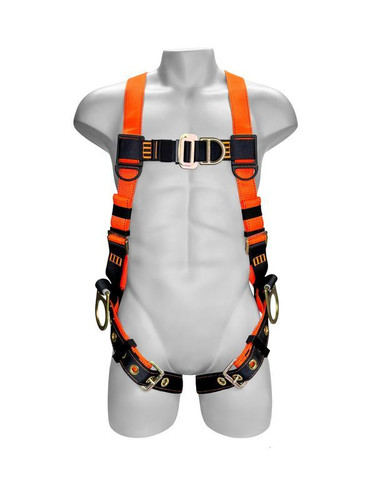
- Combat Economy Positioning Harness - 3 D-Rings (100VTB-UN-3D). Three D-rings: dorsal arrest + two side hip.
- Combat Economy Positioning Harness - 4 D-Rings (100VTB-UN-4D). Four D-rings: dorsal arrest + front sternal + two side hip.
- Combat Economy Vest Harness (50VTB). Vest cut.
- Frontline RPW062R Web Twin Leg 6 ft SRL. Twin-leg web SRL for 100% tie-off while moving.
Buying Harnesses for a Crew?
Need help specifying the right system for your jobsite? Confirm your application, anchorage, and clearance with us and we will walk through the kit list so the right equipment ships together.
Call 863-703-4522 to talk to a fall protection specialist.