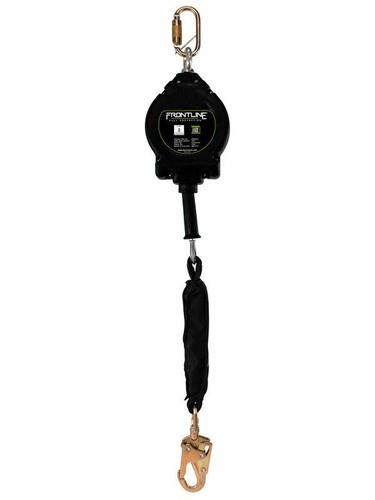


Built for abrasive jobsites. Built to lock fast. The Frontline RPG is a Class 1 self-retracting lifeline (SRL) built around a 3/16-inch galvanized steel aircraft cable inside a heavy-duty thermoplastic housing. A swivel eye on top of the housing anchors overhead, and a forged steel swivel snap hook with an integrated impact indicator connects to the dorsal D-ring of the worker's harness. A steel cable lifeline resists abrasion, sparks, and sharp metal edges far better than synthetic webbing. This is the right choice for structural steel, roofing on metal seams, refinery and tank work, and any environment where the lifeline is going to drag across the work surface. ANSI/ASSP Z359.14-2021 tested by Intertek Testing Services NA Inc., an ISO/IEC 17025:2017 accredited laboratory. Available in 30, 50, 70, and 100 ft working lengths.
Overhead anchorage only. The RPG is an ANSI Z359.14-2021 Class 1 SRD. The anchor must be located at or above the worker's dorsal D-ring. The RPG is not rated for leading edge work and is not rated for foot-level attachment. If your application requires the anchor to be at foot level, on sharp edges, or below the D-ring, you need a Class 2 SRL or a dedicated leading-edge SRL instead.
What Sets the Frontline RPG Apart
3/16-inch Galvanized Steel Cable
The lifeline is a 3/16-inch galvanized steel aircraft cable with a minimum breaking strength of 3,400 lbs. Steel cable resists abrasion, cuts, and heat damage that destroy synthetic webbing in days. On structural steel, metal roofs, and around hot work, the cable is the lifeline material that lasts.
Cable vs. Webbing — Harder Working Surfaces
Where webbing tears on a sharp seam or melts from a stray spark, galvanized cable shrugs it off. The trade-off is weight; cable SRLs are heavier than webbing of the same length. For long working ranges (30 to 100 ft) and abrasive environments, that weight is the right price for durability.
Quick-Action Centrifugal Brake
An internal centrifugal brake engages in fractions of a second when the cable accelerates beyond walking speed. In Intertek dynamic ambient testing, all three test samples arrested 310-lb weights from a 36-inch free fall within 14 inches, less than one-third of the 42-inch ANSI Class 1 ceiling height.
Forged Steel Swivel Snap Hook
A forged steel snap hook with a 3,600 lb gate strength and 5,000 lb connector strength connects the cable to the dorsal D-ring of the harness. The swivel head prevents cable twist as the worker repositions around the anchor.
Internal Energy Absorber
An integrated energy absorber within the housing keeps the average arrest force well below ANSI's 1,350-lb. limit for Class 1 devices. Intertek measured 706 to 808 ft-lbs. average arrest force across three dynamic ambient samples. This means the system protects the worker by a wide margin even when the brake engages at maximum force.
Swivel Eye Anchorage Connector
The top of the housing is a swivel steel eye that connects to a self-locking carabiner on the overhead anchor. The eye rotates freely, so the housing tracks the worker without applying torsion to the cable or the anchor connector.
Heavy-Duty Thermoplastic Housing
The housing is a heavy-duty polymer engineered for impact and weather resistance. A sealed shell keeps dust, moisture, and debris out of the brake mechanism. The whole assembly is light for a cable SRL and compact enough to carry up a ladder or hoist into position with a tool tether.
Visual Impact Indicator
An impact indicator built into the snap hook activates and turns red when the SRL has been subjected to a fall arrest. There is no guessing whether a used SRL is still safe to put back in service. A Competent Person can easily identify equipment that has been subjected to impact loads during the pre-use inspection.
Four Working Lengths to Match the Job
Four lifeline lengths, ranging from 30 to 100 ft, allow a crew to choose the working range that matches the actual fall distance. Shorter units are lighter on the harness; longer units cover wide work areas from a single overhead anchor without repositioning.
RPG (Cable) vs. RPAS (Webbing) — Which Frontline SRL Is Right for You?
Fall Protection Distributors stocks two Frontline single-leg overhead SRLs. Both are ANSI Z359.14-2021 Class 1 devices with the same 5,000-lb connector strength and 310-lb capacity. They differ in lifeline material and working length.
Choose the RPG (this page)
When the lifeline will be subject to abrasion, sparks, sharp metal edges, hot work, or chemical exposure, or when you need a working length of 30 to 100 ft from a single overhead anchor. Structural steel, refinery and tank, standing seam roofing, telecom towers.
Choose the RPAS instead
When the lifeline needs to stay free of abrasion, and you want the lightest possible SRL on the harness for long shifts, or when 6, 12, or 20 ft of working length is enough. Mechanical platforms, lift baskets, ladder access, light overhead production work.
Understanding Class 1 SRDs — What "Overhead Only" Means
ANSI/ASSP Z359.14-2021 divides self-retracting devices into two performance classes. Understanding the difference is the most important decision a buyer makes before specifying an SRL.
| Attribute | Class 1 SRD (RPG) | Class 2 SRD |
|---|---|---|
| Anchor location | At or above the dorsal D-ring (overhead) | Anywhere from foot level to overhead |
| Maximum free fall | 2 ft (anchor at D-ring) — typically less in overhead use | Up to 6 ft (anchor at foot level) |
| Max average arrest force (ambient) | 1,350 ft-lbs. | 1,350 ft-lbs. |
| Maximum arrest distance | 42 inches | 54 inches |
| Leading edge use | No — separate Class A or Class B LE certification required | No — separate LE certification required |
| Frontline RPG rating | ✓ Certified Class 1 | ✗ Not rated for Class 2 use |
The takeaway: using a Class 1 SRD at foot level voids both the manufacturer's certification and the worker's OSHA fall protection compliance.
Choose Your Length — 30, 50, 70, or 100 ft
All four RPG lengths share identical hardware, certification, and performance specifications. The only differences are working length and total weight. Choose based on the size of your work area, anchor location, and total fall clearance available below the work surface.
| Length | SKU | Total Weight | Best For |
|---|---|---|---|
| 30 ft (9.1 m) | RPG30 | 11.6 lbs. (5.2 kg) | Standard overhead use on roofs, mechanical platforms, and structural work where the worker stays within a single 12–15 ft radius of the anchor. Lightest RPG; easiest to carry up a ladder. |
| 50 ft (15.2 m) | RPG50 | 17.0 lbs. (7.7 kg) | Larger work areas and high overhead anchors. Good fit for tank tops, refinery platforms, and mid-rise roofing where the anchor is set above multiple work stations. |
| 70 ft (21.3 m) | RPG70 | 28.8 lbs. (13.06 kg) | Wide work areas and tall anchors. Common on structural steel erection where the anchor is set well above the work surface to maximize free movement. |
| 100 ft (30.5 m) | RPG100 | 31.0 lbs. (14.0 kg) | Maximum working range. Used when the anchor is set very high, on multi-story towers, communication structures, or any application where the worker needs the most free vertical movement from a single anchor point. |
Selecting the correct SRL length. For most applications, the optimal SRL is the shortest SRL that allows the worker to reach the full work area. A longer lifeline does not improve fall protection, but it does increase the swing-fall radius if the worker moves laterally away from the anchor. Plan the anchor location first, then choose the lifeline length that just covers the work envelope.
Technical Specifications
| Model | Frontline RPG Cable Single Leg SRL with Steel Snap Hook End |
|---|---|
| Available SKUs | RPG30 (30 ft) • RPG50 (50 ft) • RPG70 (70 ft) • RPG100 (100 ft) |
| Device Class | ANSI/ASSP Z359.14-2021 Class 1 SRD |
| Device Type | Single-leg Self-Retracting Lifeline (SRL) |
| Lifeline Material | 3/16-inch (5 mm) galvanized steel aircraft cable |
| Cable Minimum Breaking Strength | 3,400 lbs. |
| Housing | Heavy-duty thermoplastic polymer with swivel eye top |
| Braking System | Quick-action centrifugal brake with integrated internal energy absorber |
| Anchorage Connector | Swivel steel eye on top of housing |
| End Connector | Forged steel swivel snap hook with double-locking gate and integrated impact indicator |
| Gate Strength | 3,600 lbs. |
| Connector Strength | 5,000 lbs. (22.2 kN) |
| User Maximum Capacity | 310 lbs. — combined weight including user, clothing, tools, and equipment |
| Maximum Arrest Force | ≤ 1,800 ft-lbs. (ANSI limit) — RPG tested 997–1,128 ft-lbs. ambient dynamic, 1,171–1,240 ft-lbs. energy capacity test |
| Average Arrest Force | ≤ 1,350 ft-lbs. ambient (ANSI Class 1 limit) — RPG tested 706–808 ft-lbs. ambient, 747–787 ft-lbs. energy capacity test |
| Maximum Arrest Distance | ≤ 42 inches (ANSI Class 1 limit) — RPG tested 13–14 inches on 36-inch free fall |
| Static Strength | 3,000 lbs. for 1 minute — passed on all three test samples |
| Visual Indicator | Permanently activates (red) on fall arrest impact load at the snap hook |
| Anchorage Requirement | Overhead only — at or above the worker's dorsal D-ring |
| Standards Met | ANSI/ASSP Z359.14-2021 • ANSI A10.32-2012 • OSHA 1910 (General Industry) • OSHA 1926 Subpart M (Construction) |
| Test Laboratory | Intertek Testing Services NA Inc., Cortland, NY — ISO/IEC 17025:2017 accredited |
| Test Report | Report 105874305CRT-007 — test dates March 16–21, 2022, report extension July 15, 2024 |
| Country of Origin | Manufactured in India for Frontline Fall Protection Inc., Malvern, PA, USA |
ANSI Z359.14-2021 Tested Performance
The Frontline RPG was witness-tested by Intertek Testing Services NA Inc., an ISO/IEC 17025:2017 accredited laboratory, against the requirements of ANSI/ASSP Z359.14-2021. Six test samples were used, three for static strength and three for dynamic and energy-capacity testing. The complete test report (105874305CRT-007) is available in the Submittal Documents section below. The summary numbers:
| Test | Sample 4 | Sample 5 | Sample 6 | ANSI Limit | Result |
|---|---|---|---|---|---|
| Max Arrest Force | 1,075 lbs. | 997 lbs. | 1,128 lbs. | ≤ 1,800 lbs. | Pass |
| Avg Arrest Force | 808 lbs. | 706 lbs. | 724 lbs. | ≤ 1,350 lbs. (Class 1) | Pass |
| Arrest Distance | 13 in | 13.5 in | 14 in | ≤ 42 in | Pass |
| Visual indicator activated | Yes | Yes | Yes | Required | Pass |
| Test | Sample 4 | Sample 5 | Sample 6 | ANSI Limit | Result |
|---|---|---|---|---|---|
| Max Arrest Force | 1,171 lbs. | 1,240 lbs. | 1,179 lbs. | ≤ 1,800 lbs. | Pass |
| Avg Arrest Force | 747 lbs. | 787 lbs. | 771 lbs. | ≤ 1,350 lbs. (Class 1) | Pass |
The RPG also passed the 3,000 lb. static strength test on all three samples (Clause 3.2.1/4.2.1), and passed the general requirements, markings and instructions, and user inspection clauses (3.1, 5.1, 5.2, and 6).
Compliance & Certification
✓ ANSI/ASSP Z359.14-2021
Tested and compliant with Clauses 3.1 (general requirements), 3.2.1 (static strength), 3.3 (dynamic performance ambient), 3.4 (energy capacity, rotary brake), and 5.1 / 5.2 / 6 (markings, instructions, and user inspection) per Intertek report 105874305CRT-007.
✓ OSHA 1926 Subpart M & 1910
Meets OSHA requirements for personal fall arrest in both Construction (29 CFR 1926 Subpart M, including 1926.502) and General Industry (29 CFR 1910). Required for US regulated work at height.
✓ ANSI A10.32-2012
Compliant with the ANSI A10.32 standard for personal fall protection used in construction and demolition operations.
✓ Independently Tested by Intertek Testing Services NA Inc.
Intertek Testing Services NA Inc. (Cortland, NY) is part of the Intertek Group, a global testing and certification body. The laboratory is ISO/IEC 17025:2017 accredited. Not self-certified by the manufacturer.
⚠ Canadian Buyers — CSA Z259.2.2 Not Certified
The RPG is certified only to ANSI/ASSP Z359.14-2021. It is not separately certified to CSA Z259.2.2, the Canadian standard for self-retracting devices. Most Canadian provincial OH&S regulations require CSA certification for regulated work at height. Verify with your site safety officer or provincial authority before use on a Canadian jobsite.
Right SRL. Right Job.
Structural Steel & Ironwork
Steel cable is the lifeline material that withstands daily exposure to raw structural steel, weld spatter, and grinding sparks. For erection work, decking, and bolt-up, where the overhead anchor is rigged to a beam above the work surface, the RPG is the cable SRL that ironworkers most often ask for by name.
Refinery, Tank, and Vessel Work
Galvanized cable resists the chemical exposure, heat, and abrasive surfaces typical of refinery and tank work. The 50- and 70-ft RPG lengths are common choices when the anchor is rigged to overhead davit arms, monorails, or fixed beam clamps high above the work.
Telecom Towers and Multi-Story Structures
When the anchor is set far above the worker, the 70 and 100 ft RPG variants cover the full work area from a single overhead anchor point without the worker having to reposition the SRL between stories.
Not for these applications. Do not use the RPG for leading edge work, foot-level anchor applications, sharp-edge work where the cable would bend over an unprotected edge, structural steel erection where the anchor is below the dorsal D-ring, or any application that requires a Class 2 SRD or a dedicated leading edge (Class A/B) SRD. Call Fall Protection Distributors at 863-703-4522 if you are unsure whether the RPG is rated for your application.
How to Connect and Use the RPG — 7 Steps
Correct connection is as important as device certification. Follow these steps every time before moving to height. If your worksite has a documented pre-use procedure, follow that procedure. These steps describe the general manufacturer-recommended sequence.
- Inspect the SRL. Visually check the housing, swivel eye, the full length of the galvanized cable for kinks or broken strands, snap hook gate, and the visual impact indicator at the snap hook. Pull the cable out by hand to confirm smooth pay-out and retraction.
- Test the lock. Give the cable a quick, sharp pull. The internal brake should engage immediately and lock the cable. Release and confirm normal retraction resumes.
- Confirm the anchor is overhead. The anchor must be located at or above the worker's dorsal D-ring. Anchor placement controls free fall distance, arrest force, and arrest distance; getting this wrong defeats the whole system.
- Verify the anchor is rated. The anchor must support at least 5,000 lbs. per attached worker (OSHA 1926.502(d)(15)) or be engineered for a safety factor of two by a Qualified Person.
- Connect the SRL housing to the anchor. Use a 5,000 lb self-locking carabiner to connect the swivel eye on top of the SRL to the overhead anchor. Use only ANSI Z359.12 compliant connectors with a locking mechanism.
- Connect the snap hook to the dorsal D-ring. Connect the forged steel snap hook directly to the dorsal (back) D-ring of an ANSI Z359.11 compliant full-body harness. Confirm the gate closes and locks fully.
- Calculate fall clearance & move to position. Required clearance below the work surface = SRL maximum arrest distance + worker height below D-ring + harness stretch + safety margin. Plan for at least 11–12 ft of clear space for an average worker before moving to height.
Calculating Fall Clearance
Fall clearance is the vertical distance required below the work surface for the SRL to arrest the worker without contact with a lower level. Insufficient clearance is one of the most common causes of serious injury in personal fall arrest. The math for the RPG, in plain English:
| Component | Typical Value | Notes |
|---|---|---|
| SRL maximum arrest distance | 3.5 ft (42 in) | ANSI Z359.14 Class 1 ceiling — RPG tested 13–14 in actual |
| Worker height below dorsal D-ring | ~4.5 ft | For a 6 ft worker; measured from D-ring to feet |
| Harness stretch | ~1 ft | Typical full-body harness stretch under arrest load |
| Safety margin | 2–3 ft | Recommended to prevent contact with obstructions or lower levels |
| Minimum required clearance | ~11–12 ft | Below the work surface, before any obstruction or lower level |
This is an example calculation. Site-specific fall clearance must be calculated by a Competent Person for every work area. Where insufficient clearance exists below the work surface, a different fall protection method is required — typically a guardrail system, a personal fall restraint system, or relocation of the anchor.
 Fall Protection
Distributors, LLC Free Tool · No Signup · OSHA 1926.502 Free Interactive Tool Fall Protection Calculator Pick your system. Run the math. Generate a plan. 1 Pick Your System Determine fall restraint vs. fall arrest based on your work surface, edge access, and clearance. 2 Run the Math Calculate exact fall clearance required below the work surface for your SRL or lanyard setup. 3 Generate a Plan Get a printable OSHA-compliant Fall Protection Plan structured around 29 CFR 1926.502(k).
Inspection & Retirement
Per ANSI Z359.2 and OSHA 1926.502, self-retracting devices require inspection at two levels. Skipping either is both an OSHA violation and a safety failure.
Pre-Use Inspection (Every Use)
Performed by the user before each work shift or each time the device is put back into service. Takes 60–90 seconds.
- Inspect the thermoplastic housing for cracks, dents, or impact damage.
- Pull the full cable out by hand and inspect along its entire length for kinks, broken strands (birdcaging), corrosion, abrasion, or heat damage.
- Confirm the cable pays out smoothly and retracts fully and steadily.
- Give the cable a sharp pull to ensure the locking brake engages immediately.
- Inspect the swivel eye for free rotation. Inspect the snap hook for gate function, gate spring, distortion, cracks, and corrosion.
- Confirm the visual impact indicator at the snap hook is NOT activated (not red).
- Confirm all labels are legible.
Competent Person Inspection (Annual Minimum)
Formal documented inspection by a Competent Person who is not the regular user. Records must be retained. Heavy-use, abrasive, chemical, or marine environments require more frequent formal inspection; quarterly or monthly may be appropriate.
Mandatory Retirement
The Frontline RPG must be removed from service and destroyed if any of the following conditions exist:
- The visual impact indicator at the snap hook has activated (red).
- The SRL has been subjected to a fall-arrest event, even if no visible damage exists.
- The cable shows kinks, broken strands, significant corrosion, or heat damage.
- The cable does not pay out, retract, or lock smoothly.
- The housing is cracked or impact-damaged.
- The snap hook gate does not fully close and lock.
- Any label is missing or illegible.
- The device has been exposed to acids, alkalis, or other corrosive substances.
- Any other condition the Competent Person determines compromises function.
Cleaning & Storage
Wipe the housing and snap hook with a clean cloth and mild detergent. Allow the cable to fully retract before storage. Do not submerge the unit. Store in a cool, dry location out of direct sunlight, away from heat sources, chemicals, and moisture. Do not store damaged equipment alongside equipment approved for use.
Frequently Asked Questions
Is the Frontline RPG a Class 1 or Class 2 SRL?
The Frontline RPG is an ANSI/ASSP Z359.14-2021 Class 1 SRD (Self-Retracting Device), confirmed by Intertek Testing Services NA Inc. witness testing on report 105874305CRT-007. Class 1 means the device is designed for use with the anchor located at or above the user's dorsal D-ring; overhead anchorage only. It is not rated for foot-level attachment (which would require a Class 2 SRD) and is not rated for leading edge applications. The Intertek report explicitly marks suitability for use with horizontal lifelines, horizontal use, and Leading Edge capability as not applicable.
Why a cable SRL instead of a webbing SRL?
A 3/16-inch galvanized steel cable handles abrasion, sharp edges, hot work, sparks, and chemical exposure better than synthetic webbing. For structural steel erection, refinery and tank work, roofing on metal seams, and anywhere the lifeline is going to drag across the work surface or be exposed to heat, a cable SRL outlasts a webbing SRL by a wide margin. The trade-off is weight; cable SRLs are heavier than webbing SRLs of the same working length, so for short, light overhead applications a webbing SRL like the Frontline RPAS may be the better choice. For longer lengths and abrasive environments, the RPG is the right tool.
Can the RPG be used at foot level or as a leading edge SRL?
No. The Frontline RPG is for overhead anchorage only. The Intertek test report classifies it as a Class 1 SRD, which by definition requires the anchor to be at or above the dorsal D-ring. It is not certified for leading edge work and not certified for foot-level attachment. If your job requires the anchor at foot level, sharp unprotected edges, or as a leading edge SRL, you need a Class 2 SRL or a dedicated leading edge (Class A or Class B) SRL, not the RPG.
What's the difference between the 30, 50, 70, and 100 ft RPG lengths?
All four lengths share the same heavy-duty polymer housing, the same 3/16-inch galvanized cable diameter, the same swivel eye, the same forged steel snap hook with impact indicator, the same 5,000 lb connector strength, the same 310 lb user capacity, and the same ANSI Z359.14-2021 Class 1 certification. The only differences are working length and total weight: RPG30 (30 ft) at 11.6 lbs.; RPG50 (50 ft) at 17 lbs.; RPG70 (70 ft) at 28.8 lbs.; RPG100 (100 ft) at 31 lbs. Choose the shortest length that covers the work area — a longer lifeline does not improve fall protection, and a heavier SRL fatigues the worker on long shifts.
How much fall clearance does the RPG require?
ANSI Z359.14-2021 caps maximum arrest distance at 42 inches (3.5 ft) for a Class 1 SRD. In Intertek dynamic ambient testing of the RPG, the actual measured arrest distances were 13, 13.5, and 14 inches on a 36-inch free fall with a 310 lb test weight — well under the 42-inch ceiling. Total required clearance below the work surface = SRL arrest distance + worker height below the dorsal D-ring (~4.5 ft for a 6 ft worker) + harness stretch + a safety margin of 2–3 ft. Most overhead RPG applications require 11–12 ft of clear space below the work surface. Always perform site-specific clearance calculations before each use.
Where do I connect the snap hook on my harness?
Connect the forged steel snap hook directly to the dorsal (back) D-ring of an ANSI Z359.11 compliant full-body harness. The dorsal D-ring is the only fall arrest attachment point on a standard full-body harness. Never connect the RPG to side D-rings (which are work positioning only), front D-rings (which are typically for ladder climbing or descent), or shoulder D-rings (which are for rescue/retrieval only). The Frontline 100RCTB Combat Reflective Harness is one fully compatible option carried by Fall Protection Distributors.
What anchor strength does the RPG require?
OSHA 1926.502(d)(15) requires anchorages used for personal fall arrest systems to either (a) support at least 5,000 lbs per attached worker, or (b) be designed, installed, and used as part of a complete personal fall arrest system that maintains a safety factor of at least two, under the supervision of a Qualified Person. The RPG connector itself is rated at 5,000 lbs, so the limiting factor in most installations is the anchor. The Standing Seam Roof Anchor SSRA1 is an engineered overhead anchor compatible with the RPG for standing-seam metal roof applications.
How do I inspect the RPG, and when do I retire it?
Pre-use inspection (every use, 60–90 seconds): inspect the housing for cracks; verify smooth cable pay-out and retraction by hand; confirm the locking brake engages with a sharp pull; inspect the full length of the galvanized cable for kinks, broken strands (birdcaging), corrosion, or heat damage; confirm the snap hook gate closes and locks; confirm the visual impact indicator at the snap hook is NOT activated (red). Competent Person inspection (minimum every 12 months, more often in heavy use): formal documented inspection by a Competent Person who is not the regular user. Retire immediately if: the impact indicator has activated; the device has been involved in any fall arrest event (even if no visible damage); the cable shows kinks, broken strands, or heat damage; the lifeline does not pay out, retract, or lock smoothly; any label is illegible; or any component fails inspection.
Frontline RPG Submittal Documents
The following manufacturer documents are available for download to support procurement, safety planning, jobsite submittals, and Competent Person inspection records. All documents apply directly to the Frontline RPG Cable Single Leg SRL with Steel Snap Hook End across all four available lengths.
| Document | Description | Download |
|---|---|---|
| Frontline RPG Spec Sheet | One-page summary of design specifications, available lengths, weights, connector and gate strength, capacity, arrest distance, arrest force, breaking strength, and relevant ANSI and OSHA standards for the Frontline RPG Cable Single Leg SRL with Steel Snap Hook End. | Spec Sheet (PDF) |
| Frontline RPG ANSI Z359.14-2021 Test Report | Intertek Testing Services NA Inc. witness testing report 105874305CRT-007 verifying compliance with ANSI/ASSP Z359.14-2021 for the RPG. Covers general requirements, static strength, dynamic performance, ambient, energy capacity (rotary brake), and markings and instructions. ISO/IEC 17025:2017 accredited laboratory. | Test Report (PDF) |
| Frontline RPG User Manual | Complete user instruction manual for the Frontline RPG cable self-retracting lifeline. Includes limitations for use, anchorage requirements, connection procedure, fall clearance calculation, inspection procedures, cleaning, and storage guidance. | User Manual (PDF) |
Building a Complete Fall Protection System?
The RPG is one leg of a personal fall arrest system. A complete system needs three certified, compatible components: an engineered anchor, a connecting subsystem (this SRL), and a full-body harness. Fall Protection Distributors stocks every piece.
- Anchor: Standing Seam Roof Anchor SSRA1 for standing seam metal roofs, or browse all anchorage solutions for other roof and structural types.
- Harness: Frontline 100RCTB Combat Reflective Full Body Harness (ANSI Z359.11 certified, 310 lbs. capacity — fully compatible with the RPG), or browse all harnesses and bodywear.
- Alternate SRL: The lighter Frontline RPAS Aramid Fiber SRL in 6, 12, or 20 ft for short overhead applications. Or browse all retractables and SRLs and shock-absorbing lanyards.
Not sure which length, anchor, or harness is right for your application? Call Fall Protection Distributors at 863-703-4522 or email [email protected]. We spec complete systems before you buy, including verifying anchor compatibility, calculating fall clearance for your jobsite, and confirming the system meets the OSHA standard for your work classification.