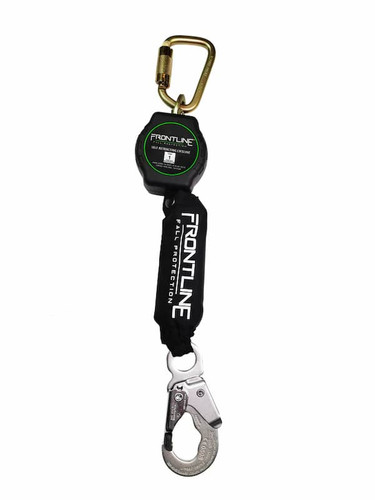


Never disconnect at height. The Frontline RPA062S is a twin leg / dual SRL-P self-retracting lifeline engineered for 100% tie-off. Two independent 6 ft lifelines, two forged steel snap hooks, one shared housing on your back. Connect leg #2 to the next anchor before disconnecting leg #1 from the old one, the worker is continuously protected during every anchor transition. Aramid fiber webbing wrapped around a UHMWPE and polyester core. ANSI/ASSP Z359.14-2021 Class 1 SRD, dual SRL-P clauses 3.6.1 and 3.6.2 tested and passed by SGS Taiwan, an ISO/IEC 17025:2017 accredited laboratory.
Overhead anchorage only, for both legs. The RPA062S is an ANSI Z359.14-2021 Class 1 SRD. Each anchor (the working one and the transition target) must be located at or above the worker's dorsal D-ring. The RPA062S is not rated for leading edge work and not rated for foot-level attachment. If your application requires the anchor at foot level, on sharp edges, or below the D-ring, you need a Class 2 SRL or a dedicated leading edge SRL instead.
Why Twin Leg? The 100% Tie-Off Standard
OSHA 1926.502(d) and ANSI Z359.2 both require continuous fall protection above the trigger height, including during the moments a worker transitions from one anchor to another. With a single leg SRL, that transition creates a gap: the worker has to disconnect from the old anchor before reconnecting to the new one, and is unprotected during the swap. Twin leg SRLs close that gap. Here is the sequence:
| Step | Single Leg SRL | Twin Leg SRL (RPA062S) |
|---|---|---|
| 1. Working at the first anchor | One connection, arrest-rated | Leg #1 connected, leg #2 parked, arrest-rated |
| 2. Preparing to move to the next anchor | Disconnect from anchor #1 first, unprotected at this moment | Connect leg #2 to anchor #2 first, now arrest-rated on BOTH anchors |
| 3. Move to the new position | Move while unconnected, OSHA gap | Disconnect leg #1 from anchor #1, still arrest-rated on anchor #2 |
| 4. Working at the new anchor | Reconnect to anchor #2, arrest-rated again | Park leg #1, continue working, arrest-rated throughout |
If your work involves walking a structural steel beam, climbing tower ladders, moving between rooftop anchor zones, or any task with more than one fall protection anchor in sequence, twin leg is the right tool. If your task stays at a single fixed anchor for the full shift, single leg is simpler and lighter.
What Sets the Frontline RPA062S Apart
Two Independent Lifelines, One Housing
Two aramid fiber webbing lifelines retract independently from a single thermoplastic housing worn on the back. Each leg operates as its own self-retracting lifeline with its own centrifugal brake, its own energy absorber, and its own visual indicator. The shared housing means less weight and bulk than carrying two separate SRLs.
100% Tie-Off Without Compromise
Connect one leg to your working anchor and the other to the transition target before disconnecting. Standard practice on structural steel, tower work, and OSHA 1926 Subpart R compliance. Independently tested under ANSI Z359.14-2021 Clause 3.6.2 for dual SRL-P connection performance.
Forged Alloy Steel Snap Hooks (2 ×)
Two forged alloy steel snap hooks with 5,000 lb gates, one at the end of each lifeline. Steel is heavier than aluminum but more durable in abrasive construction environments. Universal compatibility with the dorsal D-ring connection point you would use on any anchor, beam clamp, anchor sling, or carabiner.
Aramid Fiber Webbing Lifelines
Both lifelines use the same aramid fiber outer webbing as the single leg RPAS, high-tenacity synthetic fiber, low stretch, high heat resistance, excellent abrasion resistance relative to weight. Sheaths a UHMWPE and polyester core. Light, compact, and durable across the device's full temperature range.
Dual Inbuilt Textile Shock Packs
One textile energy absorber per leg, each inside its own protective cover. Either absorber deploys progressively to keep arrest force within ANSI limits if that leg arrests a fall. The protective covers keep the absorbers clean and uncontaminated until the moment they have to work.
Swivel Tops & Side Lifeline Exits
Both swivel tops rotate independently of the housing, allowing each lifeline to follow the worker's movement without twist. Lifelines exit from the sides rather than the bottom of the housing, which reduces wear and improves lifeline routing during dual-anchor work.
Thermoplastic Housing
Engineered thermoplastic housing, impact-resistant, dielectric, and corrosion-immune. Stainless steel and non-corrosive internal components passed 96-hour salt spray corrosion testing per ANSI Z359.14 §3.1.5 with no signs of corrosion and full functional retention on both retractors.
Dual Visual Fall Arrest Indicators
Each leg has its own visual indicator that activates permanently if that leg is subjected to fall arrest forces. SGS confirmed indicator activation on every dynamic test specimen during the dual SRL-P testing. If either indicator is deployed, the entire SRL must be removed from service immediately, both legs share the same housing and energy management system.
Built on the Same Proven RPAS Platform
The RPA062S shares its housing, braking system, webbing, and certification platform with the single leg RPAS, just configured with two retractors instead of one. The same 5,000 lb connector strength per leg, the same 310 lb user capacity, the same ANSI/OSHA compliance.
Technical Specifications
| Model | Frontline RPA062S Aramid Twin Leg SRL with Steel Snap Hooks |
|---|---|
| SKU | RPA062S |
| Configuration | Twin leg / Dual SRL-P (two lifelines, two snap hooks, single shared housing) |
| Tie-Off Capability | 100% tie-off, continuous protection during anchor transitions |
| Device Class | ANSI/ASSP Z359.14-2021 Class 1 SRD |
| Device Subtype | Self-Retracting Lanyard, Personal (SRL-P, dual configuration) |
| Lifeline Length (per leg) | 6 ft (1.83 m) |
| Number of Lifelines | 2 (independent retractors, shared housing) |
| Lifeline Material | Aramid fiber outer webbing with UHMWPE (Ultra-High-Molecular-Weight Polyethylene) and polyester core |
| Housing | Engineered thermoplastic, dual swivel tops, side lifeline exits |
| Braking System | Quick-action centrifugal brake on each leg with dual inbuilt textile shock packs (protective covers) |
| End Connectors | 2 × forged alloy steel snap hooks (locking gate, 5,000 lb each) |
| Internal Hardware | Stainless steel and non-corrosive components |
| Connector Strength (per leg) | 5,000 lbs. (22.2 kN) |
| User Maximum Capacity | 310 lbs., combined weight including user, clothing, tools, and equipment |
| Maximum Arrest Force (single leg, ANSI limit) | ≤ 1,800 lbf |
| Average Arrest Force (single leg, ANSI ambient limit) | ≤ 1,350 lbf |
| Dual SRL-P Maximum Arrest Force (ANSI Clause 3.6.2 limit) | ≤ 1,800 lbf, RPA062S tested 1,554.13 lbf (Pass) |
| Dual SRL-P Static Test (ANSI Clause 3.6.1) | 3,600 lbs (16 kN), passed without breaking |
| Maximum Arrest Distance | ≤ 42 inches (1,067 mm) per leg |
| Static Strength (per leg) | 3,600 lbs (16 kN), passed without breaking |
| Locking Strength (per leg) | 1,800 lbs (8 kN), passed without breaking or releasing load |
| Corrosion Resistance | 96-hour salt spray (fog) test per ANSI Z359.14-2021 §3.1.5, no signs of corrosion, full functional retention |
| Visual Indicators | One per leg, permanently activates on fall arrest impact load |
| Anchorage Requirement | Overhead only, each anchor at or above the worker's dorsal D-ring |
| Standards Met | ANSI/ASSP Z359.14-2021 (Class 1 SRD, dual SRL-P) • OSHA 1910.140 (General Industry) • OSHA 1926 Subpart M (Construction) • OSHA 1926 Subpart R compatible (Steel Erection) |
| Test Laboratory | SGS Taiwan Ltd., ISO/IEC 17025:2017 accredited (witnessing Hardline Laboratory) |
| Test Report | SGS Hardline Laboratory Report TH10297A/2022 (issued 20 Mar 2023), covers RPA062S dual SRL-P configuration |
| Total Weight | [Confirm with manufacturer spec sheet, approximately 5 lbs (2.3 kg) for the twin leg 6 ft configuration] |
| Country of Manufacture | Manufactured for Frontline Fall Protection Inc., Malvern, PA |
ANSI Z359.14-2021 Tested Performance: Dual SRL-P Clauses
The RPA062S is tested under the standard single-leg ANSI Z359.14-2021 requirements and the additional dual SRL-P clauses (3.6.1 and 3.6.2) that apply specifically to twin leg configurations. Testing performed by SGS Taiwan Ltd., an ISO/IEC 17025:2017 accredited laboratory, under Report TH10297A/2022.
| Clause | Test | ANSI Limit | RPA062S Measured | Result |
|---|---|---|---|---|
| 3.6.1 | Static Test for Dual SRL-Ps | 3,600 lbs (16 kN), no breaking | Withstood load, no breaking | Pass |
| 3.6.2 | SRL-P Dual Connection Max Arrest Force | ≤ 1,800 lbf | 1,554.13 lbf | Pass |
| 3.1.5 | 96-hr Salt Spray Corrosion | Functional retention, no corrosion | Functional, no corrosion | Pass |
| 3.2.1 | Static Strength (per leg) | 3,600 lbs (16 kN), no breaking | Withstood load, no breaking | Pass |
| 3.2.3 | Locking Strength (per leg) | 1,800 lbs (8 kN), no release | Withstood load, no release | Pass |
| 3.3.1 | Dynamic Performance (single leg) | Max 1,800 / avg 1,350 lbf / 42 in | Max 961.60 / avg 754.75 lbf / 20.0 in | Pass |
| 3.3.2 | SRL-P Dynamic Performance (single leg) | ≤ 1,800 lbf ambient | 953.84 lbf | Pass |
| 3.5.1 | Retraction Tension | 1.25–25 lbf | 1.80–9.71 lbf | Pass |
Why the dual SRL-P arrest force (1,554 lbf) is higher than single leg (961 lbf): Clause 3.6.2 tests the worst-case scenario where both lifelines are connected simultaneously and one is loaded under fall arrest. The unloaded leg shares some of the load path through the shared housing and harness, which produces a slightly higher peak arrest force on the loaded leg. The result is still well under the ANSI 1,800 lbf ceiling, but it is structurally a different test from single-leg dynamic performance. This is normal and expected behavior for any compliant dual SRL-P.
Compliance & Certification
✓ ANSI/ASSP Z359.14-2021: Including Dual SRL-P Clauses
Tested and compliant with Clauses 3.1.5 (corrosion), 3.2.1 (static), 3.2.3 (locking), 3.3.1 (dynamic, single leg), 3.3.2 (SRL-P dynamic), 3.5.1 (retraction tension), 3.6.1 (dual SRL-P static), and 3.6.2 (dual SRL-P connection) per the published SGS test report.
✓ OSHA 1910.140, 1926 Subpart M, and 1926 Subpart R Compatible
Meets OSHA personal fall arrest requirements for General Industry (29 CFR 1910.140) and Construction (29 CFR 1926 Subpart M, including 1926.502). Twin leg configuration supports OSHA 29 CFR 1926 Subpart R (Steel Erection) 100% tie-off requirements during structural steel work and connection.
✓ Independently Tested by SGS Taiwan Ltd.
SGS Taiwan Ltd. is part of the SGS Group, the world's leading inspection, verification, testing, and certification company. The testing laboratory holds ISO/IEC 17025:2017 accreditation. Not self-certified.
⚠ Canadian Buyers: CSA Z259.2.2 Not Certified
The RPA062S is certified to ANSI/ASSP Z359.14-2021 only. It is not separately certified to CSA Z259.2.2, the Canadian standard for self-retracting devices. Most Canadian provincial OH&S regulations require CSA certification for regulated work at height. Verify with your site safety officer or provincial authority before use on a Canadian jobsite.
Right SRL. Right Job.: When to Choose Twin Leg
Structural Steel Erection (OSHA 1926 Subpart R)
Connectors moving along beams, plumb-up crews, decking installation. 100% tie-off is mandatory above 15 ft per 1926.760, and the worker must maintain continuous attachment when moving from one anchor to the next. Twin leg is the standard answer.
Tower & Tall-Structure Climbing
Telecom towers, transmission line work, wind turbine ladders, any vertical climb where the worker passes through multiple fall protection anchors as they ascend. Twin leg keeps the worker continuously attached during every step of the climb.
Roof Crews Moving Between Anchor Zones
Large-roof work where the crew moves between multiple installed roof anchors over the course of the shift. Single leg is fine within one anchor's working radius, but twin leg is required for the transition between zones.
Multi-Story Mechanical and Electrical Work
Mezzanine edge crews, HVAC rigging across floors, multi-level construction where each work position requires a different overhead anchor.
Not for these applications. Do not use the RPA062S for leading edge work, foot-level anchor applications, sharp-edge work, or any application that requires a Class 2 SRD or a dedicated leading edge (Class A/B) SRD. Call Fall Protection Distributors at 863-703-4522 if you are unsure whether the RPA062S is rated for your application.
How to Maintain 100% Tie-Off in 7 Steps
The sequence matters. The whole point of a twin leg SRL is that the worker is never disconnected at height, which requires connecting leg #2 to the new anchor before disconnecting leg #1 from the old one. Follow these steps every transition.
- Inspect both legs of the SRL. Check the housing, both swivel tops, both aramid lifelines, both energy absorber covers, both snap hook gates, and the visual indicators. Pull each lifeline out by hand and confirm smooth pay-out and retraction on both legs.
- Attach the housing to your dorsal D-ring. Use the harness carabiner connection point on the SRL housing to connect to the dorsal (back) D-ring of an ANSI Z359.11 compliant full-body harness. The housing rides on your back; both lifelines extend over your shoulders.
- Confirm both target anchors are overhead and rated. Each anchor must be at or above your dorsal D-ring and rated for 5,000 lbs per attached worker (OSHA 1926.502(d)(15)) or engineered with a safety factor of 2.
- Connect leg #1 to the first overhead anchor. Confirm the gate closes and locks fully. You are now arrest-rated.
- Park the unused leg. Use the SRL housing's parking attachment or your harness lanyard parking point to keep leg #2's snap hook secured until needed. Never let it dangle.
- Transition with both legs connected. Before disconnecting leg #1, connect leg #2 to the next overhead anchor. Confirm the gate is closed and locked. You are now arrest-rated on both anchors momentarily, only then disconnect leg #1.
- Repark and continue work. Park the now-free snap hook on the housing or harness parking attachment. Move to the next anchor transition the same way. If either visual indicator ever deploys, remove the SRL from service immediately.
Calculating Fall Clearance
Fall clearance is the vertical distance required below the work surface for the SRL to arrest the worker without contact with a lower level. Each leg of the RPA062S has the same arrest distance characteristics as the single leg RPAS, the clearance math is identical to a single leg SRL connected to whichever anchor is currently the active fall arrest path. The math, in plain English:
| Component | Typical Value | Notes |
|---|---|---|
| SRL maximum arrest distance | 3.5 ft (42 in) | ANSI Z359.14 ceiling, RPA062S tested well under this |
| Worker height below dorsal D-ring | ~4.5 ft | For a 6 ft worker; measured from D-ring to feet |
| Harness stretch | ~1 ft | Typical full-body harness stretch under arrest load |
| Safety margin | 2–3 ft | Recommended to prevent contact with obstructions or lower levels |
| Minimum required clearance | ~11–12 ft | Below the work surface, before any obstruction or lower level |
This is an example calculation. Site-specific fall clearance must be calculated by a Competent Person for every work area and for every anchor location the twin leg SRL will be used with. Where insufficient clearance exists below the work surface, a different fall protection method is required, typically a guardrail system, a personal fall restraint system, or relocation of the anchor.
 Fall Protection
Distributors, LLC Free Tool · No Signup · OSHA 1926.502 Free Interactive Tool Fall Protection Game Plan Pick your system. Run the math. Generate a plan. 1 Pick Your System Determine fall restraint vs. fall arrest based on your work surface, edge access, and clearance. 2 Run the Math Calculate exact fall clearance required below the work surface for your SRL or lanyard setup. 3 Generate a Plan Get a printable OSHA-compliant Fall Protection Plan structured around 29 CFR 1926.502(k).
Inspection & Retirement
Per ANSI Z359.2 and OSHA 1926.502, self-retracting devices require inspection at two levels. Twin leg SRLs require slightly longer pre-use inspection because both legs must be checked.
Pre-Use Inspection (Every Use, 90–120 Seconds)
- Inspect the thermoplastic housing for cracks, dents, or impact damage.
- Pull each lifeline out by hand and inspect the full length of both aramid webbings for cuts, fraying, abrasion, burns, chemical contamination, or stitching damage.
- Inspect both energy absorber covers for damage, contamination, or evidence of deployment.
- Confirm both lifelines pay out smoothly and retract fully and steadily.
- Give each lifeline a sharp pull to ensure each locking brake engages immediately.
- Inspect both swivel tops for free rotation. Inspect both snap hooks for gate function, gate spring, distortion, cracks, and corrosion.
- Confirm both visual fall arrest indicators are NOT deployed.
- Confirm all labels are legible.
Competent Person Inspection (Annual Minimum)
Formal documented inspection by a Competent Person who is not the regular user. Records must be retained. Heavy-use, abrasive, chemical, or marine environments require more frequent formal inspection; quarterly or monthly may be appropriate.
Mandatory Retirement
The Frontline RPA062S must be removed from service and destroyed if any of the following conditions exist:
- Either visual fall arrest indicator has deployed.
- Either leg has been subjected to any fall arrest event, even if no visible damage exists.
- The aramid webbing on either leg shows cuts, significant abrasion, burns, or chemical damage.
- Either lifeline does not pay out, retract, or lock smoothly.
- The housing is cracked or impact-damaged.
- Either snap hook gate does not close and lock fully.
- Any label is missing or illegible.
- The device has been exposed to acids, alkalis, or other corrosive substances.
- Any other condition the Competent Person determines compromises function.
Both legs are retired together. The legs share the housing and energy management platform, you cannot retire one leg and continue using the other.
Cleaning & Storage
Wipe the housing and both snap hooks with a clean cloth and mild detergent. Allow both lifelines to fully retract before storage. Do not machine wash, dry clean, or use solvents on the webbing. Store in a cool, dry location out of direct sunlight, away from heat sources, chemicals, and moisture. Do not store damaged equipment alongside equipment approved for use.
Frequently Asked Questions
What is 100% tie-off and why does the RPA062S provide it?
100% tie-off means the worker stays continuously connected to a fall arrest anchor at all times when exposed to a fall hazard, including during transitions between anchor points. With a single leg SRL, the worker must disconnect from one anchor before reconnecting to the next, leaving a moment of zero protection. The RPA062S has two independent lifelines and two snap hooks: connect leg #2 to the new anchor before disconnecting leg #1 from the old anchor. You are never unprotected at height. OSHA 29 CFR 1926.502(d) and ANSI Z359.2 both require continuous fall protection when working above the trigger height, twin leg SRLs are the most common way to achieve it.
When is a twin leg SRL required versus a single leg SRL?
Twin leg is required (or strongly recommended) any time the worker must move between two or more anchor points while exposed to a fall hazard. Common scenarios: structural steel erection (moving along a beam, climbing through floors), ladder climbing on tall structures, tower work, scaffolding transitions, rooftop crews moving between separate anchor zones. Single leg is appropriate when the worker stays attached to one fixed anchor for the entire task (single-position rooftop work, fixed mechanical platforms, single-anchor confined space work). If you don't know in advance which scenario applies, choose twin leg, single leg is never wrong to use, it just won't provide 100% tie-off during transitions.
Is the Frontline RPA062S a Class 1 or Class 2 SRL?
Class 1 SRD (Self-Retracting Device) per ANSI/ASSP Z359.14-2021. The RPA062S is tested as a dual SRL-P (Self-Retracting Lanyard, Personal) under SGS Hardline Laboratory Report TH10297A/2022, including Clause 3.6.1 (static test for dual SRL-Ps, passed at 3,600 lbs with no breaking) and Clause 3.6.2 (SRL-P dual connection, measured 1,554.13 lbf max arrest force, well under the 1,800 lbf ANSI ceiling). Class 1 means overhead anchorage only, both lifelines must connect to anchors at or above the worker's dorsal D-ring. The RPA062S is not rated for foot-level attachment or leading edge use.
Can I connect both legs of the RPA062S to the same anchor?
No. Connecting both snap hooks to the same anchor or carabiner defeats the purpose of a twin leg SRL and can concentrate arrest force on a single connector. Each leg must be used independently, one connected to the working anchor, the other parked on the housing or harness parking attachment until needed for transition to the next anchor. If you only have one anchor available for the whole task, a single leg SRL is the correct device.
Where on my harness does the RPA062S housing attach?
The twin leg SRL housing attaches to the dorsal (back) D-ring of an ANSI Z359.11 compliant full-body harness, the same connection point you would use for any other fall arrest device. The two lifelines extend from the housing over your shoulders and connect to overhead anchors via the steel snap hooks. The Frontline 100RCTB Combat Reflective Harness is one fully compatible option carried by Fall Protection Distributors.
What anchor strength does each leg of the RPA062S require?
Each anchor used with the RPA062S must independently meet OSHA 1926.502(d)(15): support at least 5,000 lbs per attached worker, or be engineered with a safety factor of 2 by a Qualified Person. Since both legs of the SRL are rarely loaded simultaneously (only one is the active fall arrest path at any moment), the per-anchor rating is the same as for a single leg SRL. The Standing Seam Roof Anchor SSRA1 is one engineered overhead anchor compatible with the RPA062S for standing seam metal roof applications.
How do I inspect the RPA062S, and when do I retire it?
Pre-use inspection (every use, 90–120 seconds for a twin leg, slightly longer than single leg): inspect the housing for cracks; pull each lifeline out by hand and inspect both aramid webbings for cuts, fraying, burns, or chemical damage; confirm each locking brake engages with a sharp pull; inspect both energy absorber covers; confirm both snap hook gates close and lock; confirm both visual fall arrest indicators are NOT deployed. Competent Person inspection minimum every 12 months. Retire immediately if: either indicator has deployed; either leg has been involved in a fall arrest event; either webbing shows damage; either lifeline does not function smoothly; or any component fails inspection. Both legs are retired together, they share the housing and energy management platform.
Frontline RPA062S Submittal Documents
The following manufacturer documents apply to the Frontline RPA062S Aramid Twin Leg SRL. The SGS test report explicitly covers the RPA062S dual SRL-P configuration under Clauses 3.6.1 and 3.6.2.
| Document | Description | Download |
|---|---|---|
| Frontline RPAS Spec Sheet | One-page summary of features, material specifications, connector strength, user capacity, and relevant standards for the Frontline RPAS aramid fiber SRL family, including the RPA062S twin leg variant. | Spec Sheet (PDF) |
| Frontline RPAS ANSI Z359.14-2021 Test Report | Complete SGS Taiwan witness testing report TH10297A/2022 covering the RPA062S dual SRL-P configuration under Clauses 3.6.1 (Static Test for Dual SRL-Ps) and 3.6.2 (SRL-P Dual Connection), plus all single-leg clauses. ISO/IEC 17025:2017 accredited laboratory. | Test Report (PDF) |
| Frontline RPAS User Manual (Non-LE SRL) | Complete user instruction manual for the Frontline RPAS Non-Leading Edge self-retracting lifeline family. Includes limitations for use, anchorage requirements, connection procedure (single and twin leg configurations), inspection procedures, cleaning, and storage guidance. | User Manual (PDF) |
Building a Complete Fall Protection System?
The RPA062S is one component of a complete personal fall arrest system. You also need certified, compatible overhead anchors and a full-body harness. Fall Protection Distributors stocks every piece.
- Single leg version (for fixed-anchor work): Frontline RPAS Single Leg SRL, same platform, single lifeline, available in 6/12/20 ft for tasks that don't require 100% tie-off.
- Anchors: Standing Seam Roof Anchor SSRA1 for standing seam metal roofs, or browse all anchorage solutions for other roof and structural types.
- Harness: Frontline 100RCTB Combat Reflective Full Body Harness (ANSI Z359.11 certified, 310 lbs. capacity, fully compatible with the RPA062S), or browse all harnesses and bodywear.
- Other connectors: Browse all retractables and SRLs or shock-absorbing lanyards.
Not sure if twin leg is right for your application? Call Fall Protection Distributors at 863-703-4522 or email [email protected]. We spec complete systems before you buy, including verifying anchor compatibility, calculating fall clearance for your jobsite, and confirming the system meets the OSHA standard for your work classification.