

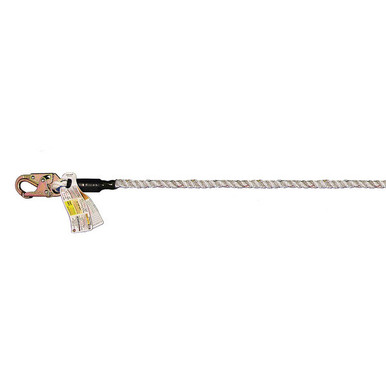
4020 3-Strand Value Lifeline with Snaphook
The Super Anchor 4020 Value Lifeline is a 5/8 inch 3-strand polyester vertical lifeline with a minimum tensile strength of 9,900 lb and a professionally swaged class 1 snaphook on the A-end. The aluminum swage carries a 5,000 lb minimum strength under a clear PVC cover, the snaphook has a 3,600 lb gate strength, and every lifeline ships in a retail box with the instruction manual and a permanently attached PID label system.
What is included: one 4020 Value Lifeline with swaged snaphook, in your choice of 25, 30, 50, 75, or 100 ft lengths. The 4020 accepts every SAS 5/8 inch rope grab, including the SuperGrab, ValueGrab, 4015-M, and 4015-Z, and is rated for fall arrest, fall restraint, and work positioning for one worker at 310 lb. Compliant with OSHA 1926.502 and ANSI Z359.1.
Who Needs This Product
Roofers, framers, painters, and maintenance crews who need a dependable vertical lifeline at a working price. Pick the length for the roof: 25 or 30 ft covers most single family homes, 50 ft handles larger residential and light commercial, and 75 or 100 ft runs full commercial slopes. Connect the snaphook A-end to an OSHA or ANSI compliant anchor, add the SAS rope grab that matches your work style, and connect to a full body harness through a personal energy absorber. One person use including tools, at up to 310 lb, for fall arrest, fall restraint, and work positioning.
Features
Swaged snaphook termination
The class 1 snaphook is professionally swaged into the lifeline with a 5,000 lb minimum strength aluminum sleeve, not tied or spliced by hand.
Accepts every SAS rope grab
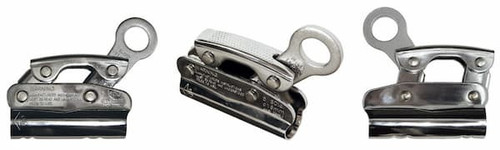
SuperGrab, ValueGrab, 4015-M Integral Adjuster, and 4015-Z Fall Arrester all run on the 4020 per the SAS compatibility table.
9,900 lb polyester rope
5/8 inch 3-strand polyester with a maximum elongation of 10 percent at 1,800 lb.
Serialized label system
PID label with serial number, inspection record, and warnings is permanently attached to every lifeline.
Five stock lengths
25, 30, 50, 75, and 100 ft boxed lengths cover residential through commercial slopes.
Wide temperature range
Specified for working temperatures from -30 F to 130 F.
Technical Specifications
| Model | 4020 Value Lifeline |
|---|---|
| Lengths | 25, 30, 50, 75, 100 ft |
| Rope | 5/8 inch (16 mm) 3-strand polyester |
| Minimum Tensile Strength | 9,900 lb |
| Maximum Elongation | 10% at 1,800 lb |
| A-End Termination | Class 1 snaphook, 3,600 lb gate strength, aluminum swage with 5,000 lb minimum strength and clear PVC cover |
| B-End | Adhesive shrink tube finish; limiter knot required in use |
| User Capacity | 1 person, 310 lb maximum including tools and equipment |
| Maximum Free Fall | 6 ft |
| Specified Use | Fall arrest, fall restraint, work positioning |
| Working Temperature | -30 F to 130 F |
| Rope Grab Compatibility | SAS 4015 SuperGrab, 4015-V ValueGrab, 4015-M Integral Adjuster, 4015-Z Fall Arrester |
| Compliance | OSHA 1926.502; ANSI Z359.1-07/15-14; connectors ANSI Z359.12-2009, CSA Z259.12-11 |
A limiter knot is required with all SAS lifelines. Tie the knot below the rope grab position to gauge free fall length and prevent the grab from sliding off the rope end. Keep the lifeline away from sharp edges, cutting tools, electrical sources, open flame, hot asphalt, adhesives, solvents, paints, and chemicals that damage polyester, and never tie lifelines together or wrap them around framing as an anchor.
Compliance Standards
OSHA 1926.502
Meets federal construction criteria for vertical lifelines in personal fall arrest systems.
ANSI Z359.1-07/15-14
Lifeline complies with the ANSI fall protection code cited in the SAS Lifeline Manual 05-2024.
ANSI Z359.12-2009 Connector
The swaged snaphook is a class 1 connector with 3,600 lb gate strength, also meeting CSA Z259.12-11.
Serialized Traceability
Permanent PID label with serial number, model, and inspection record on every lifeline.
Typical Applications
Installation Overview
Rigging figures, rope grab installation, and the length of fall plan worksheet are in the SAS Lifeline Manual 05-2024 linked below. The basics:
- Connect the snaphook A-end only to an OSHA or ANSI compliant anchorage device specified for fall protection use.
- Install your rope grab with the direction arrow or prussic wraps oriented per its manual, toward the lifeline A-end.
- Connect the rope grab to a personal energy absorber, and the absorber to the harness dorsal D-ring.
- Tie a limiter knot below the rope grab position to gauge free fall length and prevent disengagement at the rope end.
- Calculate the length of fall: free fall plus grab deceleration, absorber deployment, harness stretch, and a 24 inch clearance margin.
- Perform the snaphook function tests and lifeline inspection before each use.
Inspection and Retirement
Inspect before installation and each use, with documented annual inspections. Remove the equipment from service when any of the following apply:
- Strands are cut, hocked, abraded, or show heat damage.
- The eye thimble is deformed or missing, or the swage is cracked or loose.
- The PID or inspection label is missing.
- The limiter knot is missing, or a knot is tied above the rope grab; correct before use.
- The snaphook fails the gate lock, gate open, or gate close function tests.
- The lifeline was subjected to a free fall or has exceeded its service life.
Tag equipment removed from service to prevent further use until inspected by a qualified or competent person.
 Fall Protection
Distributors, LLC Free Tool · No Signup · OSHA 1926.502 Free Interactive Tool Fall Protection Calculator Pick your system. Run the math. Generate a plan. 1Pick Your SystemDetermine fall restraint vs. fall arrest based on your work surface, edge access, and clearance. 2Run the MathCalculate exact fall clearance required below the work surface for your SRL or lanyard setup. 3Generate a PlanGet a printable OSHA-compliant Fall Protection Plan structured around 29 CFR 1926.502(k).
Frequently Asked Questions
Super Anchor 4020 Submittals and Documentation
SAS Synthetic Lifelines Manual 05-2024 (PDF)Lifeline model specifications, rope grab compatibility, limiter knot requirements, lock tests, and length of fall calculations. Lifelines Compatibility with Rope Grabs (PDF)Standard and reverse rigging diagrams, lifeline material specifications, and rope grab pairing table. Rope Grabs Instruction/Specification Manual (PDF)Rope grab types, performance specifications, function tests, and inspection requirements for SAS 5/8 inch lifelines. Lifeline Reverse Rigging Manual 2015 (PDF)Reverse rigging instructions, PPE requirements, and compatibility table for SuperGrab and ValueGrab rope grabs. Super Anchor Warranty and Compliance Statement (PDF)Manufacturer warranty terms and compliance statement for Super Anchor Safety products.Compatible and Related Products
- Super Anchor SuperGrab 4015 Rope Grabs. Prussic grab that pairs with every 4020 length.
- Super Anchor 4015-V ValueGrab Rope Grabs. Prussic grab with factory swaged snaphook.
- Super Anchor 4015-M Mechanical Rope Grabs. Dual cam mechanical grab for the 4020.
- Super Anchor RS-10 2813 Roof Anchors. Permanent retrofit anchors for the lifeline A-end.
Not Sure Which Lifeline Length You Need?
Send us the roof measurements and anchor locations and we will size lifeline lengths, grabs, and absorbers for the whole crew in one order with accurate freight, based on the delivery location.
Call 863-703-4522 to talk to a fall protection specialist.
Super Anchor Safety Manufacturer Warranty
Super Anchor Safety (SAS) warrants to the purchaser that all products are free from defect in material and workmanship at the time of shipment. This warranty is limited to product replacement for a period of one (1) year from the date of installation or use by the owner, provided that this period shall not exceed two (2) years from the date of shipment. This warranty only covers defects in material and workmanship. It does not cover conditions resulting from normal wear, neglect, abuse, or accident. This product warranty does not cover oxidation of zinc, dacromet, or powder coatings used on permanent and temporary anchors that results from connector abrasion unless the coating can be shown to be defective at the time of purchase. This warranty is non-transferable. Any unused defective product will be replaced at no charge by returning the product to Super Anchor Safety or to the distributor the product was purchased from.
Permanent Anchor Warranty
Super Anchor Safety warrants to the purchaser that all anchors sold as a permanent fixture with Hot Dip Galvanizing, Stainless Steel, and Thermo-Plastic finishes are fully warranted against failure due to defects in materials or workmanship for a period of five (5) years from the date of initial installation. SAS does not warranty the installation or flashing system used to waterproof the anchors. The SAS factory warranty is void if the product has been modified or has not been used in accordance with SAS specifications and instructions for that product. Anchors that have been removed from service due to re-roofing or remodel of the structure they were originally attached to must be inspected by an SAS factory representative or a competent person before being reinstalled.
See the Super Anchor Warranty and Compliance Statement (PDF) for the full manufacturer document.