


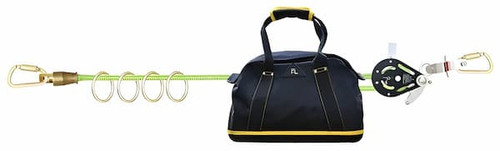
HLK1004 4-Person 100 ft Adjustable Horizontal Lifeline Kit
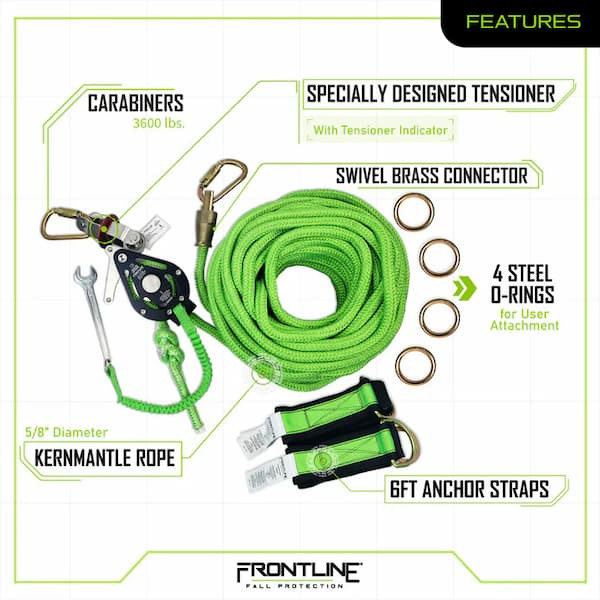
One length of high-strength 5/8 inch kernmantle rope protects up to four workers along any span from 15 to 100 feet. The integrated aluminum and stainless steel pulley and tensioner sets with a single included spanner, and the swiveling tension indicator spins freely the moment the line reaches correct working tension - visual confirmation the system is ready for use. A factory-sewn swivel brass connector keeps the rope from twisting and tangling.
Let us provide a free custom quote for your Permanent Horizontal Lifeline project. HLL Quote Request Form
Four high-strength steel O-ring mobile anchors ride the line as connection points, with pass-through carriages that let workers cross each other without disconnecting. The kit includes two 6 ft cross-arm anchor straps, two locking carabiners, and a carry bag that doubles as rope storage during use. Minimum breaking strength 5,620 lbs. SATRA-certified to EN 795:2012 Type C and CEN/TS 16415:2013 Type C, conforming to ANSI Z359.1-2007 and OSHA 1910 and 1926.
Who Needs This Product
This product is a temporary horizontal lifeline (HLL) kit - the anchorage portion of a fall protection system for crews working along an edge. Strung between two anchor points, it gives up to four workers continuous horizontal mobility without disconnecting and re-anchoring. Each worker still wears a full body harness connected by a shock-absorbing lanyard or self-retracting lifeline (SRL) to one of the O-rings or pass-through carriages. The HLK1004 is not a complete fall arrest system on its own.
Features
One line, four workers, 100 feet
A single-span lifeline that adjusts from 15 ft to 100 ft and supports four simultaneous users - no intermediate anchors and no separate setups per worker.
Tool-light tensioning you can see
The tensioner sets with the included 0.944 in (24 mm) open-end spanner. When the tension indicator plate spins freely, the line is at correct working tension.
Swivel brass connector
Factory-sewn swivel end prevents the rope from twisting and tangling during installation and use.
Pass-through carriages
Workers can cross each other along the line without ever disconnecting - each stays tied off at all times.
Anchor straps included
Two 6 ft cross-arm anchor straps and two locking carabiners create end anchorages on structural beams where no fixed anchor exists.
Bag doubles as rope storage
The carry bag stays connected and stows the unused rope during use, protecting it from cuts, abrasion, and contaminants.
Kit Components
| Component | Description |
|---|---|
| Lifeline rope | 100 ft of 5/8 in (16 mm) kernmantle rope, virgin synthetic fiber, with factory-sewn swivel brass connector. |
| Tensioner and pulley | Aluminum and stainless steel, highly corrosion resistant, with integrated swiveling tension indicator. |
| Mobile anchors | Four high-strength steel O-rings with pass-through carriages for crossing without disconnecting. |
| Anchor straps | Two 6 ft cross-arm anchor straps for creating end anchorages on structural members. |
| Carabiners | Two locking carabiners for the end connections. |
| Tensioning spanner | 0.944 in (24 mm) open-end spanner - the only tool the system needs. |
| Carry bag | Duffel-style bag with carry handles and integrated rope storage during use. |
Technical Specifications
| SKU | HLK1004 |
|---|---|
| Anchor type | Type C (flexible / horizontal anchor line) |
| Maximum users | 4 simultaneous users (personal fall arrest or restraint) |
| User capacity | 130 to 310 lb per worker (including clothing, tools, and equipment) |
| Minimum breaking strength | 5,620 lb |
| Span coverage | 15 ft minimum to 100 ft maximum (single span) |
| Required anchor strength | 5,000 lb minimum (fall arrest); 3,375 lb minimum (restraint) |
| Rope | 5/8 in (16 mm) kernmantle rope, virgin synthetic fiber, contrasting sewing thread |
| Tensioner / pulley | Aluminum and stainless steel with integrated swiveling tension indicator |
| Mobile anchor points | 4 high-strength steel O-rings with pass-through carriages |
| Anchorage connectors | (2) 6 ft cross-arm anchor straps and (2) locking carabiners, included |
| End connector | Swivel brass connector to prevent rope twisting |
| System weight | 20.5 lbs (plus or minus 0.2 lbs) |
| Estimated service life | 10 years from date of manufacture, subject to inspection results |
| Compliance | OSHA 1910/1926; ANSI Z359.1-2007; EN 795:2012 Type C; CEN/TS 16415:2013 Type C |
Horizontal Lifeline Deflection Chart by Span and Number of Users
Total fall clearance must include line deflection below plus lanyard length, energy absorber extension, worker height, and a minimum safety factor. Values are from the Frontline HLK1004 user instruction manual. Worked example for a 50 ft span with 2 workers and a 6 ft shock-absorbing lanyard: 9.65 ft deflection + 6.56 ft lanyard + 3.28 ft absorber extension + 5.00 ft worker height + 3.28 ft safety clearance = 27.77 ft total clearance required below the anchor. A Qualified Person must verify clearance for each specific setup.
| Span Length | 1 User | 2 Users | 3 Users | 4 Users |
|---|---|---|---|---|
| 15 ft | 3.87 ft | 4.30 ft | 3.87 ft | 3.87 ft |
| 20 ft | 4.33 ft | 4.82 ft | 4.36 ft | 4.36 ft |
| 25 ft | 5.28 ft | 5.91 ft | 5.31 ft | 5.31 ft |
| 30 ft | 5.74 ft | 6.43 ft | 5.81 ft | 5.81 ft |
| 35 ft | 6.69 ft | 7.51 ft | 6.76 ft | 6.76 ft |
| 40 ft | 7.15 ft | 8.04 ft | 7.25 ft | 7.25 ft |
| 45 ft | 8.07 ft | 9.09 ft | 8.20 ft | 8.20 ft |
| 50 ft | 8.56 ft | 9.65 ft | 8.69 ft | 8.69 ft |
| 55 ft | 9.48 ft | 10.70 ft | 9.65 ft | 9.65 ft |
| 60 ft | 9.94 ft | 11.22 ft | 10.14 ft | 10.14 ft |
| 65 ft | 10.89 ft | 12.30 ft | 11.12 ft | 11.12 ft |
| 70 ft | 11.35 ft | 12.83 ft | 11.58 ft | 11.58 ft |
| 75 ft | 12.30 ft | 13.95 ft | 12.56 ft | 12.56 ft |
| 80 ft | 12.76 ft | 14.44 ft | 13.02 ft | 13.02 ft |
| 85 ft | 13.68 ft | 15.49 ft | 14.01 ft | 14.01 ft |
| 90 ft | 14.14 ft | 16.01 ft | 14.50 ft | 14.50 ft |
| 95 ft | 15.06 ft | 17.06 ft | 15.49 ft | 15.49 ft |
| 100 ft | 15.52 ft | 17.59 ft | 15.98 ft | 15.98 ft |
Use limits. Both anchor structures must support 5,000 lbs (3,375 lbs for restraint-only use), verified by a Qualified Person. The line and both anchors must be above the user's head. One attachment per O-ring or carriage. Never use the system for fall arrest and restraint simultaneously. After any fall event, remove the entire system from service for manufacturer or manufacturer-approved inspection.
Compliance Standards
ANSI Z359.1-2007
American National Standards Institute safety requirements for personal fall arrest systems, subsystems, and components.
EN 795:2012 Type C
European standard for anchor devices using flexible horizontal anchor lines - SATRA-certified.
CEN/TS 16415:2013 Type C
European technical specification extending EN 795 to multi-user anchor devices - rated here for up to 4 users.
OSHA 29 CFR 1910 and 1926
General industry and construction fall protection, including horizontal lifeline design under qualified-person supervision per 1926.502(d)(8).
Typical Applications
Installation Overview
Installation must follow the Frontline user manual and be supervised per OSHA 1926.502(d)(8). The sequence below is an overview only.
- Verify anchors. Both anchor structures must support a 5,000 lb impact load (3,375 lbs restraint-only), confirmed by a Qualified Person.
- Plan the run. Keep the lifeline overhead and as in-line with the work as possible to eliminate swing-fall hazards.
- Load the tensioner. Loosen the housing-cover knob, route the rope around the pulley, realign the cover plate, and re-tighten fully.
- Connect end one. Clip the swivel connector to the first anchor point with a locking carabiner - use a 6 ft cross-arm strap where no fixed anchor exists.
- Connect end two. Clip a locking carabiner through the tension indicator eye to the second anchor point and pull the slack out by hand.
- Tension. Turn the tensioner nut with the included 24 mm spanner until the tension indicator plate spins freely - the system is at working tension.
- Stow the rope. Feed unused rope back into the attached bag to protect it during the shift.
- Connect workers. Each worker (max 4) connects a shock-absorbing lanyard or SRL from their harness to an O-ring or pass-through carriage after verifying fall clearance including deflection.
Inspection and Retirement
Inspect every component before each use. A competent person inspects formally on a documented interval, typically every 6 months under ANSI Z359.2. Pull the system out of service for any of the conditions below.
- Rope: cuts, abrasion, burns, chemical attack, glazing, flat spots, or exposed core fibers.
- Tensioner and pulley: cracks, deformation, corrosion, or a tension indicator that does not swivel freely at working tension.
- O-rings and carriages: deformation, sharp edges, cracks, or corrosion.
- Carabiners: gates close and lock fully under spring tension; no rollout exposure.
- Anchor straps: cut, abraded, or burned webbing; damaged wear pads or D-rings.
- Labels: legible and intact, with date of first use recorded.
Retirement triggers: any fall event on the system (entire system goes to the manufacturer or a manufacturer-approved repair entity for inspection), rope or hardware damage, service life beyond 10 years from manufacture, or any condition where the inspector cannot positively verify the system is fit for service.
 Fall Protection
Distributors, LLC Free Tool · No Signup · OSHA 1926.502 Free Interactive Tool Fall Protection Calculator Pick your system. Run the math. Generate a plan. 1Pick Your SystemDetermine fall restraint vs. fall arrest based on your work surface, edge access, and clearance. 2Run the MathCalculate exact fall clearance required below the work surface for your SRL or lanyard setup. 3Generate a PlanGet a printable OSHA-compliant Fall Protection Plan structured around 29 CFR 1926.502(k).
Frequently Asked Questions
Frontline HLK1004 Submittals and Documentation
Frontline HLK1004 Spec Sheet (PDF)Materials, breaking strength, span coverage, anchorage requirements, and the full compliance summary. Frontline HLK1004 SATRA Lab Test Report (PDF)Independent SATRA Technology Centre test results to EN 795:2012 Type C and CEN/TS 16415:2013. Frontline HLK1004 User Instruction Manual (PDF)Installation, tensioning, deflection tables, inspection, and retirement procedures.Compatible and Related Products
- Frontline HCLL260 Elite 2-Person 60 ft Cable Horizontal Lifeline. Retractable galvanized cable HLL with built-in winch tensioner.
- SSRA3 Anchor Plate Bundle for Standing Seam Horizontal Lifelines. End anchorages for HLL spans on standing seam metal roofs.
- SSRA 100 ft Horizontal Lifeline Kit. Complete standing seam HLL package with anchors and plates.
- Frontline RO-CAL Commercial Roof Anchor. Permanent CAL-OSHA certified end anchorage for HLL spans.
Buying a Horizontal Lifeline for a Crew?
Need help specifying the right system for your jobsite? Confirm your application, anchorage, and clearance with us and we will walk through the kit list so the right equipment ships together.
Call 863-703-4522 to talk to a fall protection specialist.


