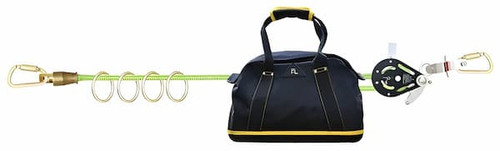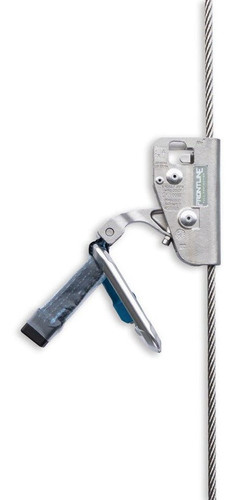


Elite 2-Person 60 ft Cable Horizontal Lifeline
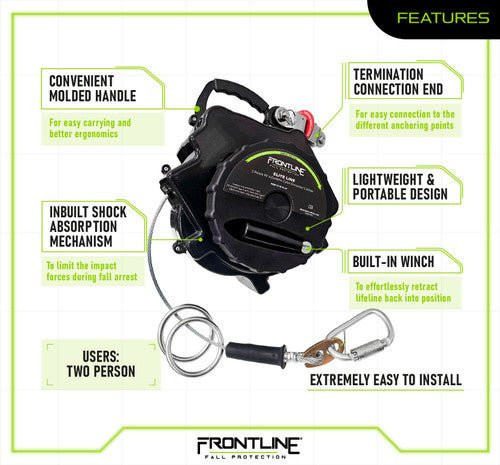
The HCLL260 is Frontline's flagship temporary horizontal lifeline: 60 feet of 1/4 inch 7x19 galvanized steel wire rope in a high-strength polymer housing, with a built-in winch tensioner and a rotating tension indicator that tells the crew at a glance when the line is ready for use. A push-button mechanism extends and retracts the cable to the exact span you need, and the inbuilt shock absorption mechanism limits impact forces during fall arrest.
Let us provide a free custom quote for your Permanent Horizontal Lifeline project. HLL Quote Request Form
Two high-strength alloy steel O-ring mobile anchors ride the line as connection points for up to two workers at 310 lbs each. System breaking strength is over 5,000 lbs. Compliant with OSHA 29 CFR 1910 and 1926 and conforming to EN 795:2012 Type C and TS 16415:2013 Type C for up to 2 users.
Who Needs This Product
This product is a temporary horizontal lifeline (HLL) - the anchorage portion of a fall protection system. Strung between two suitable anchor points, it gives up to two workers continuous horizontal mobility along a 60 ft span without disconnecting and re-anchoring. Each worker still wears a full body harness connected to one of the O-ring mobile anchors by an energy-absorbing lanyard or self-retracting lifeline (SRL). The HCLL260 is not a complete fall arrest system on its own.
Features
Built-in winch with tension indicator
Crank the integrated winch to tension the line; when the rotating tension indicator moves freely, the system has reached working tension and is ready for use.
Retractable cable design
Push the release button, pull the wire rope to the span you need, and winch it back into the compact case when the job is done. No loose cable to coil, kink, or lose.
Inbuilt shock absorption
An internal energy-absorbing mechanism limits the impact forces transmitted to workers and anchor structure during fall arrest.
High-strength polymer housing
Durable, lightweight case stands up to jobsite-to-jobsite transport at a portable 34.5 lbs, with a molded handle for easy carrying and better ergonomics.
Two O-ring mobile anchors
High-strength alloy steel O-rings travel the line as the connection points for each worker's lanyard or SRL.
Termination connection end
Dedicated termination end with carabiner makes connection to the anchorage points straightforward on both ends of the span.
Technical Specifications
| Series | Elite Line |
|---|---|
| SKU | HCLL260 |
| Users | 2 (maximum two persons on the system) |
| User capacity | 310 lb per person (worker, clothing, tools, and equipment combined) |
| Lifeline | 7x19 galvanized steel wire rope, 1/4 in diameter |
| Wire rope length | 60 ft (maximum span) |
| System breaking strength | Over 5,000 lb |
| Housing | High-strength polymer |
| Mobile anchors | 2 high-strength alloy steel O-rings |
| Tensioning | Built-in winch with rotating tension indicator |
| Dimensions | 13 in L x 13.5 in H x 11 in W |
| Weight | 34.5 lbs |
| European standards | EN 795:2012 Type C; TS 16415:2013 Type C (for up to 2 users); ATEX 2014/3 |
| OSHA alignment | 29 CFR 1910; 29 CFR 1926 |
Anchorage and clearance. Both end anchor points must meet the strength requirements in the Frontline user manual for a 2-person horizontal lifeline. A horizontal lifeline deflects (sags) during fall arrest - the longer the span, the more it deflects - so always add the system deflection to your personal fall clearance calculation before anyone ties off.
Compliance Standards
OSHA 29 CFR 1926
Construction industry fall protection, Subpart M (1926.500-503), including horizontal lifeline design under qualified-person supervision per 1926.502(d)(8).
OSHA 29 CFR 1910
General industry walking-working surfaces and personal fall protection systems (Subparts D and I).
EN 795:2012 Type C
European standard for anchor devices using flexible horizontal anchor lines.
TS 16415:2013 Type C
European technical specification extending EN 795 to anchor devices used by more than one user simultaneously - rated here for up to 2 users.
Typical Applications
Installation Overview
Installation must follow the Frontline user manual and be supervised per OSHA 1926.502(d)(8). The sequence below is an overview only.
- Inspect. Check the wire rope, housing, winch, tension indicator, carabiners, and labels before every installation.
- Select anchorages. Choose two end anchor points at a suitable height and spacing (up to 60 ft) that meet the manual's strength requirements for a 2-person system.
- Connect the termination end. Attach the termination connection end to the first anchorage.
- Extend the line. Press the release button and pull the cable to the second anchorage; connect the carabiner.
- Tension. Crank the built-in winch until the rotating tension indicator spins freely - the system is now at working tension.
- Connect workers. Each worker (max 2) connects an energy-absorbing lanyard or SRL from their harness to an O-ring mobile anchor, after verifying fall clearance including line deflection.
Inspection and Retirement
Inspect every component before each use. A competent person inspects formally on a documented interval, typically every 6 months under ANSI Z359.2 practice. Pull the system out of service for any of the conditions below.
- Wire rope: broken wires, kinks, bird-caging, flattening, corrosion, or damaged terminations.
- Housing: cracks, impact damage, missing fasteners, or any deformation of the polymer case.
- Winch and release: mechanism must extend, retract, and hold tension smoothly with no slipping.
- Tension indicator: must rotate freely at working tension and show no damage.
- Carabiners and O-rings: gates close and lock fully under spring tension; no cracks, deformation, or corrosion.
- Labels: legible and intact, with date of first use recorded.
Retirement triggers: any fall event on the system, evidence of shock absorber deployment, wire rope or housing damage, or any condition where the inspector cannot positively verify the system is fit for service.
 Fall Protection
Distributors, LLC Free Tool · No Signup · OSHA 1926.502 Free Interactive Tool Fall Protection Calculator Pick your system. Run the math. Generate a plan. 1Pick Your SystemDetermine fall restraint vs. fall arrest based on your work surface, edge access, and clearance. 2Run the MathCalculate exact fall clearance required below the work surface for your SRL or lanyard setup. 3Generate a PlanGet a printable OSHA-compliant Fall Protection Plan structured around 29 CFR 1926.502(k).
Frequently Asked Questions
Frontline HCLL260 Submittals and Documentation
Frontline HCLL260 Spec Sheet (PDF)Dimensions, weights, materials, rope specifications, and the full feature and compliance summary. Frontline HCLL260 User Instruction Manual (PDF)Installation, anchorage requirements, tensioning, inspection, and retirement procedures.Compatible and Related Products
- Frontline HLK1004 4-Person 100 ft Adjustable Horizontal Lifeline Kit. Kernmantle rope HLL for up to 4 workers with 6 ft anchor straps.
- SSRA3 Anchor Plate Bundle for Standing Seam Horizontal Lifelines. End anchorages for HLL spans on standing seam metal roofs.
- SSRA 100 ft Horizontal Lifeline Kit. Complete standing seam HLL package with anchors and plates.
- Frontline RO4W Multifunction 4-Way Anchor. Fastened end anchorage option for metal, wood, and concrete per the manual.
Buying a Horizontal Lifeline for a Crew?
Need help specifying the right system for your jobsite? Confirm your application, anchorage, and clearance with us and we will walk through the kit list so the right equipment ships together.
Call 863-703-4522 to talk to a fall protection specialist.