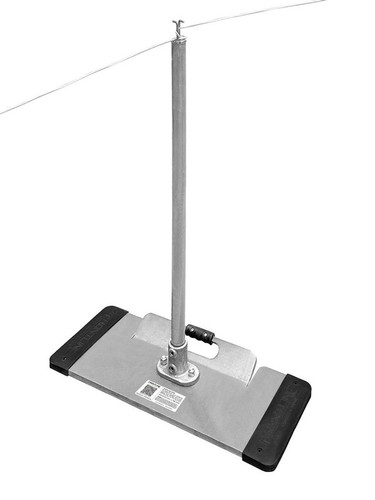


What Sets the WLS16 Apart
System Components
The WLS16 platform separates the load-bearing stanchion from the cable hardware so you can spec the right length for the perimeter you need to mark. The stanchion ships fully assembled. Cable, flags, clips, and thimbles can be ordered as a kit with the stanchion or sourced separately.
Technical Specifications
| Specification | Detail |
|---|---|
| Model | Frontline WLS16 Warning Line System |
| Type | Non-penetrating roof-top warning line stanchion (cross-leg base) |
| Stanchion Weight | 41 lb (Spec Sheet, Rev. May 2024) |
| Stanchion Height | 39 in (per Frontline product listing); base footprint 47 in L x 47 in W x 40 in H (Spec Sheet) |
| Material | High-strength ASTM-rated steel, electrostatic safety yellow powder coat finish |
| Surface Protection | Rubber pads on bottom of each cross leg |
| Cable Height Range | Minimum 34 in (lowest point including sag), maximum 39 in (per OSHA 1926.502(f)(2)(ii) and User Manual) |
| Maximum Stanchion Spacing | 24 ft between posts on a single run (User Manual Installation Step 6) |
| Maximum Flag Spacing | 6 ft, including from the stanchion (OSHA 1926.502(f)(2)(i)) |
| Cable Tensile Requirement | 500 lb minimum tensile strength (OSHA 1926.502(f)(2)(iv)); WLS16-CABLE316 sized accordingly |
| Stanchion Tip Resistance | 16 lb horizontal force at 30 in above walking surface without tipping (verified at Intertek, see Test Report) |
| Assembly Hardware | (1) 1/2 in x 2 1/2 in hex bolt, (1) washer, (1) nut; assembled with 3/4 in hex socket |
| Compatible Accessories | WLS16-FLAG, WLS16-CABLE316, WLS16-CLIP, WLS16-THIMBLE (sold separately or as kits) |
| Application | Low-slope roofs (4 in 12 or less), flat working surfaces, non-penetrating warning line barrier |
| Certification Standard | Client Specified Testing referencing OSHA 1926.502(f)(2)(iii) |
| OSHA Compliance | Meets or exceeds OSHA 29 CFR 1926.502(f) and 29 CFR 1910.28 / 1910.29 |
| Test Lab | Intertek Testing Services NA Inc., 3933 US Route 11, Cortland, NY 13045 |
| Test Report Reference | 105938082CRT-013, issued September 27, 2024 (testing performed September 26, 2024) |
| Manufacturer | Frontline Fall Protection Inc., 6 Lee Blvd, Malvern, PA 19355 |
| User Manual Revision | Rev. February 2026 |
| Spec Sheet Revision | Rev. May 2024 |
Kit Selection
Order the stanchion alone if you already have compatible cable, flags, and end hardware. Otherwise, match the kit length to the linear footage of your warning-line perimeter, keeping in mind that stanchions can be placed up to 24 ft apart.
| Variant | Includes | Typical Use |
|---|---|---|
| Stanchion Only | (1) WLS16 stanchion with cross-leg base and assembly hardware | Add to existing inventory, replace damaged unit, or use with cable already on hand |
| Stanchion + 24 ft Kit | (1) WLS16 stanchion plus 24 ft of WLS16-CABLE316 with flags, clips, and thimbles | Spot perimeters, single-edge runs between two stanchions |
| Stanchion + 96 ft Kit | (1) WLS16 stanchion plus 96 ft of WLS16-CABLE316 with flags, clips, and thimbles | Medium-sized roof sections, multi-stanchion perimeters |
| Stanchion + 1000 ft Kit | (1) WLS16 stanchion plus 1000 ft of WLS16-CABLE316 with flags, clips, and thimbles | Full commercial low-slope roof perimeters and large staging areas |
The WLS16 is a passive awareness barrier. It alerts workers that they are approaching an unprotected edge. It does not stop a fall and is not rated to take the load of a person leaning, sitting, or falling against it.
Workers on the unprotected side of the line (between the line and the edge) must be protected by a guardrail system, personal fall arrest system, safety net, or other OSHA-acceptable fall protection per 29 CFR 1926.501.
Compliance & Certification
Right Tool. Right Job.
How to Install the WLS16 in 7 Steps
The full procedure is in the WLS16 User Instruction Manual (Rev. February 2026). The condensed version below assumes a trained installer working on a flat, dry, low-slope surface at least 18 inches inside any fall hazard and at least 10 feet from any energized line.
- Plan the perimeter. Lay out the warning line perimeter at least 6 ft from any unprotected roof edge (10 ft on edges perpendicular to mechanical equipment travel). Confirm the substrate is flat, dry, and free of gravel or slope.
- Assemble the cross legs. Lay the bottom stanchion leg flat. Insert the supplied 1/2 in x 2 1/2 in hex bolt with washer and nut through the underside hole.
- Stack the upper leg. Lay the upper stanchion leg over the bottom leg and the hex bolt so the cross is square, and the rubber pads contact the surface.
- Drop in the post stanchion. Insert the post stanchion male tabs into the female openings on the upper leg. Hold the bolt from below and tighten with a 3/4-in hex socket or impact driver until the post stands upright.
- Flag the cable. Run WLS16-CABLE316 through WLS16-FLAG markers spaced no more than 6 ft apart, using high-visibility flagging that stays legible from working distance.
- Connect to stanchions. Thread the flagged cable through the warning line connection point at the top of each stanchion. Keep the lowest point (including sag) no lower than 34 in and no higher than 39 in from the walking surface. Posts no more than 24 ft apart.
- Terminate the runs. At the start and end of each run, form a loop, seat a WLS16-THIMBLE inside it, and clamp with WLS16-CLIPS until firmly captured. Verify pulling one section does not pull slack from the next.
Inspection & Retirement
Warning line systems take incidental contact from tools, materials, and weather every day they are deployed. Routine inspection catches problems before they let a worker through the line at the wrong moment.
Pre-Use Inspection (Every Use)
Before each shift, confirm each stanchion stands upright at a true 90 degrees with the cross legs flat on the surface. Verify that the cable's lowest point is at or above 34 in and its highest point is at or below 39 in. Confirm visibility flags are present at intervals of 6 ft or less, including from the stanchion. Look for cracks, dents, deformed legs, missing bolts, missing rubber pads, and corrosion on any component. Confirm the perimeter is at least 6 ft from the unprotected edge (10 ft on edges perpendicular to mechanical equipment travel).
Competent Person Inspection (Minimum Every 6 Months)
A Competent Person, as defined in 29 CFR 1926.32(f), must perform and document a full inspection at least every six months. The inspection covers permanent deformation of any leg or post; weld integrity at the cross-leg joint; condition of the warning line connection point at the top of the stanchion; bolt tension on the 1/2-in hex assembly; label legibility; and any signs of unauthorized field modification. Log results on the inspection checklist included in the User Manual.
Inspection After Impact
If a stanchion has been struck, knocked over, dropped from height, or hit by mechanical equipment, remove it from service until a Competent Person inspects and clears it. Tip-force performance depends on the geometry of an undeformed cross-leg base.
Retirement for Damage
Retire any stanchion with cracked welds, bent posts or legs that will not sit flat, missing or torn rubber pads that compromise base friction, severe corrosion that has pitted the steel, or any deformation that prevents the post stanchion from seating fully vertical in the cross-leg openings. Retire any cable showing fraying, kinks, or damaged thimble terminations.
Cleaning and Storage
After exposure to rainwater, concrete slurry, paint, or construction debris, clean each component with mild soap and water and dry before storage. Equipment exposed to chemicals that cannot be removed with soap and water must be retired. Store disassembled or fully assembled in a clean, indoor, room-temperature space away from sunlight, rain, and chemical contaminants.
Setback & Use Limits
Warning lines are not a substitute for fall arrest near the edge. OSHA 29 CFR 1926.502(f) requires warning lines to be set back at least 6 ft from any unprotected roof edge when mechanical equipment is not in use, and at least 6 ft (parallel) or 10 ft (perpendicular) from edges when mechanical equipment is in use. No worker is permitted between the line and the edge unless that worker is actively performing roofing work and is otherwise protected per 1926.501.
For fall-arrest connector sizing for workers operating outside the warning line, use our Fall Protection Clearance Calculator.
Frequently Asked Questions
Frontline WLS16 Submittal Documents
The following manufacturer documents are available for download to support procurement, safety planning, jobsite submittals, and Competent Person inspection records.
| Document | Description | Download |
|---|---|---|
| Frontline WLS16 Spec Sheet | One-page reference covering material, dimensions, weight, color, application, and the OSHA 1926 / 1910 standards the system addresses. Spec sheet revision May 2024. | Frontline WLS16 Spec Sheet (PDF) |
| Frontline WLS16 Test Report | Five-page Intertek test report covering the 16 lb horizontal tip force test referencing OSHA 1926.502(f)(2)(iii), with calibration data and pass/fail result. Report 105938082CRT-013. | Frontline WLS16 Test Report (PDF) |
| Frontline WLS16 User Instruction Manual | Full manufacturer manual covering definitions, warnings, training requirements, installation, OSHA setback rules, repair and maintenance, labels, and the Competent Person inspection checklist. Rev. February 2026. | Frontline WLS16 User Manual (PDF) |