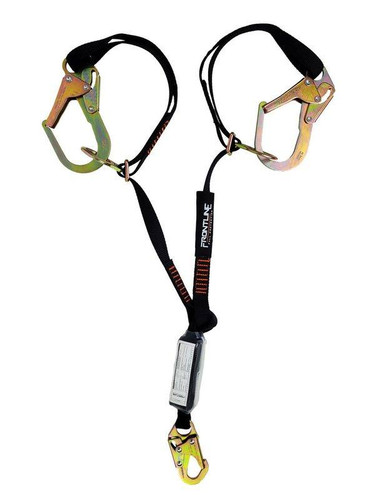


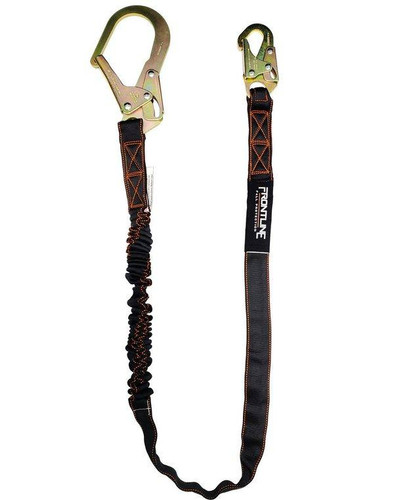
LIS61R Combat 6 ft Single Leg Rebar Hook Lanyard, 2-Pack
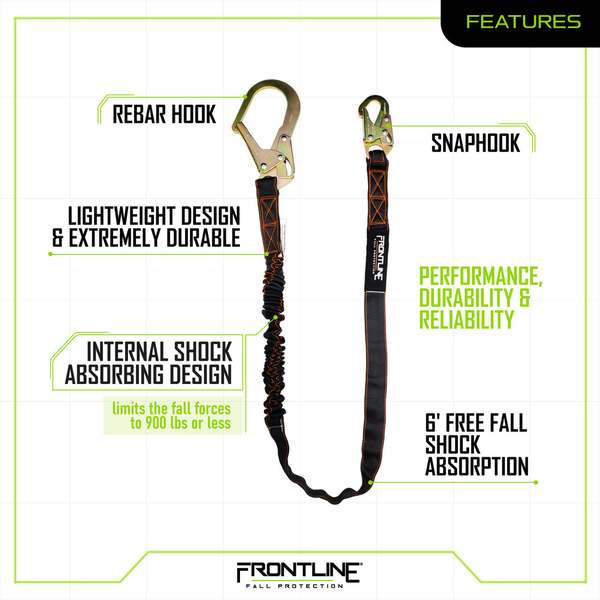
The Frontline LIS61R is a 6 ft single leg shock absorbing lanyard built around an internal energy absorber: 1.57 in polyester tubular webbing with the absorber integrated inside the web, so there is no bulky external pack to snag. The harness end carries a steel stamped snap hook; the anchor end carries a steel rebar hook for wrapping rebar, angle, and pipe.
Hardware is alloy steel, zinc plated and shot blasted, with a 5,000 lb minimum breaking strength; the polyester webbing carries 6,000 lbs, sewn with high-tenacity polyester thread. Rated for one worker up to 310 lbs, and built to ANSI Z359.13-2013 and ANSI A10.32-2004, aligning with OSHA 1926 and 1910.
Who Needs This Product
This product is a fall arrest connecting device - the link between a full body harness and an anchorage connector. Construction crews, steel erectors, and maintenance workers use shock absorbing lanyards where an SRL is not practical and the fall clearance below the work surface allows the absorber to deploy. You still need a harness and a rated anchor to complete the system.
Features
Internal energy absorber
The absorber is integrated inside the tubular webbing - no external shock pack to snag or abrade.
Rebar hook anchor end
A large-throat steel rebar hook connects directly over rebar, angle iron, and pipe.
Textile loop terminations
Sewn loops at both ends keep the connection compact and reduce hardware weight.
1.57 in tubular webbing
Polyester webbing rated to 6,000 lbs, sewn with high-tenacity polyester thread.
Anchorage-grade hardware
Alloy steel hooks, zinc plated and shot blasted, rated to 5,000 lbs.
Compact and light
At about 2.5 lbs it hangs off the harness all shift without fighting you.
Technical Specifications
| SKU | LIS61R |
|---|---|
| Type | Single leg internal shock absorbing lanyard, 6 ft |
| Webbing | Polyester tubular, 1.57 in wide |
| Webbing breaking strength | 6,000 lbs |
| Hardware | Alloy steel, zinc plated, shot blasted |
| Hardware breaking strength | 5,000 lbs |
| Stitching | High-tenacity polyester thread |
| Length | 6 ft |
| Weight | Approx. 2.5 lbs |
| Max capacity | 310 lbs (one worker) |
| Standards | ANSI Z359.13-2013; ANSI A10.32-2004; OSHA 1926; OSHA 1910 |
Clearance is everything with a shock absorbing lanyard. The energy absorber needs room to deploy below the work surface - account for free fall distance, absorber elongation, harness stretch, and worker height before trusting any tie-off point. Run the Fall Protection Calculator below, and keep the free fall within the limits in the Frontline manual.
Compliance Standards
ANSI Z359.13-2013
American National Standard for personal energy absorbers and energy absorbing lanyards. Third-party test report linked in Submittals.
ANSI A10.32-2004
Fall protection requirements for construction and demolition operations.
OSHA 29 CFR 1926.502
Federal construction fall protection criteria, including connecting device requirements.
OSHA 29 CFR 1910.140
General industry personal fall protection system requirements.
Typical Applications
How to Use the LIS61R Lanyard
Follow the manufacturer's manual. The sequence below is an overview only.
- Inspect. Check webbing, absorber, stitching, and both hooks before each use.
- Verify clearance. Confirm total fall clearance including absorber deployment - run the calculator below.
- Connect to the harness. Attach the harness end to the dorsal D-ring of a full body harness.
- Connect to the anchor. Attach the anchor end to a rated anchorage connector at or above the D-ring where possible.
- Check the gates. Confirm both hooks are fully closed and locked.
- Limit free fall. Work so free fall stays within the limits in the Frontline manual.
Inspection and Retirement
Inspect before each use, with a documented competent-person inspection at least every 6 months. Pull the equipment from service for any of the conditions below.
- Webbing: cuts, fraying, abrasion, burns, chemical damage, or stiffness.
- Energy absorber: deployment, torn cover, or a tripped impact indicator.
- Stitching: broken, pulled, or abraded threads at terminations.
- Hooks: deformation, cracks, corrosion, or gates that fail to close and lock.
- Markings: labels must be present and legible.
Retire the lanyard immediately after any fall arrest event - the energy absorber is single-use - or if any inspection point fails. Destroy retired equipment so it cannot return to service.
 Fall Protection
Distributors, LLC Free Tool · No Signup · OSHA 1926.502 Free Interactive Tool Fall Protection Calculator Pick your system. Run the math. Generate a plan. 1Pick Your SystemDetermine fall restraint vs. fall arrest based on your work surface, edge access, and clearance. 2Run the MathCalculate exact fall clearance required below the work surface for your SRL or lanyard setup. 3Generate a PlanGet a printable OSHA-compliant Fall Protection Plan structured around 29 CFR 1926.502(k).
Frequently Asked Questions
Frontline LIS61R Submittals and Documentation
Frontline LIS61R Spec Sheet (PDF)Webbing, hardware, strength ratings, and standards. LIS61R-2PK Frontline LIS User Manual (PDF)Use, limitations, free fall limits, inspection, and retirement for the LIS lanyard family. Frontline LIS61R Test Report (PDF)Third-party test results to ANSI Z359.13-2013. LIS61R-2PK Frontline Catalog (PDF)The full Frontline Fall Protection product catalog with the complete anchor, lanyard, and SRL range.Compatible and Related Products
- Frontline 100CTB Combat Construction Harness. The construction harness this lanyard clips into.
- Frontline MPS Cross Arm Strap. A wrap-around anchorage connector for beams and trusses.
- Frontline ROB01 Bull Ring Roof Anchor. A reusable roof anchor to complete the system.
Building Out Fall Arrest Systems for Your Crew?
Need help matching lanyards, harnesses, and anchors? Confirm your application, anchorage, and clearance with us and we will walk through the kit list so the right equipment ships together.
Call 863-703-4522 to talk to a fall protection specialist.