

Product Video

Unbox the kit on video: the American style harness, anchor, and 50 ft vertical lifeline that come in the bucket, and how they work together on the roof.
What Sets the RK5PTB50-AM Apart
What is in the Kit
The complete kit ships in the carry bag. Every component is listed below with its model number for replacement-part ordering and inspection records.
Technical Specifications
| Specification | Detail |
|---|---|
| Model | Frontline RK5PTB50-AM Combat American Style Complete Roofers Kit with 50-foot VLL |
| Tier | Combat American Style (lightweight components, American flag graphic harness webbing, Made-in-USA visual identity) |
| Harness Included | 100VTB-UN-AM universal-sizing full-body harness with American flag graphic |
| Harness Webbing | Polyester with American style graphic webbing |
| Harness Hardware | Aluminum, lightweight |
| Harness Adjustability | 5-point: chest pass-through buckles, tongue-buckle leg straps, back support strap, sub-pelvic strap, elastic loops |
| Fall Indicator | On shoulder strap |
| Harness Breaking Strength | Greater than 5,000 lb (Spec Sheet) |
| Anchor Included | RO01 hinged reusable roof anchor (8-hole nail flap, nails not specified included; verify with manufacturer) |
| Anchor Material | High-strength galvanized steel with powder-coated finish |
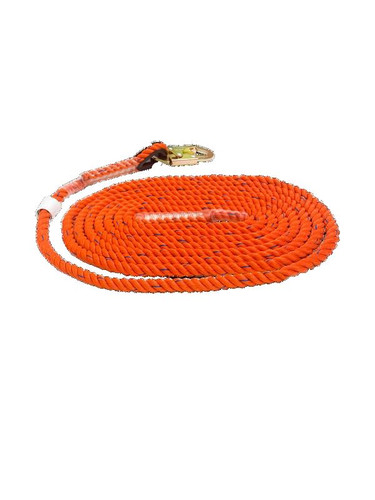
| Vertical Lifeline Included | VLP50R3L-AM 50-foot polysteel rope, 5/8-inch diameter, snap hook one end + stop knot other end |
| Rope Grab | Steel, self-locking when not adjusted, integrated shock pack |
| Snap Hook | Stamped steel |
| Carry Bag | RKBAG-AM American style duffel bag |
| Complete Kit Breaking Strength | 5,000 lb minimum (Spec Sheet) |
| Maximum User Capacity | 310 lb (single user, including clothing and tools) |
| Standards | ANSI Z359.11-2014, Z359.18-2017, A10.32-2004; OSHA 29 CFR 1926 and 1910 |
| Independent Lab Testing | ISO/IEC 17025:2017 accredited 3rd-party lab |
| Manufacturer | Frontline Fall Protection Inc., 6 Lee Blvd, Malvern, PA 19355 |
The RK5PTB50-AM is designed and tested for use by ONE person at a time with a combined weight (worker plus clothing, tools, and equipment) not exceeding 310 pounds. Do not exceed rated capacity. Do not share the system between users on the same lifeline at the same time.
All users must be trained in personal fall arrest system use, harness donning, anchor installation, rope grab operation, and fall clearance calculation before stepping on a roof with this kit.
Compliance & Certification
Right Kit. Right Job.
How to Don and Set Up the RK5PTB50-AM in 7 Steps
The full procedure is in the Frontline Roofer Kit User Manual. The condensed version below assumes a trained user installing on a wood-framed roof with a planned work zone and rescue plan in place.
- Inspect every component. Before each use, inspect the harness, vertical lifeline rope, rope grab, snap hook, shock pack, and roof anchor. Check for cuts, fraying, broken stitching, corrosion, deformation, missing fall indicator, and proper hardware function. Pull the kit and tag for inspection by a Competent Person if any component fails inspection.
- Install the RO01 roof anchor. Position the hinged RO01 anchor at the peak or chosen anchorage location. Adjust the hinge to fit the roof pitch. Nail the anchor through every nail hole into the underlying wooden structural member (rafter or truss). Confirm all nails are fully driven and the anchor sits flush.
- Don the harness. Hold the harness by the back D-ring with the front of the harness facing away from you. Step into the leg straps, pull the harness up, and slip the shoulder straps over your arms one at a time. Connect and adjust the chest strap (quick-connect or pass-through depending on kit). Adjust leg straps with tongue or quick-connect buckles for a snug fit. Confirm all straps lie flat and the back D-ring sits between your shoulder blades.
- Connect the vertical lifeline to the anchor. Pass the snap hook end of the vertical lifeline through the forged D-ring of the RO01 anchor. Verify gate closure and that the connection is fully seated. Confirm the rope hangs cleanly down the roof slope without twists.
- Install the rope grab on the lifeline. Open the rope grab per the kit's specific design (slide-on for standard kits, or unscrew-and-thread for the RGSS58ES openable rope grab in the Premium kit). Confirm the rope grab orientation arrow points UP toward the anchor. Verify the double-locking closing mechanism engages and the unit cannot accidentally open under load.
- Connect the shock-pack lanyard to the harness. The integrated shock pack lanyard exits the rope grab and ends in a snap hook. Attach that snap hook to the dorsal (back) D-ring on the harness. Verify the gate closes and locks fully. Pull the connection to confirm it is seated.
- Set fall clearance before stepping out. Calculate the required fall clearance below the anchor based on the deceleration distance of the shock pack, lanyard length, your height, and the depth of the working surface. Position the rope grab so that you cannot fall past the edge or strike a lower level. Re-check the rope grab position each time you change work areas on the roof.
Inspection & Retirement
Roofer kits see weather, sun, tool contact, and rooftop debris every shift. Pre-use inspection and periodic Competent Person inspection keep the system field-ready and protect every user.
Pre-Use Inspection (Every Use)
Before each use, inspect the harness webbing for cuts, fraying, burns, chemical damage, and broken stitching. Inspect hardware for cracks, deformation, corrosion, and proper buckle function. Inspect the vertical lifeline rope along its entire length for cuts, fraying, melting, or chemical damage. Inspect the rope grab for smooth operation, proper closing-mechanism lock, and a clean shock pack with no signs of activation. Inspect the RO01 roof anchor for cracks, bent flaps, missing nails, or corrosion.
Competent Person Inspection (Minimum Every 6 Months)
A Competent Person, as defined in 29 CFR 1926.32(f), must perform and document a full inspection at least every six months. The inspection covers all of the pre-use items plus stitching integrity per ANSI Z359.11, hardware load-bearing surfaces, shock pack visual integrity, rope grab disassembly and lubrication per manufacturer schedule, and any signs of unauthorized field modification.
Inspection After Fall Arrest or Impact
If any component has arrested a fall or sustained significant impact, remove the entire kit from service until a Competent Person inspects every component. The harness fall indicator on the back straps or shoulder strap will tear or display a colored marker if arrest forces have been transmitted through the harness.
Retirement for Damage
Retire the harness immediately for any cuts, burns, frayed webbing greater than the manufacturer's threshold, broken stitching, deformed hardware, or tripped fall indicator. Retire the vertical lifeline for cuts, fraying, melt damage, chemical exposure, or activated shock pack. Retire the rope grab for cracked housing, malfunctioning closing mechanism, or activation marks. Retire the RO01 anchor for cracked welds, bent base flaps, severe corrosion, or any deformation visible to the naked eye.
Cleaning and Storage
After use, wipe the harness and lifeline with mild soap and water and air dry away from direct heat or sunlight. Do not lubricate the rope grab or any synthetic webbing. Store the dry kit in the carry bag in a clean, room-temperature space away from sunlight, solvents, chemicals, and direct heat.
Fall Clearance & Use Limits
The RK5PTB50-AM is a personal fall arrest system. Required fall clearance below the worker depends on the anchor height, vertical lifeline length, rope grab position, shock pack deceleration distance, worker height, and any obstructions or lower levels below the working surface. Calculate fall clearance BEFORE stepping on the roof and re-check each time you change work zones.
 Fall Protection
Distributors, LLC Free Tool · No Signup · OSHA 1926.502 Free Interactive Tool Fall Protection Calculator Pick your system. Run the math. Generate a plan. 1 Pick Your System Determine fall restraint vs. fall arrest based on your work surface, edge access, and clearance. 2 Run the Math Calculate exact fall clearance required below the work surface for your SRL or lanyard setup. 3 Generate a Plan Get a printable OSHA-compliant Fall Protection Plan structured around 29 CFR 1926.502(k).
Frequently Asked Questions
Frontline RK5PTB50-AM Submittal Documents
The following manufacturer documents are available for download to support procurement, safety planning, jobsite submittals, and Competent Person inspection records.
| Document | Description | Download |
|---|---|---|
| Frontline RK5PTB50-AM Spec Sheet | One-page reference covering harness, roof anchor, 50-foot vertical lifeline, and duffel bag of the American style kit. Lists material specs and ANSI Z359.11, Z359.18, A10.32 compliance. | Frontline RK5PTB50-AM Spec Sheet (PDF) |
| Frontline RK5PTB50-AM Test Report | Frontline test report covering the RK5PTB50-AM complete kit components. Confirms 5,000-pound breaking strength and 310-pound maximum user capacity. Independent 3rd-party lab accredited to ISO/IEC 17025:2017. | Frontline RK5PTB50-AM Test Report (PDF) |
| Frontline Roofer Kit User Manual | Frontline Roofer Kit user instruction manual covering kit assembly, harness donning, anchor installation, vertical lifeline rigging, rope grab use, inspection, retirement, fall clearance, and rescue planning. | Frontline Roofer Kit User Manual (PDF) |