
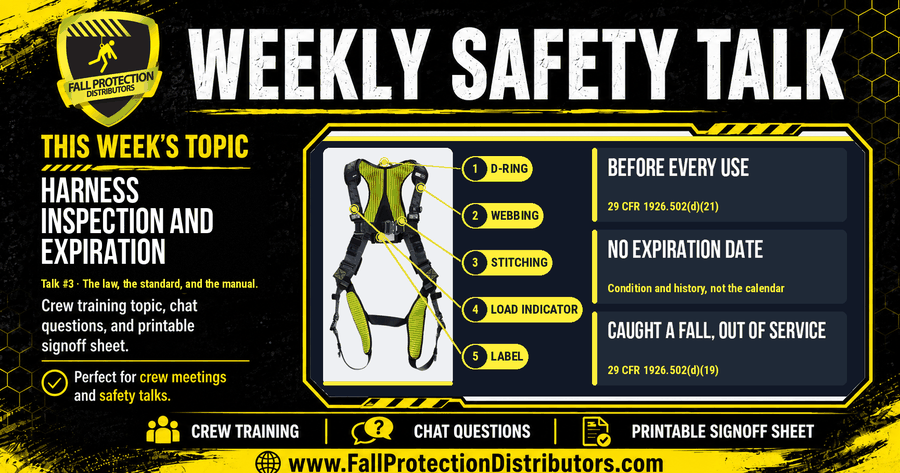
Harness Inspection (Talk #3)
Posted by Howie Scarboro - COO- Fall Protection Distributors, LLC on Aug 7th 2026
By Howie Scarboro, COO, Fall Protection Distributors, LLC · Last verified against the eCFR, osha.gov, and manufacturer documentation: July 29, 2026
For information purposes only. This page supports your safety planning; it does not replace professional judgment. All safety plans and fall protection decisions for the task must be reviewed and approved by a Competent Person or a Qualified Person before work begins, as required by OSHA.
How Often Must Safety Harnesses Be Inspected? The Quick Answer
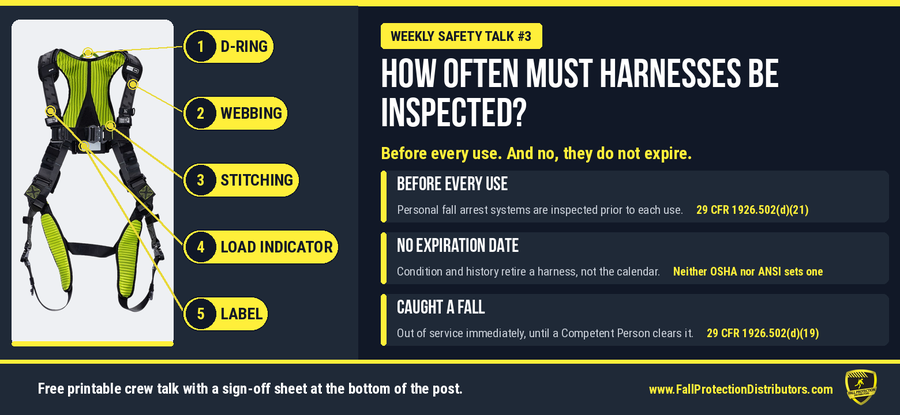
Quick answer: Under federal OSHA, a personal fall arrest system (PFAS) must be inspected before every single use. In construction, that is 29 CFR 1926.502(d)(21); in general industry, 1910.140(c)(18) requires inspection before initial use during each work shift. In addition to the legal minimum, ANSI/ASSP Z359.2 calls for a documented formal inspection by a Competent Person at least annually, and most manufacturers shorten that interval in their own manuals, commonly to every six months depending on use and conditions. And here is the part that surprises most crews: there is no OSHA or ANSI expiration date on a harness. Retirement is based on condition and history, not the calendar, and the one absolute rule is that any harness that has been involved in a worker fall is to be removed from service immediately.
This is Talk #3 of our Weekly Safety Talk series. Talk #1 covered fall protection trigger heights in all 50 states and Talk #2 covered the rules for steep-slope residential roofs. This week we are covering questions about harness inspections: how often does it get inspected, by whom, and when does it retire?
What the Law Actually Requires: Before Every Use
The construction rule is short enough to memorize. Here is the actual text:
"Personal fall arrest systems shall be inspected prior to each use for wear, damage and other deterioration, and defective components shall be removed from service." (29 CFR 1926.502(d)(21))
Notice what that sentence does not say. It does not say weekly, monthly, or annually. It says before each use, and it applies to the whole system: harness, lanyard or lifeline, connectors, and the anchor you are about to rely on. The worker wearing the gear does this daily inspection, every shift, before they clip in. Positioning device systems carry the same requirement under 1926.502(e)(9).
General industry says the same thing in its own words. Under 1910.140(c)(18), personal fall protection systems must be inspected before initial use during each work shift for mildew, wear, damage, and other deterioration, and defective components must be removed from service. So whether your crew is roofing a house under OSHA 1926 or your maintenance tech is on a warehouse mezzanine under OSHA 1910, the legal baseline is identical in practice: the gear gets looked at before it gets used, every workday, and anything defective comes out of service on the spot.
The Three Compliance Layers: Law, Standard, and Manufacturer
There are multiple agencies governing the use of fall protection, so the requirements can be confusing. Let's clarify the regulations to dispel some of the misunderstandings.
| Layer | What it requires | Where it comes from |
|---|---|---|
| OSHA law (mandatory) | Inspection before each use; defective components removed from service; any system that catches a fall is removed immediately. | 29 CFR 1926.502(d)(21) and (d)(19); 29 CFR 1910.140(c)(18) and (c)(17) |
| ANSI Z359 (consensus standard) | Documented inspection by a Competent Person at least annually, in addition to daily pre-use checks; manufacturers commonly shorten the interval to six months, and work conditions can shorten it further. | ANSI/ASSP Z359.2 section 4.4.15, with Z359.11 for the harness itself |
| Manufacturer instructions | Follow the manual: inspection criteria, formal inspection interval, and any service-life guidance for your specific model. |
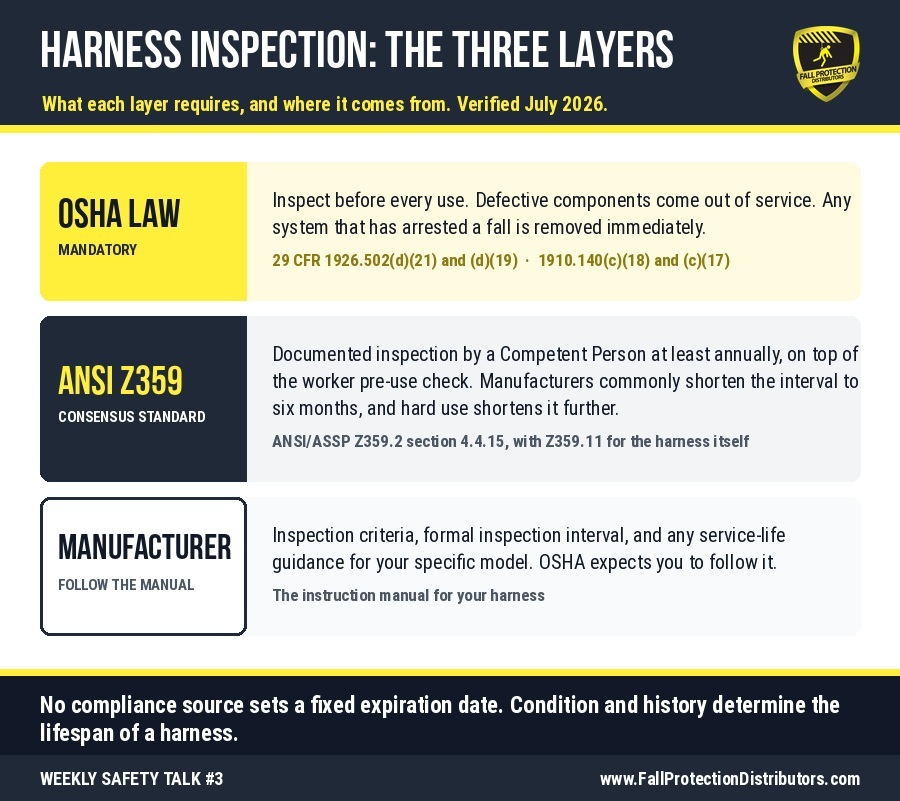
ANSI standards are not law by themselves, but they are how OSHA and the industry define recognized practice, and manufacturers write them into their manuals. This is also where a lot of bad information starts, because the six-month figure gets quoted as though ANSI requires it. It does not. ANSI/ASSP Z359.2 sets the floor at annually and the manufacturers are the ones who shorten it. Either way, if your harness manual calls for a documented Competent Person inspection every six months and you cannot produce a record of one, you have a problem in an incident investigation even though the CFR never printed the words "six months." The path to compliance is simple: workers inspect before every use because the law says so, and a Competent Person runs a documented formal inspection on the schedule set by the manual, because the standard and the manual have the final say.
Do Safety Harnesses Expire? No, but They Must Be Retired Under Certain Circumstances
There is no expiration date printed in OSHA or ANSI for fall protection harnesses. MSA, one of the largest harness manufacturers in the world, states it flat out: there is no such thing as a predetermined or mandated expiration date on fall protection harnesses. The five-year rule you have heard at tailgate meetings is a leftover from older manufacturer guidance and from other countries' regulations.
What actually retires a harness is its condition and its history:
- It caught a fall. Any harness or component subjected to impact loading comes out of service immediately and stays out until a Competent Person inspects it and determines it is undamaged and suitable for reuse (29 CFR 1926.502(d)(19); 1910.140(c)(17)). For a harness that has actually arrested a fall, the practical answer from nearly every manufacturer is replacement.
- Cut, frayed, abraded, or burned webbing. Including heat damage from torch work and friction burns.
- Broken, pulled, or ripped stitching. Partially separated stitching can indicate the harness has been loaded, even if nobody reported a fall.
- Chemical or UV damage. Stiff, faded, or discolored webbing from sun exposure, acids, solvents, or concrete wash.
- Deformed or corroded hardware. Bent D-rings, cracked buckles, tongues that do not seat, corrosion that does not wipe off.
- Deployed load indicators. Most modern harnesses have fold-and-stitch indicators at the dorsal D-ring that tear open under load. Once the load indicator is deployed, the harness is to be removed from service immediately.
- Missing or illegible label. Pull any harness whose label no longer shows the model, date of manufacture, and standards. If you cannot read the label, you cannot verify the gear, and unverified gear does not go on a worker.
The Pre-Use Inspection: A Two-Minute Procedure Can Save Your Life
Malta Dynamics, one of the harness manufacturers we carry, demonstrates this same inspection in the video below.
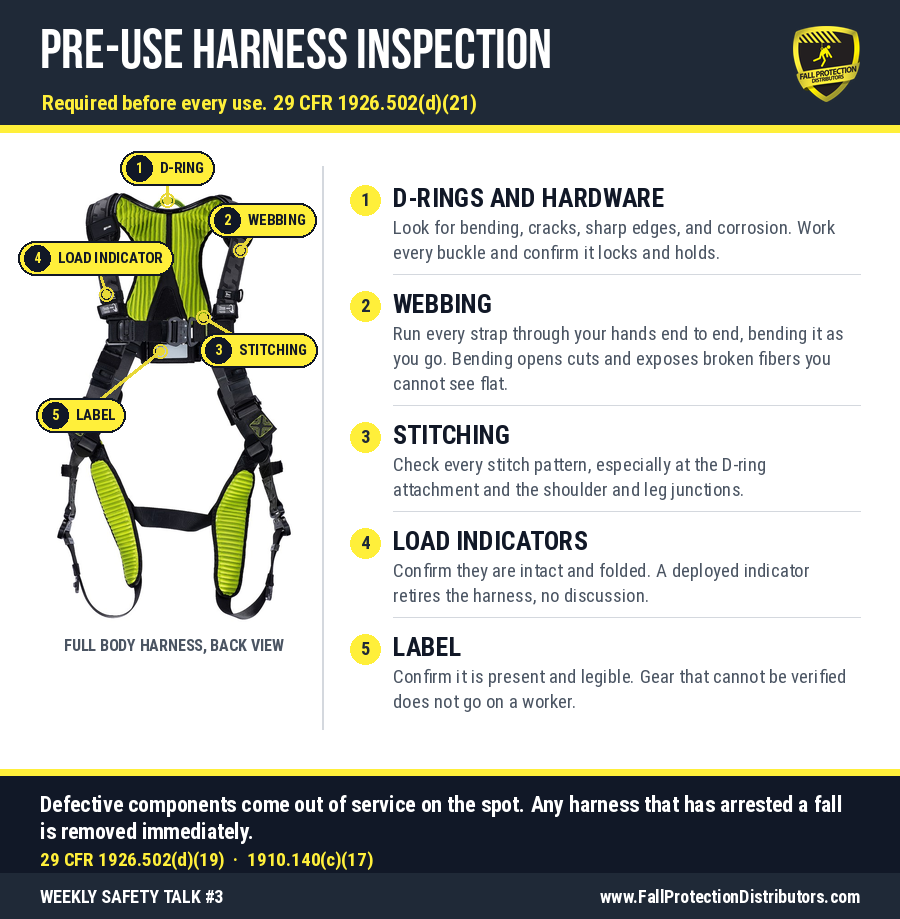
A pre-use inspection is not just a simple glance at the harness. Teach your crew a fixed routine so nothing gets skipped, and have them do it the same way every time. Start at the dorsal D-ring and work the whole harness through your hands:
- D-rings and hardware: look for bending, cracks, sharp edges, and corrosion; work every buckle and confirm it locks and holds.
- Webbing: run every strap through your hands end to end, bending it as you go; bending opens cuts and exposes broken fibers you cannot see flat.
- Stitching: check every stitch pattern, especially at the D-ring attachment and the shoulder and leg junctions.
- Load indicators: confirm they are intact and folded.
- Label: confirm it is present and legible.
- The rest of the system: the law says the system, not just the harness, so the lanyard or SRL, the connectors, and the anchor point get the same attention before anyone clips in. Our harness lineup, lanyards, and SRLs all ship with the manufacturer inspection criteria in the manual; keep those manuals on file.
While you are at it, check the harness fit on the intended worker. Since January 13, 2025, OSHA's construction PPE rule requires equipment to properly fit each worker who wears it (29 CFR 1926.95(c)), so the inspection habit and the fit check belong in the same two-minute procedure. A perfect harness adjusted wrong will still hurt somebody.
The Formal Inspection: What the Competent Person Does Differently
The formal inspection is the same physical examination done slower, by a designated Competent Person, with two additions the pre-use check does not have: written documentation and authority. It gets recorded, with the harness identified by serial number and date of manufacture from the label, the date of inspection, the inspection results, and the inspector's name. And the Competent Person has the authority to pull gear from service on the spot, which is why OSHA defines the role as someone capable of identifying hazards and authorized to take prompt corrective action. Run the formal inspections on the interval your manufacturer's manual sets, log every harness every time, and store the log where you can produce it. If an inspector or an insurance adjuster ever asks for your equipment inspection records, that log and your signed training sheets are the first two documents out of the folder.
Our free fillable harness inspection form is the same one on our resources page: straps, D-rings, load indicator, and label, with space for the serial number, date, result, and inspector name. Keep one per harness.
The free printable inspection checklist at the bottom of this post gives you both layers on one page: the pre-use routine for the crew and a formal inspection log table for the Competent Person, with a sign-off section that satisfies the written documentation habit. Print one per harness or one per crew, whichever best suits your operation.
Storage and Care Between Inspections
Inspection catches damage; storage prevents it. Hang harnesses by the dorsal D-ring in a dry place out of sunlight, away from chemical and heat sources. Do not leave them baking on the dash or marinating in a wet gang box, because UV and mildew both retire webbing early, and mildew is specifically called out in the general industry rule (1910.140(c)(18)). Clean the harness regularly according to the manual's procedures with mild soap and water, never solvents. Gear that gets hung up dry after every shift passes inspections for years; gear that lives on the truck floor can fail in just a few months.
Equipment Failures Are Expensive
Fall protection violations top OSHA's citation list every year, and equipment condition is one of the easiest things for an inspector to check: they pick up a harness and look at it. In 2026, a serious violation runs up to $16,550 and a willful or repeat violation up to $165,514 (OSHA penalties). A new full-body harness costs a fraction of an OSHA fine. Replacing worn gear is the cheapest insurance against fines, injuries, and potential fatalities.
Frequently Asked Questions
How often does OSHA require safety harness inspections?
The simple answer is before every use. In construction, 29 CFR 1926.502(d)(21) requires personal fall arrest systems to be inspected before each use for wear, damage, and other deterioration. In general industry, 29 CFR 1910.140(c)(18) requires inspection before initial use during each work shift. Defective components come out of service immediately.
Do safety harnesses expire?
No. Neither OSHA nor ANSI sets an expiration date for fall protection harnesses, and major manufacturers state there is no predetermined expiration. Harnesses are retired on condition and history: damage found at inspection, a deployed load indicator, an unreadable label, or any fall arrest. Follow your manufacturer's manual for model-specific service-life guidance.
Is the five-year harness replacement rule real?
Not in OSHA or ANSI. The five-year figure comes from older manufacturer guidance and from regulations in other countries, and that rumor spread because it is easy to remember. Condition determines retirement, not age. A five-year-old harness that has been properly stored and passes inspection can be compliant while a six-month-old harness that has been abused and damaged must be removed from service.
Who can perform the formal harness inspection?
A Competent Person: someone capable of identifying existing and predictable hazards and authorized to take prompt corrective action, including removing gear from service. ANSI/ASSP Z359.2 calls for that documented formal inspection at least annually, and most manufacturer manuals shorten it, commonly to every six months depending on use severity. It is in addition to the worker's pre-use check.
What happens to a harness after it catches a fall?
It comes out of service immediately. Under 29 CFR 1926.502(d)(19) and 1910.140(c)(17), any system or component subjected to impact loading is removed from service. It cannot be used again until a Competent Person inspects it and determines it is undamaged and suitable for reuse. For a harness that has arrested a fall, nearly every manufacturer's answer is replacement.
Does a harness inspection need to be documented?
The daily pre-use check does not require written documentation under OSHA, though many companies log it anyway. The formal Competent Person inspection should always document the harness serial number, inspection date, result, and inspector name. Our free harness inspection form gives you that record on one page.
What should I look for when inspecting a harness?
Run every strap through your hands checking for cuts, fraying, burns, stiffness, and discoloration; check every stitch pattern, especially at the D-ring; check D-rings and buckles for bending, cracks, and corrosion; confirm load indicators are intact; and confirm the label is legible. Then inspect the rest of the system: lanyard or SRL, connectors, and anchor.
How should harnesses be stored between shifts?
Hung by the dorsal D-ring, dry, out of direct sunlight, away from chemicals and heat. UV, mildew, and chemical exposure are three of the main reasons webbing fails inspection early. Clean with mild soap and water per the manufacturer's manual, never with solvents.
Where is the expiration date on a safety harness?
There is not one, and that is the honest answer to the most common question on this subject. What the label carries is a date of manufacture, along with the model, the serial number and the standards the harness was built to. Service life runs from when the harness is first put into use, not from the date printed on the label, so a harness that sat in the box for a year has not spent a year of its life. If the label is missing or unreadable, the harness comes out of service, because gear you cannot verify does not go on a worker.
How long is a safety harness good for?
As long as it keeps passing inspection. Neither OSHA nor ANSI sets a service life, so there is no number to give you. What ends a harness is condition and history: damage found at inspection, a deployed load indicator, an unreadable label, or any fall arrest. A harness stored properly and inspected on schedule can stay in service for years, and one left in a wet gang box can fail in months. Check your manufacturer's manual, because some of them do publish a service life for a specific model and OSHA expects you to follow the manual you were given.
Does OSHA require an annual harness inspection?
No, and this one gets repeated a lot. OSHA requires inspection before each use in construction (29 CFR 1926.502(d)(21)) and before initial use during each work shift in general industry (29 CFR 1910.140(c)(18)). There is no annual Competent Person inspection anywhere in either standard. The annual documented inspection comes from ANSI/ASSP Z359.2 and from your manufacturer's manual, and the six-month interval you will see quoted comes from the manufacturers rather than from ANSI. Both are worth following. Neither is in the CFR.
Toolbox Quiz: Test Your Crew
Five questions from this week's talk. Run it at the tailgate, let the crew argue, then score it. The one-page printable inspection guide has the pre-use routine, a formal inspection log, and a crew sign-off table for your training records (29 CFR 1926.503(b) requires written certification). It's free, and you don't have to give us an email address to get it.
That is a proper harness inspection procedure: the law says look at it before every use; the standard and your manual add a documented formal inspection on a schedule; OSHA doesn't dictate harness life spans; and anything that caught a fall or fails inspection is done. Print the checklist, put a Competent Person's name on the formal inspections, and keep the log where you can find it. If you have a question about your own gear or a situation on your roof, send it through our contact page; we read every one, and answers may become future talks.
Work safe up there.