
OSHA Trigger Height (Talk #1)
Posted by Howie Scarboro - COO- Fall Protection Distributors, LLC on Jul 28, 2026
By Howie Scarboro, COO, Fall Protection Distributors, LLC · Last verified against the eCFR and state codes: July 23, 2026
For information purposes only. This page supports your safety planning; it does not replace professional judgment. All safety plans and fall protection decisions for the task must be reviewed and approved by a Competent Person or a Qualified Person before work begins, as required by OSHA.
At What Height Is Fall Protection Required? The Quick Answer
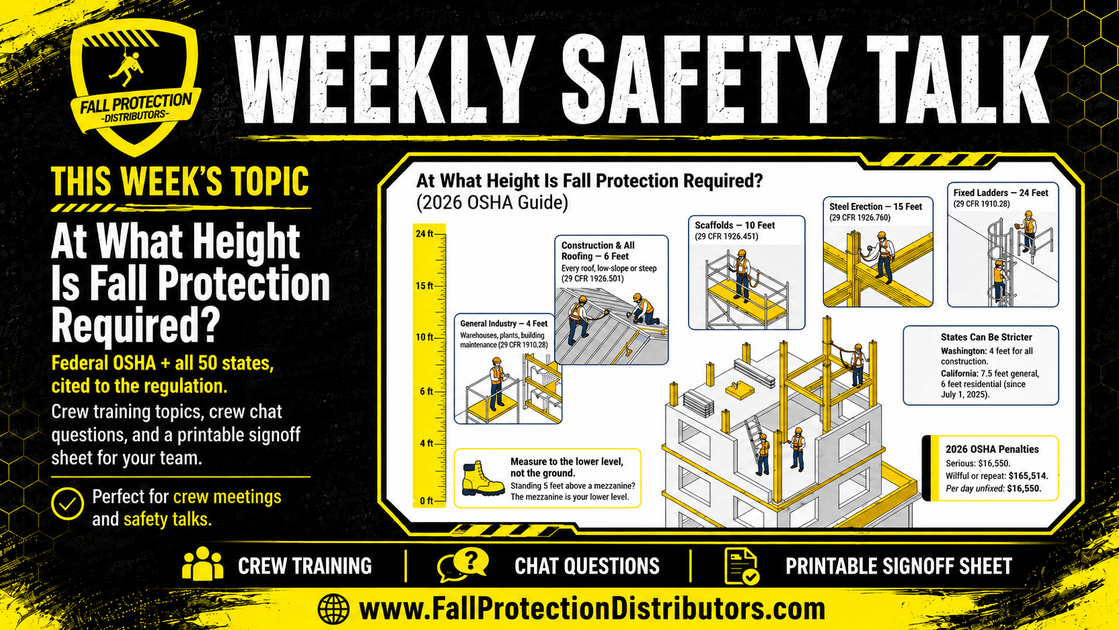
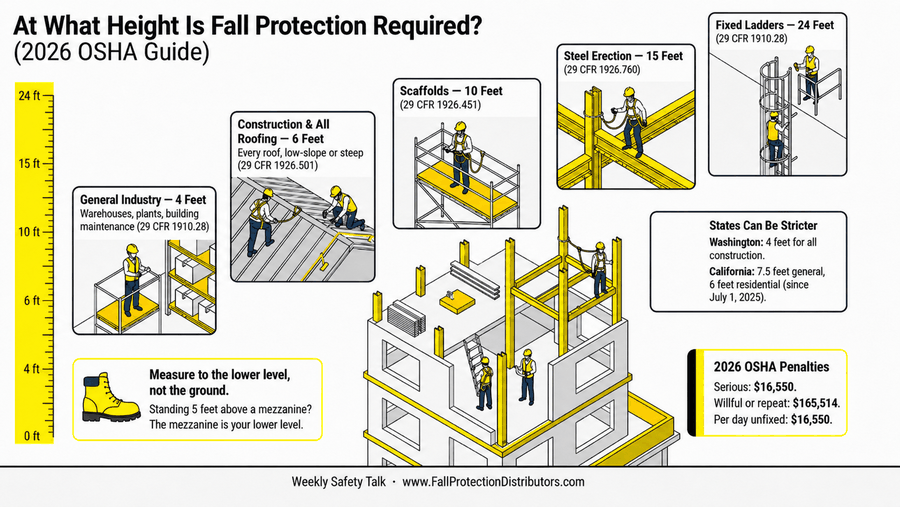
Federal OSHA requires fall protection at 6 feet in construction (29 CFR 1926.501) and 4 feet in general industry (29 CFR 1910.28). Scaffolding triggers at 10 feet, steel erection at 15, fixed ladders at 24. Roofing work, low-slope or steep, is 6 feet. Federal OSHA rules are the basic guidelines; however, Washington requires fall protection at 4 feet for all construction, California's general construction trigger is 7½ feet with residential work now at 6, and 18 other states run their own private-sector OSHA plans. The full answer depends on what you're doing, where on the structure you're standing, and which state you're in.
Jump to: Federal heights by trade · The 6-foot rule · Roofing rules · Roof maintenance zones · Residential · All 50 states · What violations cost · Building a compliant system · FAQ
Federal Trigger Heights, Trade by Trade
Under federal OSHA, the trigger heights break out like this:
| Type of work | Fall protection required at | Regulation |
|---|---|---|
| General industry (warehouses, plants, maintenance) | 4 feet | 1910.28(b)(1) |
| Construction: unprotected sides and edges | 6 feet | 1926.501(b)(1) |
| Roofing: low-slope roofs (4:12 or less) | 6 feet | 1926.501(b)(10) |
| Roofing: steep roofs (steeper than 4:12) | 6 feet | 1926.501(b)(11) |
| Residential construction | 6 feet | 1926.501(b)(13) |
| Holes and skylights | 6 feet | 1926.501(b)(4) |
| Scaffolds | More than 10 feet¹ | 1926.451(g) |
| Steel erection | 15 feet² | 1926.760(a)(1) |
| Fixed ladders (general industry) | 24 feet | 1910.28(b)(9) |
¹ Scaffold erectors and dismantlers get a feasibility exception under 1926.451(g)(2). ² Connectors and workers in controlled decking zones have special rules between 15 and 30 feet; see 1926.760(b) and (c).
Those are the headline numbers. But Subpart M covers special situations:
| Situation | Requirement | Regulation |
|---|---|---|
| Leading edge work | 6 feet | 1926.501(b)(2) |
| Hoist areas | 6 feet | 1926.501(b)(3) |
| Formwork and reinforcing steel | 6 feet | 1926.501(b)(5) |
| Ramps, runways, and walkways | 6 feet | 1926.501(b)(6) |
| Edges of excavations (when not readily visible) | 6 feet | 1926.501(b)(7) |
| Above dangerous equipment | Any height | 1926.501(b)(8) |
| Overhand bricklaying | 6 feet | 1926.501(b)(9) |
| Precast concrete erection | 6 feet | 1926.501(b)(12) |
| Wall openings (inside edge below 39 in.) | 6 feet | 1926.501(b)(14) |
| Boom lifts (aerial lifts) | Tied off at all times | 1926.453(b)(2)(v) |
Working above dangerous equipment such as an auger, a conveyor, or exposed rebar requires protection at any height. Boom lift use requires full tie-off from the moment you leave the ground. Boom lifts are notorious for catapulting workers out, so the lanyard is your lifeline (Scissor lifts are a different animal; see the FAQ.)
These are legal trigger height minimums. A fall from five feet onto concrete can still end a career, and OSHA's injury files are full of falls from under the legal trigger height.
Construction Work: The 6-Foot Rule
The rule for most contractors is 29 CFR 1926.501(b)(1). The actual text reads:
"Each employee on a walking/working surface (horizontal and vertical surface) with an unprotected side or edge which is 6 feet (1.8 m) or more above a lower level shall be protected from falling by the use of guardrail systems, safety net systems, or personal fall arrest systems."
Most inspectors will explain this rule as follows: "6 feet or more above a lower level" means you measure from your boots to the next level down, not to the ground. Standing 5 feet above a mezzanine that sits 20 feet above a warehouse floor? You measure to the mezzanine. Working the edge of that same mezzanine? Now the floor is your lower level, and you're at 25 feet.
The rule provides three worker options: guardrails, safety nets, or a personal fall arrest system. Nets are rare outside big commercial work, and guardrails are expensive to move, so for most crews the real-world answer is a PFAS: harness, connector, anchor. Notice who the rule is written to. "Shall be protected" puts the duty on the employer. Employers have the solemn duty to protect the workers.
Working on a Roof: Low-Slope, Steep, and Skylights
Roofing work gets its own provisions. The trigger stays at 6 feet on every roof, but the pitch determines which methods are allowed.
Low-slope roofs (4:12 or less): 1926.501(b)(10)
On a low-slope roof with edges 6 feet or more above the lower level, you get the most options in Subpart M: guardrails, nets, PFAS, or a warning line combined with one of those or with a safety monitoring system. There's also a provision almost nobody quotes correctly: on roofs 50 feet or less in width, a safety monitoring system alone is permitted, no warning line required. It's right there in (b)(10), and it changes the safety plan for small commercial re-roofs.
Steep roofs (steeper than 4:12): 1926.501(b)(11)
Past 4:12 pitch, there are fewer options: guardrails with toeboards, safety nets, or PFAS. Warning lines and safety monitors are no longer permitted. OSHA understands that workers slipping on steep roofs (especially metal panels) involve sliding and acceleration factors not seen in low-slope roofs.
Penetrations are not permitted through most standing seam roof systems. Therefore, most standing seam roofs require specialized anchors for PFAS attachment. So what do you anchor to when you can't put a hole in a watertight roof? The SSRA1 anchor clamps to the seam with six pairs of set screws, no penetrations are required. We publish the load testing and the panel compatibility chart so you can check your exact profile before you make a purchase.
Skylights are dangerous and require special attention.
Under 1926.501(b)(4), every skylight opening 6 feet or more above a lower level needs a cover, a guardrail, or PFAS. And a skylight is a hole in the roof with a non-structural cover that typically won't stop a falling worker. Workers die every year stepping onto or leaning against skylight domes and covers. Most roofing veterans can tell you skylight accident stories that didn't end well. The best advice is to stay tied off and stay clear of all fall hazards, including skylights.
The Maintenance Trap: 1910.28 Roof Zones
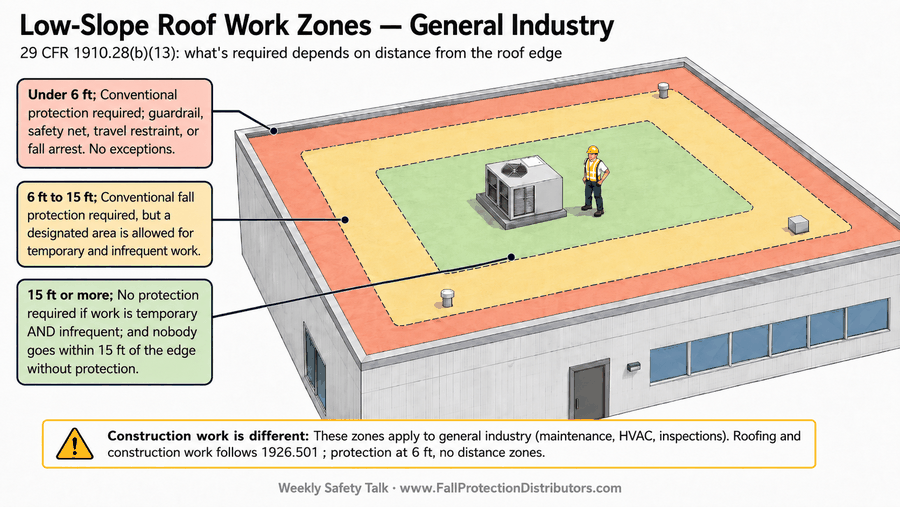
OSHA makes a distinction between Construction work and General Industry operations. If the work on the roof is maintenance rather than construction, you're not under 1926 at all. You're in general industry, and 1910.28(b)(13) creates three work zones by distance from the edge:
- Less than 6 feet from the edge: conventional protection required including guardrails, safety net, travel restraint, or PFAS. No exceptions.
- 6 to less than 15 feet: requires the same conventional protection as the 6-foot zone, except a designated area is allowed if the work is temporary and infrequent.
- 15 feet or more: no fall protection is required, but only when the work is both infrequent and temporary, and the employer enforces a rule keeping everyone 15 feet from the edge.
OSHA purposefully uses the phrase "temporary and infrequent" to describe General Industry work. Changing a filter twice a year qualifies as General Industry maintenance work. A tech who's up there every other week doesn't. OSHA looks at how often the task actually happens and how long it takes. Calling it "routine maintenance" on the work order changes nothing.
The same roof can require different rules based on the type of work being performed. The crew replacing that roof works under 1926.501 with its 6-foot trigger and no distance zones, while the tech servicing the HVAC units works under 1910.28. It is easy to get confused until you realize that the OSHA rules are based on the work, not the roof.
Residential Construction: 6 Feet Trigger Height, and the New Rules Are In Effect
Under 1926.501(b)(13), residential work at 6 feet or more requires guardrails, nets, or PFAS, same as commercial. The reason old-timers resist the updated regulations: from 1995 to 2011, OSHA's interim residential directives were much less strict. OSHA rescinded all of it in 2011 with STD 03-11-002. That was fifteen years ago. If anyone on your crew learned the trade under the old rules, it's time to advise them on the latest rules.
There is one narrow exception. Where conventional protection is genuinely infeasible or would create a greater hazard, 1926.502(k) allows a written, site-specific fall protection plan prepared by a qualified person. It's a real provision, but a demanding one: OSHA treats "infeasible" as a claim you'd better be ready to prove with engineering, and inspectors hold it to a high bar.
Fall Protection Trigger Heights by State: All 50 States
Twenty-one states plus Puerto Rico run their own OSHA-approved plans covering private employers (another seven states have plans covering public employees only). Most enforce the federal trigger heights. Three of the big ones don't, and this is where multi-state contractors can make mistakes if they aren't careful:
- Washington: 4 feet. WAC 296-880-20005 requires fall protection at 4 feet or more for construction work, the strictest general trigger in the country. Full breakdown: Washington fall protection requirements.
- California: 7½ feet general, 6 feet residential. Title 8 §1670 sets the general construction trigger at 7½ feet, and yes, that's higher than federal. But effective July 1, 2025, Cal/OSHA dropped residential work to 6 feet: §1716.2 for framing, and §1731 for residential roofing: 6 feet on slopes up to 7:12, and protection at any height on slopes steeper than 7:12. Commercial roofing didn't change; it still runs under §1730 and its 20-foot rule. The same update also tightened §1671.1: if your fall protection plan uses anything other than conventional methods, it now has to spell out why. Our California guide has the whole picture.
- Oregon: 6 feet, but read the fine print. Oregon writes its own construction code. OAR 437-003-1501 sets the general trigger at 6 feet, with different numbers for specific activities: steel erection at 15 feet, holes and skylights at any height per Oregon OSHA's trigger-height fact sheet. Details: Oregon fall protection requirements.
The table below covers all 50 states. Click yours for the full picture: enforcement office info, recent changes, and the contacts and penalty schedule for your state.
| State | Who enforces | Construction trigger | State guide |
|---|---|---|---|
| Alabama | Federal OSHA | 6 ft | Alabama guide |
| Alaska | State plan (AKOSH) | 6 ft | Alaska guide |
| Arizona | State plan (ADOSH) | 6 ft | Arizona guide |
| Arkansas | Federal OSHA | 6 ft | Arkansas guide |
| California | State plan (Cal/OSHA) | 7½ ft general · 6 ft residential | California guide |
| Colorado | Federal OSHA | 6 ft | Colorado guide |
| Connecticut | Federal OSHA (private sector) | 6 ft | Connecticut guide |
| Delaware | Federal OSHA | 6 ft | Delaware guide |
| Florida | Federal OSHA | 6 ft | Florida guide |
| Georgia | Federal OSHA | 6 ft | Georgia guide |
| Hawaii | State plan (HIOSH) | 6 ft | Hawaii guide |
| Idaho | Federal OSHA | 6 ft | Idaho guide |
| Illinois | Federal OSHA (private sector) | 6 ft | Illinois guide |
| Indiana | State plan (IOSHA) | 6 ft | Indiana guide |
| Iowa | State plan (Iowa OSHA) | 6 ft | Iowa guide |
| Kansas | Federal OSHA | 6 ft | Kansas guide |
| Kentucky | State plan (KY OSH) | 6 ft | Kentucky guide |
| Louisiana | Federal OSHA | 6 ft | Louisiana guide |
| Maine | Federal OSHA (private sector) | 6 ft | Maine guide |
| Maryland | State plan (MOSH) | 6 ft | Maryland guide |
| Massachusetts | Federal OSHA (private sector) | 6 ft | Massachusetts guide |
| Michigan | State plan (MIOSHA) | 6 ft | Michigan guide |
| Minnesota | State plan (MNOSHA) | 6 ft | Minnesota guide |
| Mississippi | Federal OSHA | 6 ft | Mississippi guide |
| Missouri | Federal OSHA | 6 ft | Missouri guide |
| Montana | Federal OSHA | 6 ft | Montana guide |
| Nebraska | Federal OSHA | 6 ft | Nebraska guide |
| Nevada | State plan (Nevada OSHA) | 6 ft | Nevada guide |
| New Hampshire | Federal OSHA | 6 ft | New Hampshire guide |
| New Jersey | Federal OSHA (private sector) | 6 ft | New Jersey guide |
| New Mexico | State plan (NM OHSB) | 6 ft | New Mexico guide |
| New York | Federal OSHA (private sector) | 6 ft · NYC adds local rules | New York guide |
| North Carolina | State plan (NC OSH) | 6 ft | North Carolina guide |
| North Dakota | Federal OSHA | 6 ft | North Dakota guide |
| Ohio | Federal OSHA | 6 ft | Ohio guide |
| Oklahoma | Federal OSHA | 6 ft | Oklahoma guide |
| Oregon | State plan (Oregon OSHA) | 6 ft (state-specific rules) | Oregon guide |
| Pennsylvania | Federal OSHA | 6 ft | Pennsylvania guide |
| Rhode Island | Federal OSHA | 6 ft | Rhode Island guide |
| South Carolina | State plan (SC OSHA) | 6 ft | South Carolina guide |
| South Dakota | Federal OSHA | 6 ft | South Dakota guide |
| Tennessee | State plan (TOSHA) | 6 ft | Tennessee guide |
| Texas | Federal OSHA | 6 ft | Texas guide |
| Utah | State plan (UOSH) | 6 ft | Utah guide |
| Vermont | State plan (VOSHA) | 6 ft | Vermont guide |
| Virginia | State plan (VOSH) | 6 ft | Virginia guide |
| Washington | State plan (WA L&I / DOSH) | 4 ft | Washington guide |
| West Virginia | Federal OSHA | 6 ft | West Virginia guide |
| Wisconsin | Federal OSHA | 6 ft | Wisconsin guide |
| Wyoming | State plan (Wyoming OSHA) | 6 ft | Wyoming guide |
Washington, D.C. falls under federal OSHA (6 feet), and Puerto Rico runs its own OSHA-approved plan. Working in Canada? The Fall Protection Regulations Database also covers all 13 provinces and territories, which run on CSA Z259 standards rather than ANSI. It's free and searchable by scenario, and we keep it verified against the current CFR and against the provincial OHS regulations for Canada. Bookmark it before your next out-of-state bid.
What Ignoring the Trigger Height Actually Costs
Fall protection violations sit at the top of OSHA's citation list, and it isn't close. 1926.501 has been the most-cited standard in America for fifteen consecutive years: 5,914 citations in FY2025 alone. When a compliance officer drives past your job, an unprotected worker on a roof edge is the violation they can spot from the truck.
The 2026 numbers: a serious violation runs up to $16,550, and willful or repeat violations run up to $165,514 each. If you fail to fix it, it's another $16,550 per day. (OSHA normally adjusts these every January for inflation; the 2026 amounts carried over from 2025 because the government shutdown delayed the CPI data the adjustment is calculated from.) And the citation is the cheap part. In 2024, falls, slips, and trips killed 389 construction workers, about 38% of every construction death in the country.
Past the Trigger Height: Building a System That Actually Works
Hitting 6 feet doesn't just mean "put on a harness." A compliant personal fall arrest system has three parts, and skipping any one of them means you don't have a system:
- A: Anchorage. Rated for 5,000 pounds per attached worker, or engineered to a safety factor of two under a qualified person (1926.502(d)(15)). That gutter bracket is not an anchor. The plumbing vent is not an anchor. On a standing-seam roof, a seam clamp like the SSRA1 meets the rating without roof penetrations, and a horizontal lifeline covers multiple workers across wide roof areas.
- B: Body harness. A full-body harness, properly fitted and inspected. Body belts have been banned for fall arrest since 1998. A loose harness is a violation and can further injure a fallen worker. Fit is also a compliance item now, not just a comfort item: since January 2025, OSHA's updated PPE rule (1926.95(c)) requires construction gear to fit each worker who wears it properly.
- C: Connector. A shock-absorbing lanyard or a self-retracting lifeline, keeping arresting force under 1,800 pounds and free fall to 6 feet or less.
Two more requirements come with the gear, and OSHA inspectors commonly ask about both. Every worker exposed to fall hazards must be trained by a competent person under 1926.503: it's a top-10 violation. And 1926.502(d)(20) requires prompt rescue capability: a worker hanging in a harness can lose consciousness from suspension trauma in minutes. Therefore, a rehearsed rescue plan can avoid further injury of a fallen worker and OSHA citations.
Next up: run the fall clearance numbers. A 6-foot shock-absorbing lanyard can need 18 feet or more of clearance below the anchor before it stops you. Off a single-story eave, the clearance is not sufficient even if the system performs properly. Check your setup with our fall clearance calculator before you trust it. At residential heights, the right answer is usually fall restraint: rig the line short so reaching the edge is physically impossible, and the fall never starts.
Frequently Asked Questions
Is the OSHA fall protection height 4 feet or 6 feet?
Both, depending on the work. General industry (warehouses, plants, building maintenance) triggers at 4 feet under 1910.28. Construction, including all roofing, triggers at 6 feet under 1926.501.
At what height do roofers need fall protection?
6 feet above a lower level on any roof, low-slope or steep (1926.501(b)(10) and (b)(11)). Pitch changes which protection methods are legal, not the height.
Is the fall protection height the same in every state?
No. Twenty-one states plus Puerto Rico run their own OSHA-approved private-sector plans, and some differ: Washington triggers at 4 feet for construction (WAC 296-880-20005), and California's general construction trigger is 7½ feet (Title 8 §1670) with residential at 6 feet since July 1, 2025. Look yours up in our regulations database.
What is the fall protection height in California?
7½ feet for general construction under Title 8 §1670. Effective July 1, 2025, residential framing (§1716.2) triggers at 6 feet, and residential roofing (§1731) triggers at 6 feet on slopes up to 7:12, with protection required at any height on slopes steeper than 7:12. Commercial roofing follows §1730's 20-foot rule. Full breakdown in the California guide.
Which state has the strictest fall protection trigger height?
Washington: 4 feet or more for construction work under WAC 296-880-20005, two feet stricter than federal OSHA. See the Washington guide.
What is the OSHA fine for no fall protection?
In 2026, up to $16,550 for a serious violation and up to $165,514 for a willful or repeat violation, plus $16,550 per day for failure to fix. Fall protection (1926.501) has been OSHA's most-cited standard for fifteen consecutive years.
Can I skip fall protection for a quick job?
No. Construction has no duration exemption. A 10-minute task at 6 feet needs the same protection as a 10-day one. The only distance-based allowances are in general industry maintenance work (1910.28(b)(13)), and those require the work to be "temporary and infrequent".
Do I need fall protection on a scissor lift?
Generally, no tie-off is required. OSHA treats scissor lifts as mobile scaffolds, so intact guardrails are the fall protection, but you must keep both feet on the platform, never climb the rails, and follow the manufacturer's manual, which can require additional steps. Boom lifts are different: workers must be tied off at all times under 1926.453(b)(2)(v).
What height requires fall protection on a ladder?
Portable ladders generally don't require fall arrest while climbing. Fixed ladders in general industry require a ladder safety system or PFAS above 24 feet (1910.28(b)(9)). Cages alone stopped qualifying after November 2018, and every existing fixed ladder over 24 feet must be equipped with a ladder safety system or PFAS by November 18, 2036.
Does the 6-foot rule apply to residential roofs?
Yes. Since OSHA rescinded its interim residential directive in 2011 (STD 03-11-002), residential construction follows 1926.501(b)(13): conventional fall protection at 6 feet. California matched the 6-foot residential trigger on July 1, 2025.
What's the difference between fall arrest and fall restraint?
Fall arrest catches you after you fall and requires a 5,000-lb anchor, a shock-absorbing connector, and enough clearance below to arrest the fall properly. Fall restraint prevents the fall entirely by rigging the line short so you physically can't reach the edge. At low heights where clearance math fails, restraint is usually the safer and simpler choice.
Does OSHA require fall protection training?
Yes. Under 1926.503, every worker exposed to fall hazards must be trained by a competent person to recognize the hazards and use the systems, with written certification. Retraining is required when equipment, sites, or behavior indicates deficiencies in training.
How do I find my state's fall protection rules?
Use the free Fall Protection Regulations Database, or jump to your state's guide from the table above. Every U.S. state and Canadian province, searchable by scenario, verified against the current CFR and provincial OHS regulations.
Toolbox Quiz: Test Your Crew
Five questions from this week's Safety Talk: see how you score. Running a tailgate meeting? Download the free printable Tailgate Discussion Guide instead: five talk-it-through prompts your foreman walks the crew through on site, a quick check, and a sign-off sheet you can file with your training records (OSHA 1926.503 requires written certification of fall protection training).
Free to use and share. Print the toolbox talk sheet for your training file: no signup, no login, no catch.
That's this week's Safety Talk, the first in the series. Got a question you want answered next week? Send it in. If contractors are asking it, we'll dig until we can answer it properly. Work safe up there.
Howie Scarboro is the COO of Fall Protection Distributors, LLC. The company's SSRA series standing seam anchors are independently load-tested and used by metal roofing crews across North America. This guide was verified against the Electronic Code of Federal Regulations and state codes on July 23, 2026. Regulations change. When in doubt, check the current CFR or your state code, and talk to a qualified person about your specific setup.