New York Fall Protection Requirements
New York private-sector construction follows federal OSHA fall protection standards, plus powerful New York State laws on elevation work, plus extra city requirements in New York City and other large municipalities. This page covers all three layers.
New York fall protection at a glance
- Private-sector authority
- Federal OSHA (NY State Plan covers public employees only)
- Construction trigger height
- 6 feet (29 CFR 1926 Subpart M)
- General industry trigger
- 4 feet (29 CFR 1910 Subpart D)
- Key NY law
- Scaffold Law (Labor Law §240 / §241)
- Public-work training
- OSHA-10 required on contracts $250k+ (Labor Law §220-h)
- Report a fatality / hospitalization
- OSHA 1-800-321-6742
Ask All of Your Fall Protection
Questions Here
Who regulates fall protection in New York
For private employers, federal OSHA sets and enforces fall protection, because New York's State Plan (the PESH program) covers public employees only. So a private contractor in New York follows the federal standards: fall protection at 6 feet in construction and 4 feet in general industry. On top of that, New York State law adds some of the strongest elevation-safety obligations in the country, and large cities add their own requirements (see below).
New York State elevation laws (beyond OSHA)
| Law | What it requires |
|---|---|
| Labor Law §240 (Scaffold Law) | Owners and GCs must furnish proper elevation-related protection (scaffolds, hoists, ladders, and other safety devices). Strict liability applies for gravity-related injuries. |
| Labor Law §241 | Requires reasonable and adequate safety measures across construction, demolition, and excavation, beyond only elevated surfaces. |
| Industrial Code Rule 23 (12 NYCRR Part 23) | New York's detailed construction safety code, including fall protection provisions enforced alongside OSHA. |
| Labor Law §220-h | On public-work contracts of $250,000 or more, every prevailing-wage worker must have completed OSHA-10 training. |
Industrial Code Rule 23: the sections inspectors and courts cite
Industrial Code Rule 23 (12 NYCRR Part 23) is New York's own construction safety code, and it matters for a reason OSHA does not: a violation of a specific ICR 23 section is the foundation of a Labor Law §241(6) claim. These are the fall protection sections that come up on real New York projects.
| Section | What it requires |
|---|---|
| 23-1.7 General hazards | Overhead protection where objects can fall, and every hatchway, chute, and floor opening guarded or covered so no one can step or fall through. |
| 23-1.15 Safety railing | Construction specifications for any railing the code requires, including member sizes and mounting, stricter and more specific than a generic guardrail. |
| 23-1.16 Safety belts, harnesses, tail lines, and lifelines | Equipment must be approved and rigged so a fall cannot exceed 5 feet, a foot stricter than the OSHA 6 foot free fall limit. Lifelines must be wire rope of at least 5/16 inch, or first grade manila or synthetic rope of at least 1/2 inch with 4,000 pounds breaking strength, protected from chafing on edges. A designated person must inspect belts, harnesses, tail lines, and lifelines before each use. |
| 23-1.17 Life nets | Approval, positioning, and clearance rules when nets are the protection in use. |
| 23-1.21 Ladders and ladderways | Condition, footing, securing, and angle requirements for every job ladder. |
| 23-1.24 Work on roofs | Roofing bracket and crawling board requirements on sloped roofs, and protection for roof edge work. |
| Subpart 23-5 Scaffolds | New York's own scaffold construction and use rules, layered on top of OSHA Subpart L. |
Equipment and anchorage requirements
Because private-sector New York follows federal OSHA, fall protection equipment must meet the federal standards in 29 CFR 1926 Subpart M and 1910. The core requirements:
| Requirement | Detail |
|---|---|
| Anchorage strength | Anchorages for personal fall arrest must support at least 5,000 lb per attached worker, or be designed with a safety factor of at least two under a qualified person (1926.502). |
| System components | Harnesses, lanyards, self-retracting lifelines, and connectors must meet OSHA criteria and are commonly built and labeled to ANSI Z359. |
| Inspection | Equipment must be inspected before each use; gear that is damaged or has arrested a fall must be removed from service. |
| Competent / qualified person | A competent person oversees fall protection in use; a qualified person designs anchorages and, where conventional protection is infeasible, the written fall protection plan. |
| Rescue | Employers must provide for prompt rescue of a fallen, suspended worker (1926.502(d)(20)). |
Reporting a serious injury or death
In a medical emergency, call 911 first. Private employers report work-related fatalities and severe injuries to federal OSHA: a fatality within 8 hours, and an in-patient hospitalization, amputation, or loss of an eye within 24 hours, at 1-800-321-6742. Public employers report to the NY PESH program.
Contacts and free resources
Federal OSHA (NY area offices): Albany, Buffalo, Manhattan, Queens, Syracuse, Tarrytown · find your OSHA area office
Free OSHA consultation (NY): New York On-Site Consultation Program · On-Site Consultation
Public employees: NY Dept. of Labor, PESH · dol.ny.gov
Penalties
Federal OSHA fall protection violations carry a 2025 maximum of $16,550 for serious and $165,514 for willful or repeat violations. Beyond OSHA fines, New York's Scaffold Law exposes owners and GCs to civil liability for elevation injuries, and city agencies (such as NYC DOB) impose their own penalties and stop-work orders.
Federal penalty amounts adjust every January. Confirm on osha.gov/penalties.Fall fatalities in New York
In 2024, falls, slips, and trips caused 24 of New York's 55 construction and extraction fatalities, and the construction sector recorded 50 deaths. Falls, slips, and trips were 23% of all New York workplace fatalities, above the 17% national share. (U.S. Bureau of Labor Statistics, Census of Fatal Occupational Injuries, New York, 2024.)
Additional requirements in New York's larger cities
Some New York cities layer their own construction-safety rules on top of state and federal requirements. If your job is in one of these cities, you must meet these in addition to everything above.
New York City
New York City imposes the most extensive city-level construction-safety rules in the country. If your job is in the five boroughs, you must meet all of the following in addition to federal OSHA and New York State law.
Site Safety Training (SST) cards, Local Law 196
Most workers and supervisors at permitted construction sites must complete Site Safety Training and carry an SST card on site. Fall protection is a required part of the curriculum.
| Card | Hours | Includes |
|---|---|---|
| SST Worker card | 40 hours | OSHA 30-Hour Construction, 8 hours fall prevention, 2 hours drug & alcohol awareness, plus specialty modules |
| SST Supervisor card | 62 hours | Worker content plus supervisor-specific training |
Cards are issued through DOB-approved providers, must be physically carried on site, and renew on a five-year cycle with annual continuing-education hours. Verification on entry is mandatory, and penalties can fall on every party that allows an un-carded worker on site, including the employer and the permit holder (SST penalties are commonly cited at up to $5,000 per untrained worker).
DOB site safety framework
Depending on building size and height, projects may need a written site safety plan, a licensed Site Safety Manager or Site Safety Coordinator, and a Construction Superintendent. Under Building Code Chapter 33 (BC 3314), suspended scaffolds require a permit and installation under a licensed rigger, and many must be designed by a registered design professional; suspended and supported scaffold users must hold the applicable DOB user training. Facade work is governed by the Facade Inspection Safety Program (FISP, Local Law 11).
NYC reporting and contacts
Construction incidents must be reported to the Department of Buildings, which tracks and investigates them, in addition to federal OSHA reporting (1-800-321-6742). Reach NYC DOB by calling 311, or see SST card information.
Find the rule for your situation
Every duty in 1926.501, one tap each
Unprotected sides and edges
Any walking or working surface with an edge 6 ft or more above a lower level.
1926.501(b)(1)Low-slope roofs
Roofing work on slopes 4:12 or less, including warning line and safety monitor combos.
1926.501(b)(10)Steep roofs
Any roof steeper than 4:12. Guardrails with toeboards, nets, or personal fall arrest.
1926.501(b)(11)Holes and skylights
Covers, guardrails, or fall arrest over every hole, including every skylight.
1926.501(b)(4)Residential construction
The 6 ft rule for home building, and what a written fall protection plan requires.
1926.501(b)(13)Leading edge work
Building the edge itself: decking, precast, and the controlled access zone rules.
1926.501(b)(2)Personal fall arrest systems
Harnesses, lanyards, SRLs, 5,000 lb anchorages, free fall and clearance limits.
1926.502(d)Guardrail systems
42 inch top rails, midrails, 200 lb strength, flagged lines, and gate rules.
1926.502(b)Warning line systems
Line height, flag spacing, stanchion strength, and the 6 ft / 10 ft setbacks.
1926.502(f)Safety monitoring systems
When a monitor alone is legal, and the five duties the monitor must perform.
1926.502(h)Hole covers
Twice the expected load, secured against displacement, marked HOLE or COVER.
1926.502(i)Training requirements
Who must be trained, by whom, the written certification record, and retraining.
1926.503Hoist areas
Guardrails or fall arrest where materials come up over the edge.
1926.501(b)(3)Excavations, wells, and pits
Guardrails, fences, barricades, or covers at the edge of excavations.
1926.501(b)(7)Fall protection plans
The only legal alternative when conventional protection is infeasible.
1926.502(k)The numbers worth quoting
Cite them anywhere, link this page as the source
Know the rule? Now check your numbers.
Run the Fall Clearance CalculatorFall protection regulation questions, answered
Buffalo, Rochester, Yonkers, Syracuse, Albany
- These cities follow New York State and federal OSHA fall protection requirements, with local building permits and inspections.
- They do not currently impose an NYC-style Site Safety Training card mandate, but confirm local permit and licensing rules with the city building department before starting work.
See how New York compares nationally: fall protection height requirements for federal OSHA and all 50 states.
New York fall protection FAQ
Is New York a federal OSHA state or a state-plan state?
For private employers, federal OSHA applies. New York's State Plan (PESH) covers public employees only.
What is the New York Scaffold Law?
Labor Law §240 places strict liability on owners and general contractors for gravity-related injuries when proper elevation protection was not provided.
At what height is fall protection required in New York?
Federal OSHA applies: 6 feet in construction and 4 feet in general industry.
Do I need OSHA-10 for public work in New York?
Yes. On public-work contracts of $250,000 or more, every prevailing-wage worker must have completed OSHA-10 (Labor Law §220-h).
Does New York City have extra requirements?
Yes. NYC requires Site Safety Training cards under Local Law 196 and a DOB site-safety framework, on top of state and federal rules.
How much clearance do you need?
Fall arrest only works when there is enough clearance below you, this is the exact calculation our fall protection calculator runs. See our full guide to fall restraint vs. fall arrest.
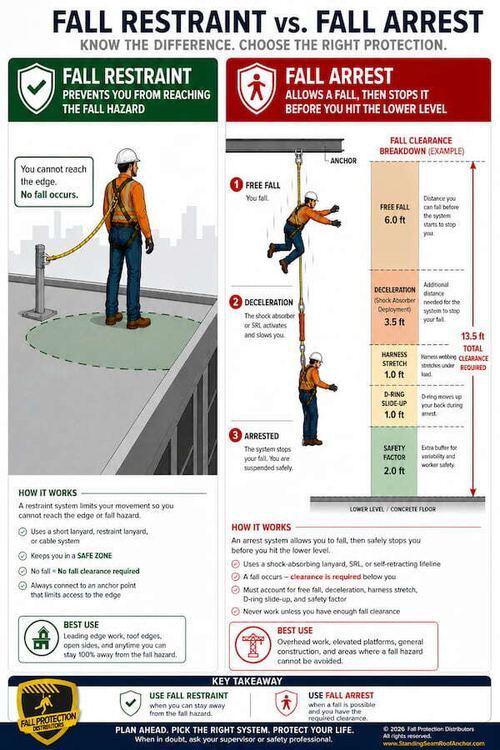 Read the full guide: Fall Restraint vs. Fall Arrest ›
Turn these requirements into a written plan and the gear to meet them
Generate a printable OSHA fall protection plan for your New York job, then equip your crew with anchors, SRLs, and harnesses built to OSHA and ANSI Z359 standards.
Generate My New York Safety Plan ›