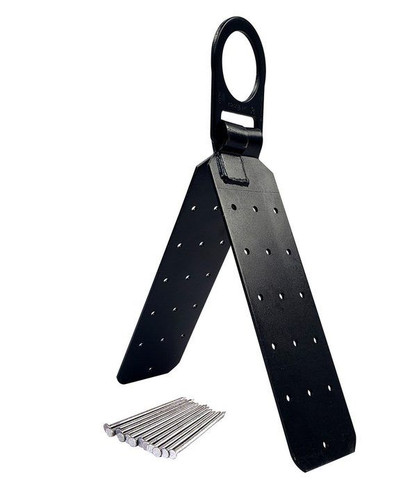


ROCH01 Halo Reusable Heavy Duty Chain Anchor
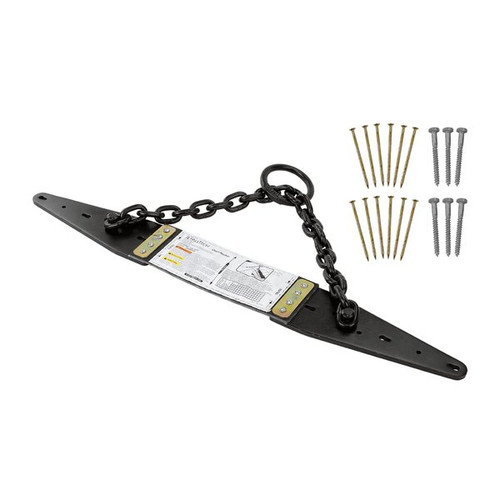
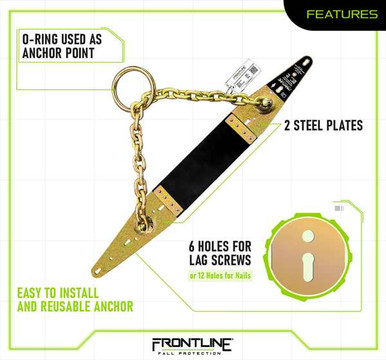
The Frontline ROCH01 Halo is a heavy duty, reusable chain anchor for wooden structural roof profiles. Two alloy steel plates fasten to the structure - 12 nails or 6 lag screws - and a link chain rises to an O-ring that serves as the tie-off point for one worker, riding over ridges and profiles that flat anchors cannot follow.
Built from high strength alloy steel with a shot blasted, yellow passivation finish, the Halo weighs about 5 lbs and carries roughly a 5,000 lb minimum breaking strength. Intertek tested it to ANSI/ASSP Z359.18-2017 as a Type A anchorage connector - static, dynamic, abrasion conditioning, and residual strength all passing - and it aligns with OSHA 1926 and 1910.
Who Needs This Product
This product is a reusable chain-style anchorage connector for personal fall arrest or restraint systems on wood-framed roofs. Roofers and framers use the Halo where the tie-off point needs to ride over a ridge, hip, or irregular profile - the chain conforms where rigid anchors cannot. Each worker still needs a full body harness and a compatible connecting device attached to the O-ring.
Features
Chain-over-ridge design
The link chain lets the O-ring sit where you need it across ridges and profiles.
Twin fastening plates
Two steel plates with 6 holes each anchor both sides of the structure.
Two fastening options
12 nails or 6 lag screws per the manual - use what the structure dictates.
High strength alloy steel
Shot blasted, yellow passivation finish stands up to repeated deployments.
Rubber substrate pad
Protects the roof surface under the anchor plate.
Independently tested
Intertek Z359.18-2017 Type A test report included in Submittals.
Technical Specifications
| SKU | ROCH01 |
|---|---|
| Type | Reusable heavy duty chain anchor (anchorage connector, Type A) |
| Construction | Two steel plates (6 holes each), link chain, O-ring tie-off point |
| Material | High strength alloy steel |
| Finish | Shot blasted with yellow passivation |
| Fastening | 12 nails or 6 lag screws (per manual) |
| Weight | Approx. 5 lbs |
| Min breaking strength | Approx. 5,000 lbs |
| Capacity | One worker per anchor point |
| Substrate | Wooden structural roof profiles |
| Standards | ANSI Z359.18-2017 Type A (Intertek tested); OSHA 1926; OSHA 1910 |
Every fastener counts. The Halo earns its rating with the full fastening schedule - 12 nails or 6 lag screws into sound structural wood, exactly as the Frontline manual specifies. Have a qualified person verify the structure before anyone ties off, and use one worker per anchor.
Compliance Standards
ANSI Z359.18-2017 Type A
American National Standard for anchorage connectors. Intertek tested the ROCH01: design, static strength, abrasion-conditioned dynamic strength, and residual strength all PASS - see the test report in Submittals.
OSHA 29 CFR 1926.502
Federal construction fall protection criteria, including anchorage strength requirements.
OSHA 29 CFR 1910.140
General industry personal fall protection system requirements.
Typical Applications
How to Install the ROCH01 Halo
Follow the manufacturer's manual. The sequence below is an overview only.
- Verify the structure. Have a qualified person confirm the wood framing can support anchorage loads.
- Inspect the anchor. Check the plates, chain links, O-ring, and rubber pad before each installation.
- Position the plates. Set the two plates over structural members per the manual, pad side down.
- Fasten. Install all 12 nails or all 6 lag screws per the Frontline manual - the full schedule, every hole the manual requires.
- Connect. Attach your connecting device to the O-ring and perform a pull test.
- Verify clearance. Confirm fall clearance below the work surface before work begins.
Inspection and Retirement
Inspect before each use, with a documented competent-person inspection at least every 6 months. Pull the equipment from service for any of the conditions below.
- Chain links: deformation, stretch, nicks, gouges, or corrosion.
- O-ring: deformation, cracks, or wear at the chain interface.
- Plates: bending, cracks, elongated fastener holes, or finish breakdown.
- Fasteners: correct type and count, fully seated, no withdrawal.
- Structure: splitting, rot, or crushing of the wood around the plates.
Retire the anchor immediately after any fall arrest event or if any inspection point fails. Destroy retired equipment so it cannot return to service.
 Fall Protection
Distributors, LLC Free Tool · No Signup · OSHA 1926.502 Free Interactive Tool Fall Protection Calculator Pick your system. Run the math. Generate a plan. 1Pick Your SystemDetermine fall restraint vs. fall arrest based on your work surface, edge access, and clearance. 2Run the MathCalculate exact fall clearance required below the work surface for your SRL or lanyard setup. 3Generate a PlanGet a printable OSHA-compliant Fall Protection Plan structured around 29 CFR 1926.502(k).
Frequently Asked Questions
Frontline ROCH01 Submittals and Documentation
Frontline ROCH01 Spec Sheet (PDF)Construction, materials, fastening options, and standards for the Halo chain anchor. Frontline ROCH01 User Manual (PDF)Installation, fastening schedule, inspection requirements, and inspection log. Frontline ROCH01 Test Report (PDF)Intertek third-party test results to ANSI/ASSP Z359.18-2017 Type A. ROCH01 Frontline Catalog (PDF)The full Frontline Fall Protection product catalog with the complete anchor, lanyard, and SRL range.Compatible and Related Products
- Frontline ROB01 Bull Ring Roof Anchor. A compact reusable plate anchor for flat wood roofs.
- Frontline ROWT18 Roof Wood Truss Anchor. A lightweight truss anchor for permanent or temporary installs.
- Frontline RK050V50 Combat Plus Roofers Kit. A complete harness, lifeline, and anchor kit for roofing crews.
Anchoring Over Ridges and Irregular Profiles?
Need help choosing between plate, chain, and truss anchors for your roof? Confirm your application, anchorage, and clearance with us and we will walk through the kit list so the right equipment ships together.
Call 863-703-4522 to talk to a fall protection specialist.