

Drop It in the Hole, Tie Off in Seconds
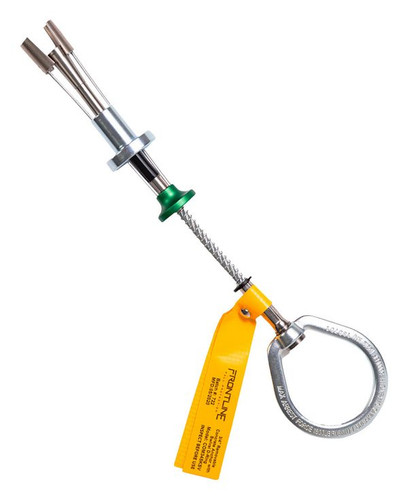
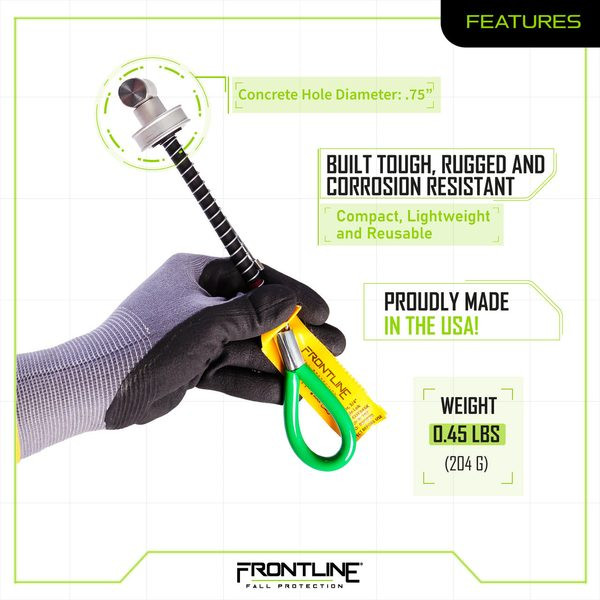
The COT345K is the most popular Frontline anchor for hollow concrete and steel work: a removable, reusable toggle bolt that inserts through a 3/4 inch hole in hollow-core precast or in steel flange with a minimum 1/4 inch thickness. Feed the stainless toggle bar through, and it cams flat behind the material — the activator wire gives a visual indicator that the toggle is locked before anyone trusts it. Installation takes seconds; removal and relocation take hardly longer.
Rated at 5,000 lbf (22 kN) tensile strength with a 310 lb maximum user capacity and a 1,000 lb working load, the COT345K runs a stainless steel toggle bar with an aircraft-cable main line and a polyurethane anchor loop, and works in vertical or horizontal applications for fall protection, lifting, hoisting, or tie-back. It meets ANSI Z359.1-2007 and Z359.7-2011, OSHA CFR 1926.502 and 1910.140, and EN 795.
Who Needs This Product
This product is an anchorage connector — the tie-off point of a personal fall protection system. The hollow-core plank or steel flange is the anchorage; the worker wears a full body harness; a lanyard or self-retracting lifeline connects to the polyurethane anchor loop. Precast crews and steel erectors who anchor, move, and anchor again all day are exactly who this toggle was built for.
Features
Seconds to install
Once the 3/4 inch opening exists, the toggle inserts, cams, and locks in a matter of seconds.
Removable and reusable
Release it, pull it, and carry it to the next hole; one anchor services the whole pour.
Visual lock indicator
The activator wire shows whether the toggle is in the open or locked position before the anchor is loaded.
Hollow concrete and steel flange
Designed for hollow-core concrete or steel flange with a minimum 1/4 inch thickness.
Corrosion-resistant build
Stainless steel toggle bar, zinc plated ball shank and spring, aircraft-cable main line, aluminum hole plug.
More than fall protection
Rated working load of 1,000 lbs supports lifting, hoisting, and tie-back uses per the manual.
Technical Specifications
| SKU | COT345K |
|---|---|
| Type | Reusable toggle bolt anchorage connector for hollow concrete and steel |
| Tensile strength | 5,000 lbf / 22 kN |
| Maximum user capacity | 310 lbs / 140 kg (single user) |
| Working load | 1,000 lbs / 454 kg |
| Required opening | 3/4 in hole |
| Substrates | Hollow-core concrete; steel flange, 1/4 in minimum thickness |
| Overall length | 13.75 in (349 mm) |
| Toggle bar | Stainless steel; 3.0 in (76 mm) x 2 in (50.8 mm) head |
| Components | Zinc plated steel ball shank and spring; zinc plated copper swage; aluminum hole plug; polyurethane anchor loop; aircraft cable main line and activator wire |
| Standards | ANSI Z359.1-2007, ANSI Z359.7-2011; OSHA CFR 1926.502, CFR 1910.140; EN 795 |
Confirm the lock before you load. The toggle must be fully cammed behind the substrate with the activator wire showing the locked position before any connection is made. A competent person must verify the hollow-core or steel flange substrate per the user manual. One worker per anchor, 310 lbs maximum including tools.
Compliance Standards
ANSI Z359.1-2007
Meets the American National Standard safety requirements for personal fall arrest system components.
ANSI Z359.7-2011
Third-party product testing and certification requirements of the Z359 fall protection code.
OSHA CFR 1926.502 / 1910.140
Designed to OSHA construction and general industry criteria for fall protection anchorages.
EN 795
Meets the European standard for personal fall protection anchor devices.
Typical Applications
Installation Overview
Follow the manufacturer's manual. The sequence below is an overview only.
- Verify the substrate. A competent person confirms the hollow-core concrete or 1/4 in minimum steel flange per the manual.
- Prepare the opening. Use an existing 3/4 in hole or drill one at the planned anchor location.
- Insert the toggle. Feed the toggle bar through the hole until it clears the back side of the material.
- Set and lock. Pull back to cam the toggle flat and confirm the activator wire shows the locked position.
- Seat and connect. Seat the hole plug, then connect the lanyard or SRL to the anchor loop; one worker per anchor.
- Remove and reuse. After the task, release the toggle per the manual, withdraw it, and relocate to the next hole.
Inspection and Retirement
Inspect before each use, with a documented competent-person inspection at least every 6 months. Pull the equipment from service for any of the conditions below.
- Toggle bar: deformation, cracks, corrosion, or a cam action that does not seat flat.
- Main cable and swage: broken wires, kinks, crushed strands, or swage damage.
- Activator wire and indicator: functions correctly and clearly shows locked versus open.
- Anchor loop: cuts, abrasion, or degradation of the polyurethane loop.
- Hole plug and hardware: missing, cracked, or deformed components; markings legible.
Retirement triggers: any fall arrest loading, cable or swage damage, a toggle that will not cam and lock positively, a lock indicator that cannot be verified, loop damage, or any condition where the inspector cannot confirm the anchor is fit for service.
 Fall Protection
Distributors, LLC Free Tool · No Signup · OSHA 1926.502 Free Interactive Tool Fall Protection Calculator Pick your system. Run the math. Generate a plan. 1Pick Your SystemDetermine fall restraint vs. fall arrest based on your work surface, edge access, and clearance. 2Run the MathCalculate exact fall clearance required below the work surface for your SRL or lanyard setup. 3Generate a PlanGet a printable OSHA-compliant Fall Protection Plan structured around 29 CFR 1926.502(k).
Frequently Asked Questions
Frontline COT345K Submittals and Documentation
Frontline COT345K Spec Sheet (PDF)Dimensions, materials, strength ratings, and the full compliance summary. Frontline COT345K Test Report (PDF)Third-party laboratory test results documenting the strength rating. Frontline COT345K User Manual (PDF)Insertion, locking, removal, inspection, and retirement procedures.Compatible and Related Products
- Frontline SBW01 Weld/Bolt-on Steel and Concrete Anchor. A fixed-mount dual-substrate plate anchor for steel or concrete.
- Frontline STM585K MEGA Swivel 5K Steel Anchor. The 360-degree swivel anchor for bolted steel installations.
- Frontline STB01 Steel Bolt Threaded Anchor 3-Pack. Three reusable threaded steel anchors in one economical pack.
- Frontline RO Commercial Roof Anchor. The ANSI Z359.18 roof anchor for concrete, metal, and wood decks.
Anchoring Through Hollow Core or Steel Flange?
Need help specifying the right system for your jobsite? Confirm your application, anchorage, and clearance with us and we will walk through the kit list so the right equipment ships together.
Call 863-703-4522 to talk to a fall protection specialist.