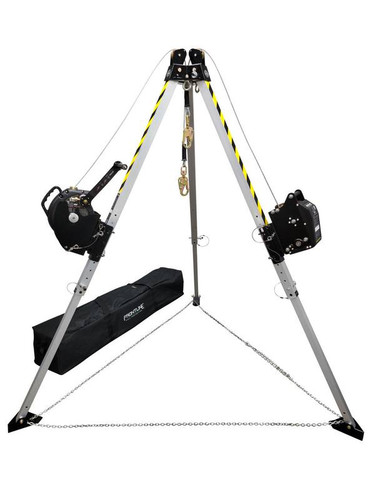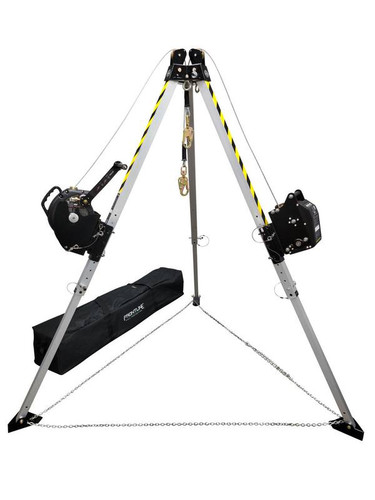


The RUW60 is the MEGApod platform's manual retrieval winch. 60 ft of 15/64 inch galvanized steel wire rope, a 310 lb rated capacity, and a 2-pin locking mounting plate that bolts the winch body to a Frontline MEGApod tripod leg (TAN07 or TAN10). Tested by Intertek to ANSI Z359.4-2013 across ambient, heat, cold, and wet conditions. The lower-cost alternative to the dual-mode RPG603W 3-Way SRL when your entry plan calls for straight up-and-down personnel lowering, lifting, or material handling over a permit-required confined space.
Independently Tested to ANSI Z359.4-2013
The RUW60 was tested by Intertek (Cortland, NY) against ANSI Z359.4-2013 Safety Requirements for Assisted-Rescue and Self-Rescue Systems, Subsystems and Components. Report Number 104387579CRT-001, issued September 8, 2020. The winch passed Static Strength Hoist Line Termination at 3,100 lb (four times rated capacity) held for one minute, Static Strength Hoist at four times rated capacity, Force to Raise and Lower under ambient, heat (54 C, 85 percent RH), cold (-40 C), and wet (3 hour spray) conditions, primary and secondary brake function across all four climates, slippage at 125 percent of rated load, wire rope minimum breaking strength greater than 3,400 lb per ASTM E8-04, and 96-hour salt spray corrosion resistance per ASTM B117-03.
 ► Watch: Frontline MEGApod Confined Space Tripod and Winch
What Sets the RUW60 Apart
System Components
The RUW60 is an accessory winch that ships ready to mount on a Frontline MEGApod tripod leg. Each component below is listed for procurement, replacement-part ordering, and inspection records.
Technical Specifications
| Specification | Detail |
|---|---|
| Model | Frontline RUW60 MEGApod 60-foot Confined Space Winch with Galvanized Steel Cable |
| Type | Manual Hoist / Winch (per Intertek Test Report 104387579CRT-001) |
| Cable | Galvanized steel wire (Spec Sheet) |
| Cable Length | 60 ft (18.28 m) (Spec Sheet) |
| Cable Diameter | 15/64 in (Spec Sheet) |
| Cable Minimum Breaking Strength | Greater than 3,400 lb on all five test samples per ASTM E8-04 (Intertek Test Report Section 8.2.2) |
| Body Material | Galvanized Steel (Spec Sheet) |
| Mounting | Mounting plate with 2 pin locking bolts for attachment to MEGApod tripod leg (Spec Sheet) |
| Connector | Swiveling steel snap hook (Spec Sheet) |
| Rated Load Capacity | 310 lb (Spec Sheet) |
| Static Strength, Hoist Line Termination | Held 3,100 lb (four times rated capacity) for one minute, 3 samples, PASS (Intertek Test Report Section 4.3.6.1) |
| Static Strength, Hoist | Sustained four times rated capacity load for one minute, 3 samples, PASS (Intertek Test Report Section 4.3.6.2) |
| Force to Raise, Ambient | 16.8 lbf average (max allowed 30 lbf), PASS (Intertek Test Report Section 4.3.6.3) |
| Force to Lower, Ambient | 8.5 lbf average, PASS (Intertek Test Report Section 4.3.6.3) |
| Force to Raise / Lower, Heat (54 C, 85 percent RH) | 19.93 lbf raise, 20.37 lbf lower, PASS |
| Force to Raise / Lower, Cold (-40 C) | 17.67 lbf raise, 17.97 lbf lower, PASS |
| Force to Raise / Lower, Wet (3 hr spray, 18 gal/hr) | 18.4 lbf raise, 21.8 lbf lower, PASS |
| Slippage at 125 percent Rated Capacity | 0 inches across ambient, heat, cold, and wet conditions (max allowed 4 in) (Intertek Test Report Section 4.3.6.4) |
| Primary Brake Slippage | 0 inches across ambient, heat, cold, and wet conditions (Intertek Test Report Section 4.3.6.5) |
| Secondary Brake Slippage | 0 inches across ambient, heat, cold, and wet conditions (Intertek Test Report Section 4.3.6.9) |
| Corrosion Resistance | 96 hours salt spray (fog) per ASTM B117-03, no signs of corrosion, no corrosion-related failures, PASS (Intertek Test Report Section 8.2.1) |
| Inbuilt Shock Absorption | Yes (per Spec Sheet) |
| Winch Weight | 39 lb (Spec Sheet) |
| Compatible Tripods | Frontline MEGApod TAN07 (7-foot) and TAN10 (10-foot) aluminum tripods |
| Standards | ANSI Z359.4-2013 (Intertek Test Report 104387579CRT-001), OSHA 29 CFR 1910, OSHA 29 CFR 1926 |
| Test Laboratory | Intertek, 3933 US Route 11, Cortland, NY 13045 |
| Test Report | Report Number 104387579CRT-001, issued September 8, 2020 (14 pages) |
| Manufacturer | Frontline Fall Protection, 2023 NW 84th Avenue, Miami, FL 33122 |
⚠ Single-User Use. 310 lb Rated Capacity. Personnel Lowering and Lifting Only.
The RUW60 is rated for use by ONE person at a time with a combined weight (worker plus clothing, tools, and equipment) not exceeding 310 lb. Do not exceed rated load. Do not use for towing, multi-user loads, fall arrest, or general-purpose lifting outside the design parameters. The RUW60 is a manual hoist for assisted lowering, lifting, and rescue, not a fall arrest device. For combined fall arrest and retrieval, use a 3-Way SRL such as the Frontline RPG603W. Confined space entry must be planned and executed per OSHA 29 CFR 1910.146 and 1926.1200 through 1926.1213 with a documented rescue plan and an attendant present at all times during entry.
Compliance and Certification
Intertek Test Report 104387579CRT-001, September 8, 2020
Intertek tested the RUW60 over a 5-day window (June 4 to June 8, 2020) at its Cortland, NY laboratory using a calibrated drop test structure, Stanley tape measure, Shimpo force gauge, and Interface 25K load cell. Project Owner Theodore Brown (Technician), Project Reviewer Matthew Stevens (Associate Engineer). Every test in the plan returned PASS.
| ANSI Z359.4 Section | Test | Result |
|---|---|---|
| 3 | Design | PASS |
| 4.3.6.1 | Static Strength, Hoist Line Termination (3,100 lb for 1 min) | PASS, 3 samples |
| 4.3.6.2 | Static Strength, Hoist (4x capacity for 1 min) | PASS, 3 samples |
| 4.3.6.3 | Force to Raise / Lower (Ambient, Heat, Cold, Wet) | PASS, max 21.8 lbf vs. 30 lbf ceiling |
| 4.3.6.4 | Slippage at 125 percent capacity (Ambient, Heat, Cold, Wet) | PASS, 0 in slippage |
| 4.3.6.5 | Primary Brake (Ambient, Heat, Cold, Wet) | PASS, 0 in slippage |
| 4.3.6.9 | Secondary Brake (Ambient, Heat, Cold, Wet) | PASS, 0 in slippage |
| 8.2.1 | Corrosion (96 hr salt spray per ASTM B117-03) | PASS, no corrosion, no failures |
| 8.2.2 | Wire Rope minimum breaking strength (ASTM E8-04) | PASS, greater than 3,400 lb on 5 samples |
| 5 | Markings and Instructions | PASS |
Right Tool. Right Job.
How to Mount and Use the RUW60 in 7 Steps
The condensed procedure below assumes a trained Competent Person setting up over a planned permit-required confined space entry with all OSHA pre-entry requirements complete. Full operating procedure is in the RUW60 User Manual (PDF download below).
- Plan the entry. Pre-plan the permit-required confined space entry with the entry supervisor, attendant, and entrant per OSHA 29 CFR 1910.146 and 1926.1204. Confirm atmospheric testing, ventilation, communication, and rescue procedures are in place before the winch leaves the truck.
- Stage the MEGApod tripod. Set up the MEGApod TAN07 or TAN10 tripod over the entry opening with the head centered over the entry, legs evenly spread, safety chains tensioned, and feet planted on stable ground per the tripod manual.
- Mount the RUW60 on a tripod leg. Align the RUW60 mounting plate against one MEGApod tripod leg and insert both pin locking bolts through the plate and the leg. Engage both locking pins fully and verify the winch body is square to the leg with no rocking.
- Route the cable up and over the head pulley. Pull the 15/64 inch galvanized steel cable off the drum and route it up the tripod leg and over the head pulley so the cable hangs centered above the entry opening. Verify the cable runs cleanly without rubbing on the leg, head, or eyebolt.
- Connect the swiveling snap hook to the entrant. Clip the swiveling steel snap hook to the dorsal D-ring of the entrant's full-body harness. Verify the gate closes and locks, the swivel rotates freely, and the cable runs straight from the head pulley to the worker with no twist.
- Pre-tension and load test. Crank the handle to take slack out of the cable and pre-tension the line. Listen and feel for smooth gear engagement, confirm the primary brake holds when the handle is released, and verify the secondary brake engages cleanly. Maintain communication with the attendant.
- Lower or lift the worker. With the attendant in continuous voice or visual contact, crank the handle to lower or raise the entrant at a controlled rate. Do not exceed the 310 lb rated load. Stop, hold, and re-check at each interval the entry plan calls for. After exit, back off tension and inspect the cable for the next entry.
Inspection and Retirement
Confined space winches see hard cycles, weather, chemical vapors, and abrasion against the rim of the entry. Routine inspection keeps the RUW60 field-ready and protects every entrant. The reference image frontline-ruw60-megapod-winch-side-detail.jpg shows the brake housing and handle assembly that competent inspectors should examine each cycle, and frontline-ruw60-megapod-winch-galvanized-cable.jpg shows the cable condition baseline.
Pre-Use Inspection (Every Use)
Before each entry, confirm the mounting plate sits flush against the tripod leg with both pin locking bolts fully engaged. Inspect the cable along its full length for fraying, kinks, broken strands, rust spots, or abrasion. Inspect the winch body, handle, and brake housing for cracks, dents, or deformation. Crank the handle to verify smooth gear engagement, confirm the primary brake holds the load when the handle is released, and confirm the secondary brake engages cleanly. Verify the swiveling steel snap hook gate closes and locks fully and the swivel rotates without binding.
Competent Person Inspection (Minimum Every 6 Months)
A Competent Person, as defined in 29 CFR 1926.32(f), must perform and document a full inspection at least every six months and after any shock load, impact, drop, or chemical exposure. Inspection covers cable condition along the entire length, drum and gear train condition, primary brake disassembly per manufacturer schedule, secondary brake function, mounting plate and pin locking bolt wear, snap hook latch and swivel integrity, body and housing weld integrity, label legibility, and any signs of unauthorized field modification.
Inspection After Shock Load or Impact
If the RUW60 has been shock loaded, struck, dropped from height, or hit by mechanical equipment, remove it from service until a Competent Person inspects and clears it. Pay particular attention to brake function and cable condition before returning the winch to service.
Retirement for Damage
Retire any RUW60 with cable fraying, kinking, broken strands, severe rust, brake malfunction, gear train binding, bent or damaged mounting plate, missing or damaged pin locking bolts, a damaged snap hook, or any deformation that prevents the winch from carrying load correctly.
Cleaning and Storage
After exposure to wet, chemical, or dirty environments, wipe the winch body, drum, and cable clean with mild soap and water and dry thoroughly. Do not lubricate brake components. Store the RUW60 in a dry, room-temperature space away from sunlight, solvents, and corrosive vapors. Recoil the cable evenly onto the drum before storage to prevent kinks.
Safe Lifting and Lowering Practices
The RUW60 is a manual hoist for assisted lowering, lifting, and rescue in a permit-required confined space, not a fall arrest device. Fall clearance calculations for personal fall arrest do not apply to the RUW60 itself. The safety envelope around the winch is governed by lifting and lowering best practice, not free-fall distance.
Stay within 310 lb rated capacity. Combined weight of worker, clothing, tools, and equipment must not exceed 310 lb. The Intertek test report verified hoist line termination static strength at four times the rated capacity (3,100 lb held for one minute), but rated working load is 310 lb. Do not exceed rated load.
Maintain a controlled rate of descent and ascent. Crank the handle at a steady pace. The Intertek test measured 16.8 to 21.8 lbf at the handle to raise the rated load across ambient, heat, cold, and wet conditions, well within the 30 lbf ANSI Z359.4 ceiling. If you are exerting noticeably more force than that, stop, hold the load on the primary brake, and inspect the cable, drum, and gear train before continuing.
Verify both brakes before every entry. The primary brake holds the load when the handle is released. The secondary brake is a redundant backup in the event the primary brake fails. Both brakes passed Intertek's slippage test at 125 percent of rated capacity with 0 inches of cable slippage across ambient, heat, cold, and wet conditions. Confirm both work before connecting the entrant.
Pair with an SRL for fall arrest, not the winch alone. If the entry profile calls for fall arrest in addition to controlled lowering and lifting, pair the MEGApod tripod with a 3-Way SRL such as the Frontline RPG603W (60-foot 3-Way Self-Retracting Lifeline) on the opposite tripod leg, or use a dual-system MEGApod kit. The RUW60 alone is not a substitute for a fall arrest connector.
Plan for rescue. OSHA 29 CFR 1910.146 and 1926.1203 require a documented rescue plan and a trained attendant for every permit-required confined space entry. The RUW60 is well suited to the controlled retrieval portion of that plan, but it does not replace the rest of the plan.
For fall-arrest connector sizing on the SRL or lanyard you pair with this winch, use our Fall Protection Game Plan tool below.
 Fall Protection
Distributors, LLC Free Tool · No Signup · OSHA 1926.502 Free Interactive Tool Fall Protection Calculator Pick your system. Run the math. Generate a plan. 1 Pick Your System Determine fall restraint vs. fall arrest based on your work surface, edge access, and clearance. 2 Run the Math Calculate exact fall clearance required below the work surface for your SRL or lanyard setup. 3 Generate a Plan Get a printable OSHA-compliant Fall Protection Plan structured around 29 CFR 1926.502(k).
Frequently Asked Questions
Frontline RUW60 Submittal Documents
The following manufacturer documents are available for download to support procurement, safety planning, jobsite submittals, and Competent Person inspection records.
| Document | Description | Download |
|---|---|---|
| Frontline RUW60 Spec Sheet | Manufacturer reference covering cable material, cable length, cable diameter, body material, rated load capacity, weight, and relevant standards (ANSI Z359.4-2013, OSHA 29 CFR 1910, OSHA 29 CFR 1926). | Frontline RUW60 Spec Sheet (PDF) |
| Frontline RUW60 User Manual | User instruction manual covering mounting to the MEGApod tripod leg, cable routing, snap hook connection, operating procedure, primary and secondary brake function, inspection, retirement, and cleaning and storage. | Frontline RUW60 User Manual (PDF) |
| Frontline RUW60 Test Report | Intertek independent test report 104387579CRT-001, issued September 8, 2020, certifying the RUW60 to ANSI Z359.4-2013. Covers design, static strength hoist line termination, static strength hoist, force to raise and lower, slippage, primary brake, secondary brake, wire rope, corrosion, and markings tests. | Frontline RUW60 Test Report (PDF) |
Building a complete confined space retrieval setup? The RUW60 mounts on the MEGApod tripod platform. Pair it with one of the following depending on your entry profile and budget:
- Frontline TAN07 MEGApod 7-foot Tripod, the standard MEGApod platform for the RUW60, sized for most manhole, vault, and tank entries.
- Frontline RPG603W MEGApod 60-foot 3-Way SRL Retrieval System, the dual-mode SRL+winch alternative when your plan needs fall arrest in addition to controlled retrieval.
- Frontline TAN07RA-US Patriot 7-foot Tripod + 3-Way SRL, the Union-Made-in-USA premium alternative for federal, state, and Buy American Act procurement.
- Frontline TAN07RU MEGApod 7-foot Kit, the pre-bundled TAN07 + RUW60 kit when you want everything shipped together.
- Frontline TAN10RU MEGApod 10-foot Kit, the same kit with the taller 10-foot TAN10 tripod for deeper entries or wider openings.
Not sure which configuration fits your entry profile? Call us, we spec complete confined space systems before you buy.
Questions before you order?
We spec systems, not just products. Pre-sale support, compatibility confirmation, and bulk pricing, call or email directly.
☎ 863-703-4522