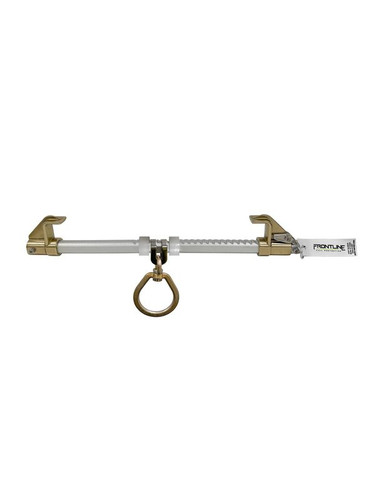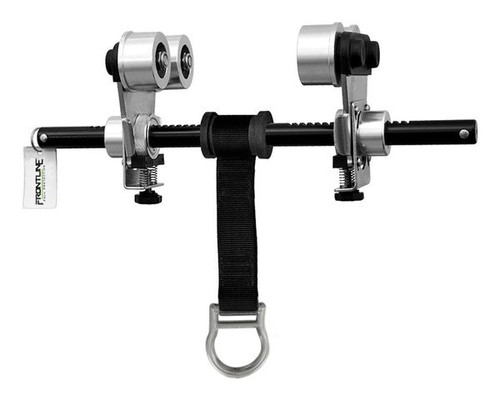


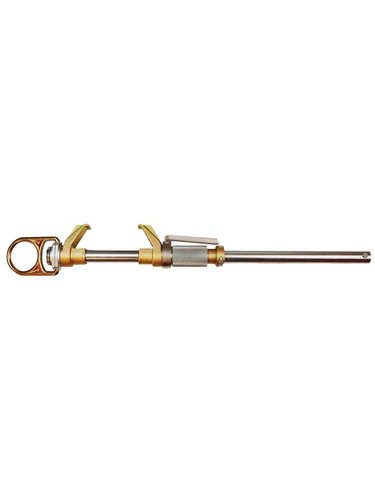
ST14V Vertical / Horizontal Fixed Beam Clamp
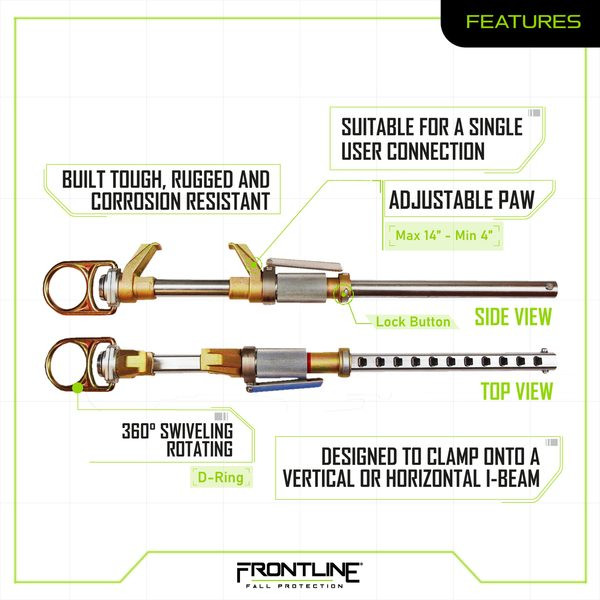
The ST14V is a fixed I-beam anchor that clamps onto a vertical or horizontal beam to create a solid, stationary anchor point - the clamp for work that happens in one place. The adjustable paw closes onto flanges from 4 to 14 inches wide with a minimum 0.25 inch thickness, and setup takes seconds without tools: position, adjust, lock the paw, work.
A 360 degree swiveling D-ring keeps the connecting device tracking the worker without twisting, and the zinc plated steel construction is rugged, compact, and easy to carry between locations. Rated at 5,000 lbf (22 kN) tensile strength with a 310 lb single-user capacity and a 1,000 lb working load. Conforms to ANSI Z359.1-2007 and Z359.7-2011 and aligns with OSHA 29 CFR 1926.502 and 1910.140.
Who Needs This Product
This product is a fixed I-beam anchorage connector - a stationary anchor point clamped to a vertical column or horizontal beam. Crews pick the ST14V when the work stays put: equipment repairs, column work, and fixed-position tasks where a sliding anchor adds no value but a vertical-capable clamp does. Suitable for a single user connection - each worker still needs a full body harness and a compatible connecting device attached to the D-ring.
Features
Vertical or horizontal beams
Clamps onto an I-beam in either orientation to create a fixed anchor point - columns included.
Tool-free, seconds to set
Easy to operate with no tools: position the clamp, run the adjustable paw to the flange, and lock it.
360 degree swivel D-ring
The swiveling, rotating D-ring keeps the connection tangle-free as the worker moves around the task.
Adjustable paw
Fits beam flanges from 4 to 14 inches wide with a minimum 0.25 inch thickness.
Compact and rugged
Zinc plated steel build that is compact in size, lightweight to carry, and tough on the jobsite.
SRL or lanyard ready
Use a self-retracting lifeline or a shock-absorbing lanyard on the D-ring.
Technical Specifications
| SKU | ST14V |
|---|---|
| Type | Fixed I-beam clamp anchorage connector, removable and reusable |
| Orientation | Clamps onto a vertical or horizontal I-beam |
| Connection | Single user; 360 degree swiveling D-ring |
| Tensile strength | 5,000 lbf / 22 kN |
| Max user weight | 310 lbs / 140 kg |
| Working load | 1,000 lbs / 454 kg |
| Flange width | 4 in to 14 in |
| Flange thickness | 0.25 in minimum |
| Materials | Swivel, swivel mount, clamps, and support bar: zinc plated steel |
| Setup | Tool-free; installs in seconds with the adjustable paw and lock button |
| Standards | ANSI Z359.1-2007; ANSI Z359.7-2011; OSHA 29 CFR 1926.502; OSHA 29 CFR 1910.140 |
The beam carries the load. The I-beam or column must be verified by a qualified person for the intended fall protection load, and the paw must be adjusted and locked to the actual flange before each use. One worker per anchor at 310 lbs maximum - calculate fall clearance, including swing fall when anchored to a vertical member, before tying off.
Compliance Standards
ANSI Z359.1-2007
American National Standard safety requirements for personal fall arrest system components, including anchorage connectors.
ANSI Z359.7-2011
Qualification and verification testing of fall protection products by accredited third-party laboratories.
OSHA 29 CFR 1926.502
Federal construction fall protection criteria, including anchorage strength requirements.
OSHA 29 CFR 1910.140
General industry personal fall protection system requirements for maintenance and facility work.
Typical Applications
Installation Overview
Follow the manufacturer's manual. The sequence below is an overview only.
- Inspect. Check the main bar, paws, lock button, D-ring, swivel, and markings before each use.
- Verify the beam. Have a qualified person confirm the beam or column carries the intended fall protection load.
- Measure the flange. Confirm flange width is between 4 and 14 inches with at least 0.25 inch thickness.
- Clamp. Seat the fixed paw on one flange edge, run the adjustable paw to the other, and lock it per the manual.
- Check the set. Confirm the clamp is captive and immovable on the flange in the work direction.
- Connect. Attach the SRL or shock-absorbing lanyard to the swivel D-ring and verify fall clearance before work begins.
Inspection and Retirement
Inspect before each use, with a documented competent-person inspection at least every 6 months. Pull the equipment from service for any of the conditions below.
- Paws: deformation, wear, or failure to hold the locked position.
- Main bar and adjuster: bending, cracks, or damaged adjustment positions.
- D-ring and swivel: bending, cracks, binding, or rough rotation.
- Hardware: corrosion, missing parts, or a lock button that does not engage.
- Markings: missing or illegible product label.
Retire the anchor immediately after any fall arrest event, any deformation or crack, or any condition where it cannot be verified as safe for service.
 Fall Protection
Distributors, LLC Free Tool · No Signup · OSHA 1926.502 Free Interactive Tool Fall Protection Calculator Pick your system. Run the math. Generate a plan. 1Pick Your SystemDetermine fall restraint vs. fall arrest based on your work surface, edge access, and clearance. 2Run the MathCalculate exact fall clearance required below the work surface for your SRL or lanyard setup. 3Generate a PlanGet a printable OSHA-compliant Fall Protection Plan structured around 29 CFR 1926.502(k).
Frequently Asked Questions
Frontline ST14V Submittals and Documentation
Frontline ST14V Spec Sheet (PDF)Flange range, strengths, materials, and the compliance summary. Frontline ST14V Test Report (PDF)Third-party test results documenting the rated performance. Frontline ST14V User Manual (PDF)Clamping, adjustment, inspection, and retirement procedures.Compatible and Related Products
- Frontline ST18AV Aluminum I-Beam Fixed Anchor. The 5 lb aluminum fixed anchor covering flanges up to 18 inches.
- Frontline ST10HTK Aluminum Beam Trolley. The rolling trolley for long runs of overhead steel.
- Frontline ST14SH Easy Slider Beam Walker. The trailing slider alternative when the work moves along the beam.
- Frontline RO4W Multifunction 4-Way Anchor. A multifunction anchor for concrete, metal, and wood substrates.
Need a Fixed Anchor Point on Steel?
Need help specifying the right system for your jobsite? Confirm your application, anchorage, and clearance with us and we will walk through the kit list so the right equipment ships together.
Call 863-703-4522 to talk to a fall protection specialist.