
OSHA Anchor Points (Talk #4)
Posted by Howie Scarboro - COO- Fall Protection Distributors, LLC on Aug 19, 2026
By Howie Scarboro, COO, Fall Protection Distributors, LLC · Last verified against the eCFR, osha.gov letters of interpretation, and ANSI documentation: August 5, 2026
For information purposes only. This page supports your safety planning; it does not replace professional judgment. A Competent Person or Qualified Person must review and approve all safety plans and fall protection decisions for the task before work begins, as required by OSHA.
What Counts as an OSHA-Compliant Anchor Point? The Quick Answer
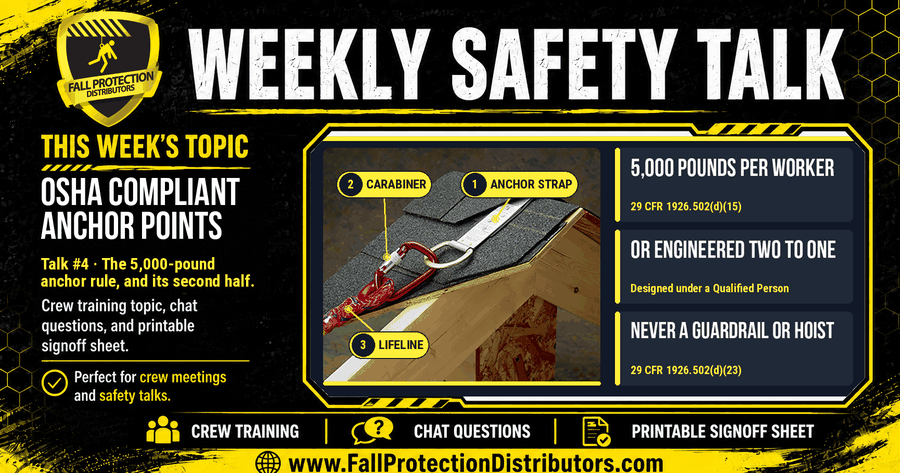
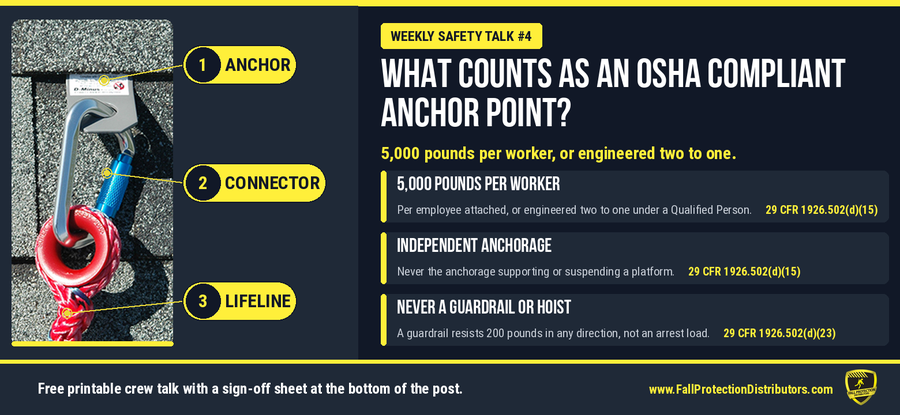
Quick answer: Under 29 CFR 1926.502(d)(15), a fall arrest anchor must either be capable of supporting at least 5,000 pounds per worker attached, or be designed, installed, and used as part of a complete personal fall arrest system that maintains a safety factor of at least two, under the supervision of a Qualified Person. Either way, the anchor must be independent of anything supporting or suspending a platform, and it can never be a guardrail or a hoist.
This is Talk #4 of our Weekly Safety Talk series. Talk #1 covered fall protection trigger heights in all 50 states, Talk #2 covered the rules for steep-slope residential roofs, and Talk #3 covered harness inspection and retirement. This week we are covering the part of the system that everything else depends on: the anchor. Ask five crews what makes an anchor legal, and you will get five versions of "5,000 pounds." That number is real, but it is only half the rule, and the part nobody quotes explains how the anchors you actually buy and install get certified.
OSHA Anchor Point Requirements: 5,000 Pounds or an Engineered System
First, what OSHA means by an anchorage, the construction standard defines it in one line: anchorage means "a secure point of attachment for lifelines, lanyards or deceleration devices" (29 CFR 1926.500(b)). That is a short definition for a part that carries the entire system, and the strength requirement that goes with it is where the real work is:
"Anchorages used for attachment of personal fall arrest equipment shall be independent of any anchorage being used to support or suspend platforms and capable of supporting at least 5,000 pounds (22.2 kN) per employee attached, or shall be designed, installed, and used as follows: (i) as part of a complete personal fall arrest system which maintains a safety factor of at least two; and (ii) under the supervision of a qualified person." (29 CFR 1926.502(d)(15))
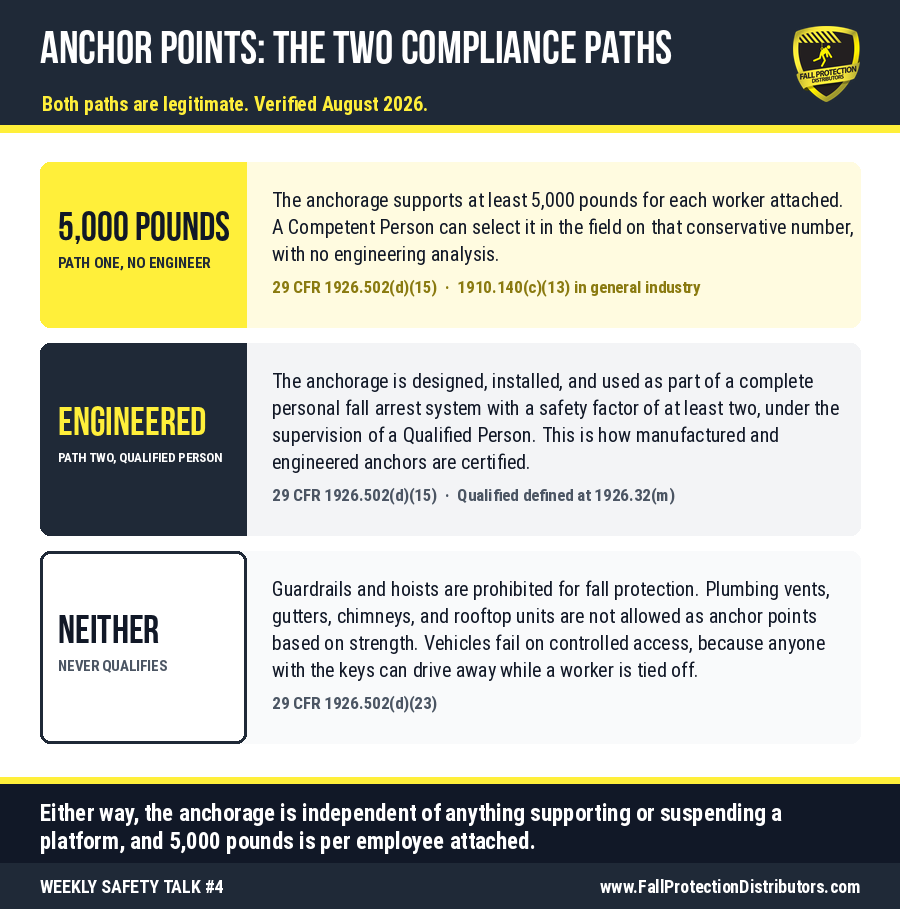
Path one is strength: if the attachment point can hold 5,000 pounds for each worker tied to it, you are compliant without an engineer in sight. Path two is engineering: a Qualified Person designs the anchorage as part of a complete system with at least a two-to-one safety factor against the loads the system can actually generate.
Why does the second path exist? Because a personal fall arrest system is required to limit the maximum arresting force on a worker to 1,800 pounds when used with a body harness (1926.502(d)(16)(ii)). A properly built system with a shock-absorbing lanyard or a self-retracting lifeline never delivers anything close to 5,000 pounds to the anchor; a single worker on a shock-absorbing lanyard typically puts something in the range of 900 to 1,200 pounds into it. Designing for twice that is the logic behind the second path: size the anchorage for double the force the system can actually produce, rather than for a number chosen to cover every case at once. OSHA put a fine point on how that is measured in a 2011 letter of interpretation: the stress limit is the yield strength of the supporting member, the point where permanent deformation first begins, not the point where the part finally breaks.
There is a second 5,000-pound number in Subpart M, and mixing the two up can lead to confusion. Snaphooks and D-rings carry their own requirement: they must have a minimum tensile strength of 5,000 pounds (1926.502(d)(3)). That number describes the hardware in your hand. The anchorage number in (d)(15) is per employee attached and describes the structure you attach that hardware to. They are two separate requirements for two different parts of the system.
Qualified Person and Competent Person: Two Different Legal Roles
The second path leans hard on one role, so let's define it. OSHA defines qualified as "one who, by possession of a recognized degree, certificate, or professional standing, or who by extensive knowledge, training, and experience, has successfully demonstrated his ability to solve or resolve problems relating to the subject matter, the work, or the project" (29 CFR 1926.32(m)). That is a different role from the Competent Person, defined at 1926.32(f) as someone capable of identifying hazards and authorized to take prompt corrective measures to eliminate them, which includes stopping the work. The Competent Person runs your inspections and your rescue plan. The Qualified Person does the engineering math. On many small crews, neither role is formally assigned, and that is the first thing an inspector notices.
That distinction pays off on the job in a way worth spelling out. When you buy a manufactured anchor that has been tested and rated for fall arrest, and you install it exactly per the manufacturer's instructions on the structure it was designed for, the manufacturer's engineering is doing the Qualified Person design work for that product. Our SSRA1 standing-seam anchor exists because of that second path: it clamps to the seams with tested holding strength (the numbers are published on our testing page), so the roof itself becomes a compliant anchorage without drilling a single hole. What the manufacturer's engineering cannot do is verify your specific roof, your seam profile, and your installation. That part belongs to your Competent or Qualified Person on site, which is why the seam compatibility check matters before the crew ever leaves the shop.
Certified vs. Non-Certified Anchors: The ANSI Layer
OSHA is the law. ANSI/ASSP Z359 is the consensus standard that fills in the engineering details, and the terms "certified" and "non-certified" come from Z359.2, the managed fall protection program standard. Z359.18 is the related standard covering anchorage connectors. A certified anchorage is one a Qualified Person has designed or evaluated for the specific structure and application. A non-certified anchorage is one selected in the field by a Competent Person using conservative strength numbers instead of engineering analysis. Two standards and one federal rule can be confusing, so here is what each one asks for, side by side:
| Application | Non-certified anchorage | Certified anchorage | OSHA baseline |
|---|---|---|---|
| Fall arrest | 5,000 lbs per system | Two times the maximum arresting force | 1926.502(d)(15): 5,000 lbs per worker or engineered two-to-one under a Qualified Person |
| Fall restraint | 1,000 lbs per system | Two times the foreseeable force | No construction standard sets one. OSHA's November 2, 1995 letter of interpretation suggests at least 3,000 pounds of force or twice the maximum expected force. In general industry, 1910.140(c)(13) still applies |
| Work positioning | 3,000 lbs, or twice the potential impact load, whichever is greater | Two times the foreseeable force | 1926.502(e)(2): same numbers, straight from the standard |
| Rescue | 3,000 lbs per system | Five times the applied load | No anchorage strength is set. 1926.502(d)(20) requires prompt rescue but assigns no number, so the rescue figures are ANSI's alone |
Notice the pattern: the non-certified numbers are big and blunt on purpose. They carry enough margin that a Competent Person can pick a heavy piece of structure without doing the math. The certified numbers are smaller because a Qualified Person calculated the actual forces instead of assuming the worst, so the extra margin is not needed.
What Never Qualifies, No Matter How Solid It Feels
OSHA names two disqualified anchors outright: "Personal fall arrest systems shall not be attached to guardrail systems, nor shall they be attached to hoists except as specified in other subparts of this part" (1926.502(d)(23)). A guardrail is built to withstand 200 pounds applied in any outward or downward direction (1926.502(b)(3)), which is a fraction of an arrest load, and a hoist is designed to move a load rather than to stop a falling worker. The same logic in the rule's first clause rules out tying off to the anchorage that is supporting or suspending your platform, because if the platform lets go, your lifeline goes with it.
Those two are the ones written into the standard. The rest of the list below is not, but every item on it fails on strength, on independence, or on both:
- Plumbing vents and flue pipes: thin-wall pipe held by flashing and caulk. They tear out under body weight, never mind arrest loads.
- Gutters and downspouts: screwed into fascia board, which is trim rather than structure, and the fasteners are sized to carry the weight of water rather than the weight of a falling worker.
- Chimneys: unreinforced masonry that looks permanent and fails in chunks, and you cannot see the mortar condition from outside.
- HVAC units and rooftop equipment: sitting on curbs by gravity more often than anyone wants to believe.
- The truck, the trailer hitch, the skid steer: anything with keys in it can be driven away by someone who does not know you are tied to it. It has happened on real job sites, and the result is a worker pulled off the roof by his own anchor. A truck is the one item on this list that can be plenty strong and still get a man killed, because nothing about the truck stops somebody from starting it and pulling forward while you are tied to the hitch.
- A "stout-looking" truss from above: a truss can be a legitimate anchorage, but only where a Qualified Person has evaluated it, or a manufactured truss anchor is installed per its instructions. Guessing at hidden framing through the deck is not an evaluation.
The test is never "does it feel solid." OSHA's own test protocol in Appendix C to Subpart M drops a 220-pound test weight to prove a system out, and a worker falling 6 feet generates forces in that neighborhood, which is why hand-tugging on an anchor tells you nothing. The test is one of the two paths: rated for 5,000 pounds, or engineered into the system by someone with the credentials to sign for it.
The Anchor Types You Will Actually Use
- Permanent roof anchors: a plate or D-bolt fastened into structural framing and left on the building for the life of the roof. These are the right answer when the same crew comes back to the same building, and they are the ones most likely to need documented recertification.
- Temporary and reusable peak anchors: nail-on or screw-down plates for shingle work, installed into rafters or trusses for the duration of the job and then removed and sealed per the instructions. The fastener schedule in the manual is the engineering, so a shortcut there voids the rating. A popular peak anchor is the Ridge Pro, which can attach to roofs from 6:12 to 12:12.
- Non-penetrating seam clamps: for standing-seam metal, a clamp such as the SSRA1 grips the seam with set screws and turns the roof itself into the anchorage without a single hole in the panel. Check your seam profile and panel gauge against the tested compatibility list first.
- Plate anchors for exposed-fastener panels: on an ag panel and R-panel, a plate fastens through the panel into the structure below. The panel is not the structure, so the fasteners have to reach the purlin or the framing.
- Beam anchors, beam straps, and cross-arm straps: for open structural steel and for wrapping a suitable member. Size the clamp to the flange and set the strap where it cannot slide, because a connector that migrates ends up loading the weakest part of the member.
- Mobile and ballasted anchors: weighted carts and deadweight bases for low-slope roofs where you can't penetrate the surface. These are engineered products with a rated setup, and the ballast, the roof surface, and the number of users are all part of what was tested. The Frontline CO2NN is a counterweight anchor system that requires no penetrations and can be hand-carried in pieces or lifted with a hoist to the roof.
- Engineered horizontal lifelines: a designed system with its own end anchorages, used where a worker has to move along a run rather than stay near one point. These are always path two, and not by choice: 1926.502(d)(8) requires horizontal lifelines to be designed, installed, and used under the supervision of a qualified person as part of a complete system with a safety factor of at least two. It is the one place in Subpart M where OSHA takes the field-selection path away from you entirely, because the forces at the end anchorages depend on the span and the sag.
Each one comes with written instructions, a rating, and a stated limit on how many workers may attach, and those three pieces of paper matter as much as the hardware does because they turn a piece of steel into a compliant anchorage. Keep them with the anchor, not in a drawer back at the shop.
Picking the Right Anchor by Roof Type
The right anchor is the one designed for the structure you are actually standing on. Here is how the common roofs sort out:
| Roof type | Anchor approach | What to watch |
|---|---|---|
| Asphalt shingle | Nail-on or screw-down peak anchors installed into structural framing per the manufacturer's fastener schedule | Fasteners must hit rafters or trusses, not just decking; remove or seal per instructions when done |
| Standing-seam metal | Non-penetrating clamp anchors such as the SSRA1 that grip the seam with set screws, no holes in the panel | Confirm your seam profile and panel gauge are on the tested compatibility list before the crew rolls |
| Exposed-fastener metal (ag panel, R-panel) | Plate-style anchors fastened through the panel into the structure per the instructions | Panel alone is not structure; the fastener schedule is the engineering, so follow it exactly |
| Low-slope membrane or built-up | Manufactured roof anchors rated for the deck type, or engineered anchorage designed by a Qualified Person | Membrane manufacturers have penetration and flashing requirements of their own |
| Open structural steel | Beam clamps, beam straps, and girder anchors rated for the member size | Size the clamp to the flange; a loose clamp slides to the weak point |
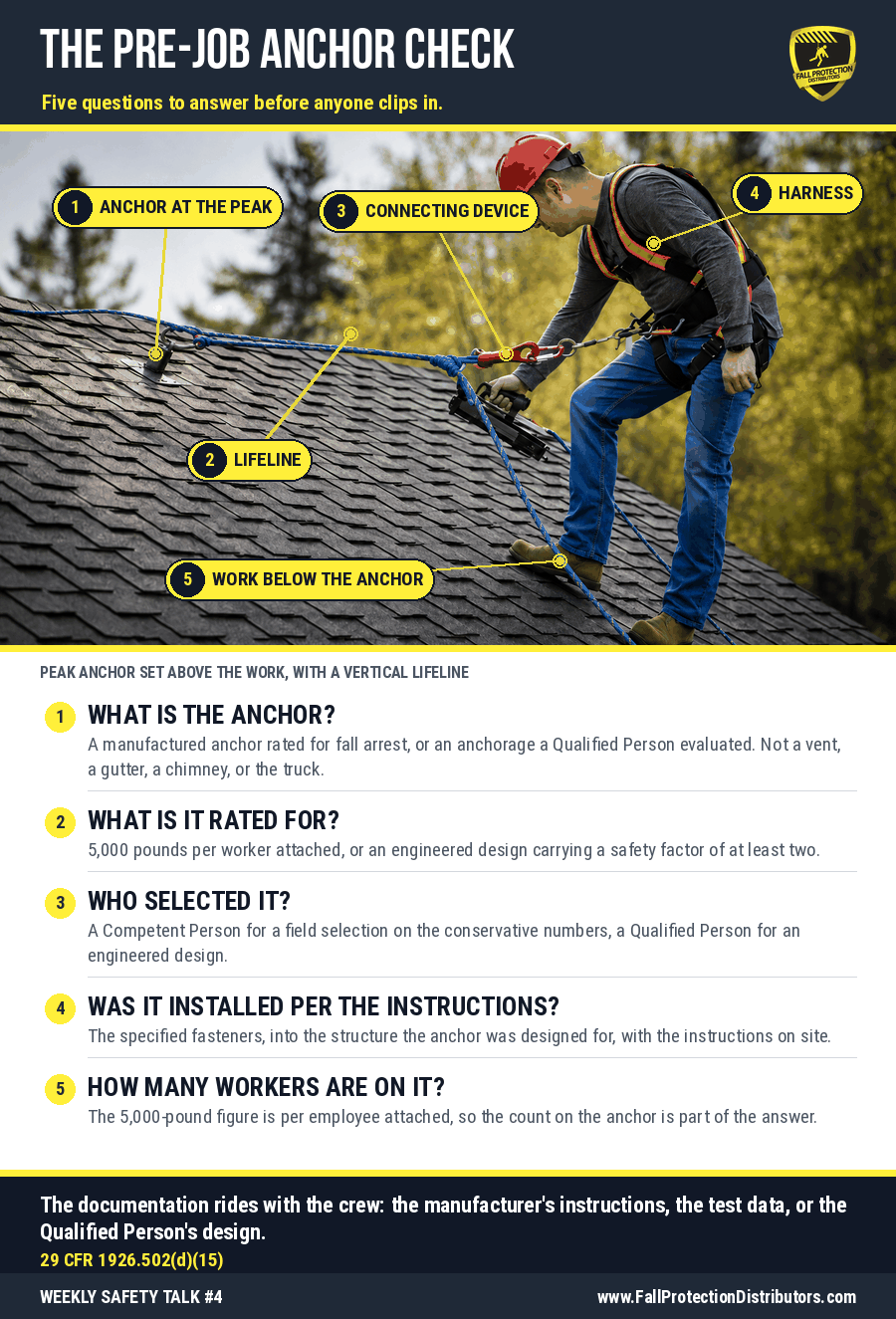
Two notes that apply across every row. First, the anchor is only one part of the system; the harness, the connecting device, and the clearance below all have to work together, and our fall clearance calculator will tell you whether the system you just built actually stops you above the ground. Second, anchor location drives swing fall. An anchor far off to the side turns a vertical fall into a pendulum, and the arithmetic that made your clearance work goes out the window. Set anchors as close to directly above the work as the job allows.
How Many Workers Can Tie Off to One Anchor?
The practical answer is almost always one. Manufactured anchors are rated and labeled for a specific number of users, and most single-point roof anchors are labeled for one worker. When the manual says one, the manual governs, and clipping a second lifeline to that anchor puts you out of compliance with 1926.502(d)(15) no matter how strong the framing underneath happens to be, because a single-user anchor has never been shown capable of 10,000 pounds and was not engineered for two. On an engineered anchorage, the user count is part of what the Qualified Person designed for, and it will be written into the design documents you keep on site.
Does the Anchor Rule Change for a Heavy Worker?
This is the question that comes up at every tailgate meeting once somebody does the arithmetic, and the standard has a real answer. OSHA's fall arrest criteria note that a system complies when the worker's combined body-and-tool weight stays under 310 pounds. Workers who exceed that weight need appropriately modified systems; otherwise the system may fall out of compliance. The 1,800-pound arresting force limit and the 6-foot free fall limit were both written around that assumption, and Appendix C to Subpart M builds its test protocol on a 220-pound test weight.
Combined person and tool weight is the worker plus the harness plus the belt plus everything hanging off it. A 265-pound man with a loaded tool belt and a cordless nailer clears 310 without trying. The anchorage requirement itself does not go up with body weight, because 5,000 pounds per employee attached already carries enormous margin over any single worker. What changes is the equipment between him and the anchor, and that's what the manufacturer rates.
Fall Arrest Anchors and Fall Restraint Anchors Are Not the Same
Everything above assumes fall arrest: the worker can fall, and the system catches them. Fall restraint is the other strategy: the system is rigged short so the worker physically cannot reach the edge. OSHA accepts restraint in construction through its letters of interpretation, and the anchor math relaxes there because a restraint anchor never sees an arrest load; it sees a worker leaning against a taut line. Be careful where you get the number, though, because no construction standard sets one. OSHA's November 2, 1995 letter of interpretation says a restraint system should, at a minimum, have the capacity to withstand at least 3,000 pounds of force or twice the maximum expected force needed to keep the worker away from the hazard, and ANSI's non-certified restraint figure is 1,000 pounds per system. Do not confuse the letter's 3,000-pound suggestion with 1926.502(e)(2), which sets the same figure for work positioning, and positioning is a different application with the worker hanging in the system rather than leaning away from an edge.
Under general industry, 29 CFR 1910.140(c)(13) applies to anchorages with no exception for restraint, and 1910.140(c)(14) requires travel restraint lines themselves to sustain 5,000 pounds. Hence, a maintenance crew working under 1910 gets no reduction.
The catch on either side is the rigging. The system only counts as restraint if the worker cannot get to the fall hazard from any position, on any line length, anywhere on the roof. If they can reach the edge, it is an arrest system being graded on arrest rules, whatever you intended.
Inspecting, Testing, and Recertifying Anchor Points
Personal fall arrest systems are inspected before each use for wear, damage, and other deterioration (1926.502(d)(21)), and the rule covers the system, not just the harness; 1926.500(b) defines the system to include the anchorage. On a roof anchor, that means looking at the plate, the fasteners, the D-ring, and the deck around it for movement, corrosion, cracked sealant, or a fastener backing out.
The periodic layer comes from the manufacturer and from ANSI Z359, which call for a documented inspection by a Competent Person at the interval printed in the manual for that specific anchor. The interval is set by the product and the conditions it lives in, not by a number in the CFR.
The certification layer is where general industry gets specific, and it is the source of the ten-year figure people repeat without a citation. Before anyone works from a rope descent system, the building owner must inform the employer in writing that the owner "has identified, tested, certified, and maintained each anchorage so it is capable of supporting at least 5,000 pounds (2,268 kg), in any direction, for each employee attached," based on an annual inspection by a qualified person and certification of each anchorage by a qualified person, as necessary, and at least every 10 years (29 CFR 1910.27(b)(1)(i)).
What an Inspector Asks About Your Anchor
OSHA compliance officers ask questions, and the questions follow the two paths. What is the anchor? Who selected it, and are they a Competent or Qualified Person? What is it rated for, and where is the documentation: the manufacturer's instructions, the test data, or the Qualified Person's design? Was it installed per those instructions, with the specified fasteners, on the structure it was designed for? Is it independent of the platform suspension? How many workers are tied to it, since 5,000 pounds is per employee attached? A crew that can answer those questions in one minute with a product manual and a name looks professional, and that impression carries through the rest of the inspection.
Anchor Failures Are Expensive
Fall protection violations top OSHA's citation list every year, and the anchorage is where a lot of those citations are written: no anchor at all, tied off to a guardrail, one anchor carrying three workers, a nail-on anchor tacked to bare decking. In 2026, a serious violation can run up to $16,550, and a willful or repeat violation up to $165,514 (OSHA penalties). A manufactured, tested roof anchor costs a small fraction of one serious citation, and that is before anyone counts the injury itself. Employers have a solemn duty to protect workers, and buying the anchor the job calls for is the least expensive way to meet it.
Frequently Asked Questions
What is the OSHA 5,000-pound anchor rule?
29 CFR 1926.502(d)(15) requires fall arrest anchorages to support at least 5,000 pounds per employee attached, or to be designed, installed, and used as part of a complete personal fall arrest system maintaining a safety factor of at least two under the supervision of a Qualified Person. It is a two-path rule, and either path is fully compliant.
Does every anchor point have to hold 5,000 pounds?
No. In ANSI's language, the 5,000-pound number applies to non-certified anchors, meaning anchors selected in the field without engineering analysis. An anchorage designed by a Qualified Person as part of a complete system is sized at two times the system's maximum fall-arresting force, which is the wording OSHA used in its 2011 letter of interpretation. That is a different quantity from the 1,800-pound limit at 1926.502(d)(16)(ii), because 1,800 pounds is the most the system may put on the worker, not the load arriving at the anchor. That second path is how most manufactured and engineered anchors are certified.
Can I tie off to a guardrail or scaffold handrail?
No. 29 CFR 1926.502(d)(23) prohibits attaching personal fall arrest systems to guardrail systems or to hoists. A guardrail only has to withstand 200 pounds applied in any outward or downward direction (1926.502(b)(3)), which is a fraction of what arresting a fall puts into an anchorage. A scaffold is a separate question. OSHA has said scaffolding can serve as an anchorage where the section being used is erected and braced so that it meets 1926.502(d)(15), and that a scaffold should never be used as an anchorage unless a Competent Person has properly evaluated it (April 2, 1998 letter of interpretation). The scaffold must also maintain its own four-to-one factor while doing so. The handrail is still a guardrail, and tying to the handrail is still prohibited.
Can I use a roof truss as an anchor point?
Only through one of the two compliance paths: a manufactured truss or ridge anchor installed into the framing exactly per its instructions, or an anchorage a Qualified Person has evaluated for your specific structure. Guessing that hidden framing is strong enough does not satisfy either path.
What is a certified anchor point?
Under the ANSI Z359.2 framework, a certified anchorage is one a Qualified Person has designed or evaluated for the specific application and structure, sized at two times the maximum arresting force for fall arrest. A non-certified anchorage is selected in the field by a Competent Person using the conservative 5,000-pound figure instead of analysis.
Who counts as a Qualified Person for fall protection anchors?
Someone with a recognized degree, certificate, or professional standing, or extensive knowledge, training, and experience, who has demonstrated the ability to solve problems in the subject (29 CFR 1926.32(m)). For anchorage design, that generally means an engineer or a specialist with documented fall protection engineering competence, not simply an experienced foreman.
How strong does a fall restraint anchor need to be?
In construction, no standard sets a restraint anchorage number. OSHA's November 2, 1995 letter of interpretation suggests at least 3,000 pounds of force or twice the maximum expected force, and ANSI's non-certified restraint figure is 1,000 pounds per system. In general industry, the relief disappears, because 29 CFR 1910.140(c)(13) applies to anchorages without a restraint exception and 1910.140(c)(14) requires travel restraint lines to sustain 5,000 pounds. The lower construction numbers only apply if the worker cannot reach the fall hazard at all; if the edge is reachable, it is a fall arrest system and arrest numbers govern.
Do standing seam roof anchors damage the roof?
Clamp-style standing seam anchors like the SSRA1 attach to the seam with set screws and do not penetrate the panel, so there are no holes and no leak path: published seam compatibility and holding-strength test data cover which profiles and gauges are approved. Panel and warranty questions get a full talk later in this series.
What can be used as an anchor point for fall protection?
A manufactured anchor rated for fall arrest and installed per its instructions on the structure it was designed for, or a structural element a Qualified Person has evaluated for the specific application. In practice that means permanent roof anchors, temporary peak anchors, non-penetrating seam clamps, plate anchors for exposed-fastener panels, beam anchors and straps, ballasted anchors on low-slope roofs, and engineered horizontal lifelines. It never means a vent, a gutter, a chimney, a rooftop unit, a guardrail, a hoist, or a vehicle.
How many people can tie off to one roof anchor?
Legally, as many as the anchorage can support at 5,000 pounds each, so two workers on a non-certified anchor require 10,000 pounds. Practically, it is whatever the manufacturer's label says, and most single-point roof anchors are rated for one worker. The label governs, and exceeding it is a violation regardless of how strong the structure underneath is.
Do roof anchor points have to be certified?
Not in construction. OSHA does not use the word certified for anchorages there, and in ANSI's language, a Competent Person may select a non-certified anchorage using the conservative 5,000-pound figure. In general industry it is different: before rope descent work, the building owner must give the employer written confirmation that each anchorage has been identified, tested, certified, and maintained for at least 5,000 pounds in any direction for each employee attached, based on an annual inspection by a qualified person and certification by a qualified person at least every 10 years (29 CFR 1910.27(b)(1)(i)).
How often do anchor points need to be inspected?
Before every use. 29 CFR 1926.502(d)(21) requires the personal fall arrest system to be inspected before each use, and the anchorage is part of the system. In addition, manufacturers and ANSI Z359 require a documented inspection by a Competent Person at the interval specified in the manual, and permanent anchorages used for rope descent in general industry require annual inspection plus recertification at least every 10 years.
Toolbox Quiz: Test Your Crew
Five questions from this week's talk. Run it by the crew, let them discuss it, then score it. The one-page printable anchor guide has the anchor selection card, a pre-job anchor checklist, and a crew sign-off table for your training records (29 CFR 1926.503(b) requires written certification). It's free, and you don't have to give us an email address to get it.
That is the whole anchor picture: two paths to compliance, 5,000 pounds of strength or a Qualified Person's engineering with a two-to-one margin, independence from anything holding up your platform, and a short list of things that never qualify no matter how solid they feel. Match the anchor to the roof, install it per the paper that came with it, and keep that paper where you can produce it. If you have a question about anchoring on your own roof or a setup you are not sure about, send it through our contact page; we read every one, and answers may become future talks.
Work safe up there.