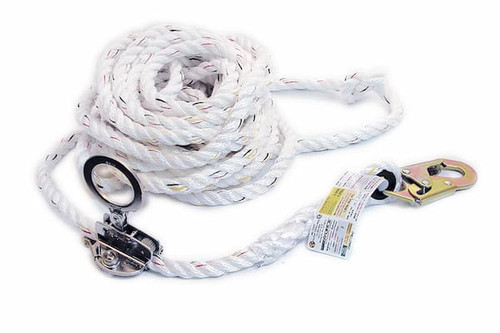



6016-D 72 Inch Heavy Duty Tie-Off Strap, 3-Pack
The Super Anchor 6016-D is a 72 inch heavy duty tie-off strap in 2 inch wide yellow nylon webbing with a 19,600 lb webbing strength, a slotted D-ring on the A-end, and a loop on the B-end. The double length wraps beams, posts, columns, and doubled framing that a 36 inch strap cannot reach, cinching into a 5,000 lb minimum breaking strength temporary anchorage point. USA made.
What is included: 3 heavy duty 6016-D 72 inch tie-off straps. Interior wear pads and a plastic roller inside the loop end protect the webbing, and sewn PID and inspection labels record annual inspections. Rated for one worker at 340 lb including tools, compliant with OSHA 1926.502 and ANSI Z359.1-07.

Who Needs This Product
Commercial framers, steel erectors, and concrete crews anchoring to members too large for a short strap: glulam beams, 6x and 8x posts, steel columns, and doubled trusses. The 72 inch service length wraps the member with enough tail to cinch tight and keep the D-ring positioned for the lifeline or SRL connection. Like all tie-off straps, it is a temporary anchor, removed after use, and it does not absorb shock, so pair it with a personal energy absorber or class 2 SRL-LE whenever free fall exposure exists.
Features
72 inch reach
Wraps large beams, posts, columns, and doubled members that stop a 36 inch strap.
Heavy duty nylon webbing
2 inch wide nylon with a 19,600 lb webbing strength, the strongest webbing in the SAS tie-off line.
Interior wear pads
Wear pads inside the webbing extend service life at the cinch friction points.
Loop end roller
A plastic roller inside the loop protects the webbing as the strap cinches down.
Slotted D-ring
Zinc plated slotted D-ring keeps the connector captive and correctly oriented.
Sewn label system
PID and inspection labels with an elastic label keeper record annual inspections on the strap itself.
Technical Specifications
| Model | 6016-D |
|---|---|
| Package | 3-pack |
| Service Length | 72 inches, measured from connector point to loop end |
| Webbing | 2 inch wide heavy duty nylon with interior wear pads, yellow |
| Webbing Strength | 19,600 lb |
| Minimum Breaking Strength | 5,000 lb assembly |
| Terminations | A-end slotted D-ring, B-end loop |
| Installation | Single D-ring cinch method around structural support |
| Structure Requirement | Wood or steel framing, structural concrete, or PPE anchors supporting 5,000 lb or 2 times the engineered load |
| User Capacity | 1 person, 340 lb maximum including tools and equipment |
| Maximum Free Fall | 6 ft |
| Maximum Arrest Force | 1,800 lb |
| Specified Use | Fall arrest, work positioning, or horizontal lifeline ends; temporary use only |
| Origin | USA made |
| Compliance | OSHA 1926.502; ANSI Z359.1-07 |
Tie-off straps do not absorb shock. An ANSI or CSA certified personal energy absorber or class 2 SRL-LE is required whenever a worker is exposed to a free fall or leading edge. Always attach the connector to the D-ring, never to the loop end, use abrasion protection on sharp steel edges, and remove the strap after use.
Compliance Standards
OSHA 1926.502
Meets federal anchorage criteria of 5,000 lb or 2 times the engineered fall protection load.
ANSI Z359.1-07
Tie-off straps comply with the ANSI fall protection code per the 2026 SAS manual.
340 lb Capacity
Rated for one worker at 130 to 340 lb including tools, above the common 310 lb rating.
USA Manufactured
6015 and 6016 heavy duty straps are USA made per Super Anchor specifications.
Typical Applications
Installation Overview
Cinch methods, steel beam guidance, and concrete embedment figures are in the 2026 Tie-Off Straps manual linked below. The basics:
- Select a structural support capable of holding 5,000 lb or 2 times the engineered fall protection load.
- Wrap the strap around the support and feed the D-ring end through the loop end.
- Cinch the strap tightly so it cannot move horizontally along the member.
- Attach your lifeline snaphook, SRL, or lanyard connector to the D-ring only.
- Add a personal energy absorber or class 2 SRL-LE to the system when any free fall exposure exists.
- Remove the strap when the task is complete; on sheathed framing, evacuate by cutting the strap off so it cannot be reused.
Inspection and Retirement
Inspect before installation and each use, with documented annual inspections. Remove the equipment from service when any of the following apply:
- Webbing is cut, abraded, or shows heat, chemical, mildew, or mold damage.
- Stitching is cut or pulled loose.
- The loop end interior is cut, abraded, or wearing through, or the D-ring roller is missing with damaged webbing beneath.
- The D-ring is deformed, cut, missing, or extremely rusted.
- Warning labels are missing or not legible.
- The strap was subjected to a free fall; dispose of it in a way that prevents further use.
Tag equipment removed from service to prevent further use until inspected by a qualified or competent person.
 Fall Protection
Distributors, LLC Free Tool · No Signup · OSHA 1926.502 Free Interactive Tool Fall Protection Calculator Pick your system. Run the math. Generate a plan. 1Pick Your SystemDetermine fall restraint vs. fall arrest based on your work surface, edge access, and clearance. 2Run the MathCalculate exact fall clearance required below the work surface for your SRL or lanyard setup. 3Generate a PlanGet a printable OSHA-compliant Fall Protection Plan structured around 29 CFR 1926.502(k).
Frequently Asked Questions
Super Anchor 6016-D Submittals and Documentation
Tie-Off Straps Instruction/Specification Manual 2026 (PDF)Material specifications, cinch installation methods, inspection points, and service life for all SAS tie-off straps. Tie-Off Straps on Wood Framing Guide (PDF)Attachment examples and framing requirements for tie-off straps on wood frame structures. Super Anchor Warranty and Compliance Statement (PDF)Manufacturer warranty terms and compliance statement for Super Anchor Safety products.Compatible and Related Products
- Super Anchor 6015-D 36 Inch Tie-Off Straps. Shorter strap for 2x framing and purlins.
- Super Anchor 4020 3-Strand Value Lifeline. Lifeline that snaps to the strap D-ring.
- Super Anchor 2904K Sidewinder SRL. Leading edge cable SRL for strap anchorage.
- Super Anchor 6101GH Deluxe Harness. Full body harness to complete the system.
Anchoring to Steel or Heavy Timber?
Send us the member sizes and we will confirm strap lengths, abrasion protection, and connector pairings for the whole job in one order with accurate freight, based on the delivery location.
Call 863-703-4522 to talk to a fall protection specialist.
Super Anchor Safety Manufacturer Warranty
Super Anchor Safety (SAS) warrants to the purchaser that all products are free from defect in material and workmanship at the time of shipment. This warranty is limited to product replacement for a period of one (1) year from the date of installation or use by the owner, provided that this period shall not exceed two (2) years from the date of shipment. This warranty only covers defects in material and workmanship. It does not cover conditions resulting from normal wear, neglect, abuse, or accident. This product warranty does not cover oxidation of zinc, dacromet, or powder coatings used on permanent and temporary anchors that results from connector abrasion unless the coating can be shown to be defective at the time of purchase. This warranty is non-transferable. Any unused defective product will be replaced at no charge by returning the product to Super Anchor Safety or to the distributor the product was purchased from.
Permanent Anchor Warranty
Super Anchor Safety warrants to the purchaser that all anchors sold as a permanent fixture with Hot Dip Galvanizing, Stainless Steel, and Thermo-Plastic finishes are fully warranted against failure due to defects in materials or workmanship for a period of five (5) years from the date of initial installation. SAS does not warranty the installation or flashing system used to waterproof the anchors. The SAS factory warranty is void if the product has been modified or has not been used in accordance with SAS specifications and instructions for that product. Anchors that have been removed from service due to re-roofing or remodel of the structure they were originally attached to must be inspected by an SAS factory representative or a competent person before being reinstalled.
See the Super Anchor Warranty and Compliance Statement (PDF) for the full manufacturer document.