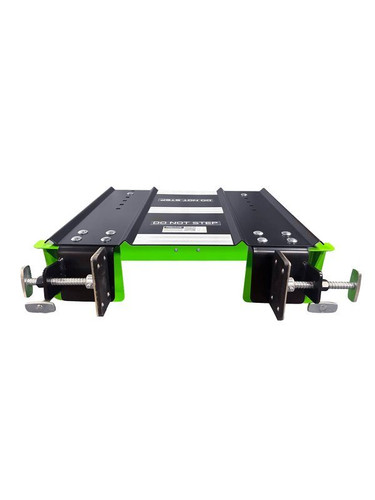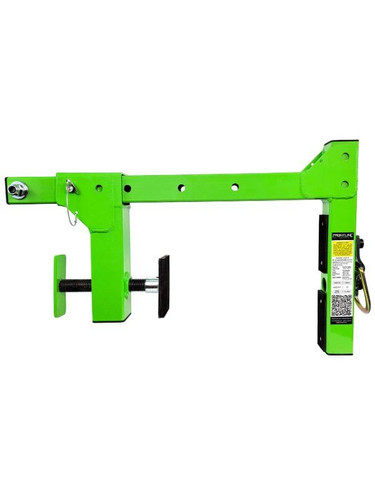


CMT04 Commando Tank Non-Penetrating Fall Protection Cart
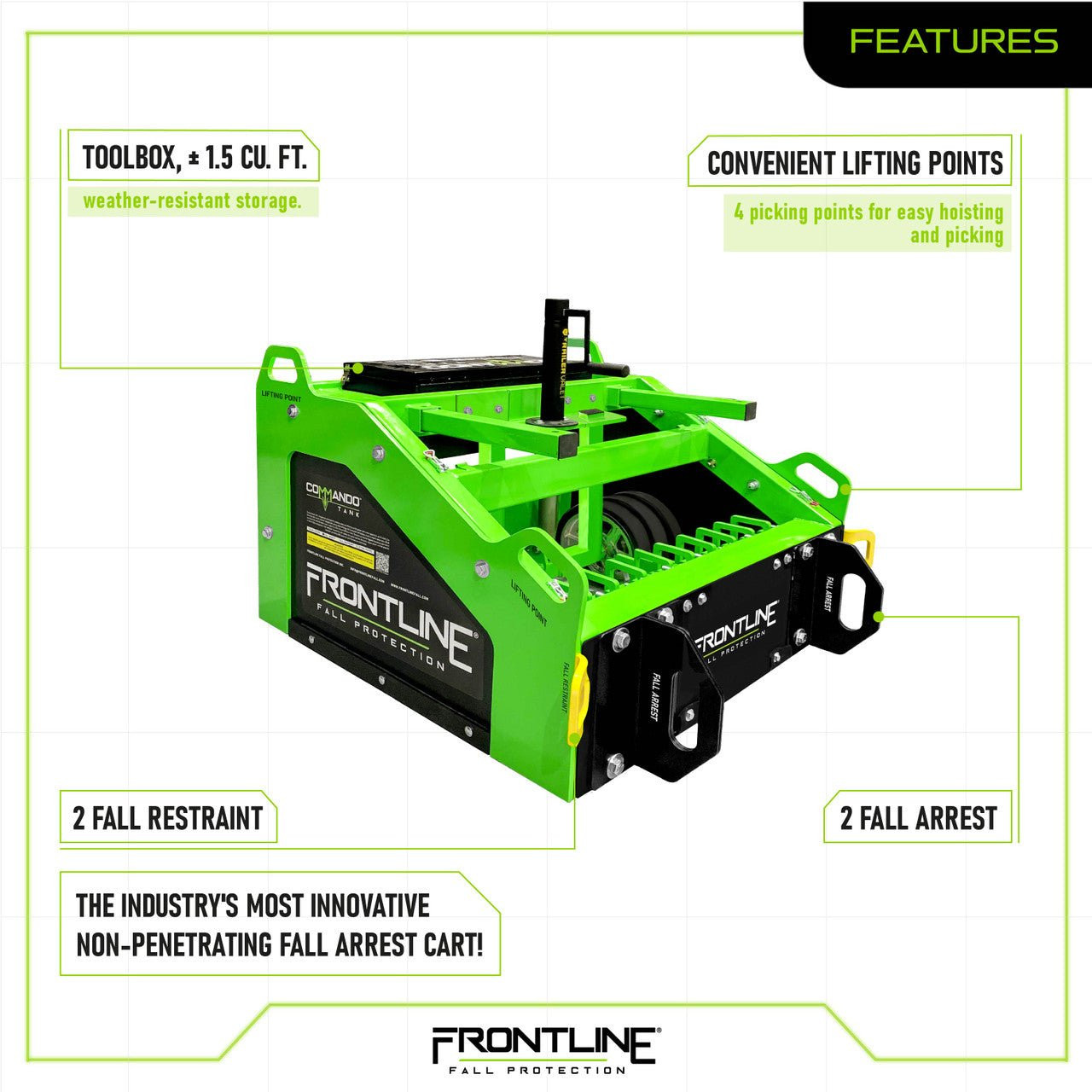
The patent-pending Commando Tank is a mobile, non-penetrating anchor cart that protects up to four workers at once - two in fall arrest and two in fall restraint - on concrete, TPO, EPDM, and asphalt roofs. Color-coded connection points keep the crew organized at a glance: black for fall arrest, yellow for fall restraint, green for the four picking points that let a crane or hoist lift and place the cart exactly where the work is.
High strength ASTM rated steel in electrostatic safety green, rolling on four flat-free tires, with a weather-resistant toolbox (about 1.5 cubic feet) built in and a weather protective cover included. No holes in the roof, no ballast to stack, no anchor points to abandon when the job moves. Compliant with OSHA 29 CFR 1926 and 1910.
Product Video

Watch the Commando Tank work a roof edge: non-penetrating mobile fall protection that counterweights your tie-off point and rolls with the crew.
Who Needs This Product
This product is a mobile anchorage for crews on low-slope commercial roofs where penetrating the membrane is not an option. Roll it to the work area, connect, and work - then roll it to the next section instead of installing and abandoning fixed anchors. Each connected worker still needs a full body harness and a compatible connecting device (SRL or shock-absorbing lanyard). The cart is the anchor, not the complete system.
Features
2 + 2 connection layout
Two dedicated fall-arrest points and two fall-restraint points protect up to four workers from a single cart.
Color-coded points
Black = fall arrest, yellow = fall restraint, green = lifting. No guesswork during tie-off or hoisting.
Truly non-penetrating
Works on concrete, TPO, EPDM, and asphalt with no holes, no sealant, and no membrane repairs when the job ends.
Four picking points
Crane or hoist the cart onto the roof and between work zones with the four green-coded lift points.
Rolls where the work is
Four flat-free tires move the cart across the roof without air pressure checks or flats.
Toolbox and cover included
Weather-resistant onboard storage (about 1.5 cu ft) plus a weather-protective cover for between shifts.
Technical Specifications
| SKU | CMT04 |
|---|---|
| Type | Non-penetrating mobile fall protection cart (patent pending) |
| Total users | 4 - two in fall arrest, two in fall restraint |
| Connection points | 2 fall arrest (black) + 2 fall restraint (yellow); 4 lifting points (green) |
| Application surfaces | Concrete, TPO, EPDM, asphalt |
| Material | High-strength ASTM-rated steel |
| Finish | Electrostatic safety green |
| Dimensions | 49 in L x 44 in W x 30 in H |
| Mobility | 4 flat-free tires |
| Storage | Weather-resistant toolbox, approx. 1.5 cu ft; weather-protective cover included |
| OSHA alignment | 29 CFR 1926; 29 CFR 1910 |
Use the points as marked. Never connect fall arrest to a yellow restraint point or vice versa - the color code exists because the two systems load the cart differently. Position the cart per the user manual for your surface and work zone, one worker per point, and verify fall clearance before anyone ties off to an arrest point.
Compliance Standards
OSHA 29 CFR 1926
Construction industry fall protection, Subpart M - anchorage requirements under 1926.502(d).
OSHA 29 CFR 1910
General industry walking-working surfaces and personal fall protection systems.
Independently tested
Third-party test report available in the Submittals section for your safety manager or GC.
Patent pending design
Frontline's engineered mobile cart platform with color-coded multi-user connection layout.
Typical Applications
Deployment Overview
Deploy per the Frontline user manual. The sequence below is an overview only.
- Inspect. Check the frame, connection points, tires, and labels before each use.
- Lift. Crane or hoist the cart to the roof using all four green picking points.
- Position. Roll the cart to the work zone and orient it per the manual for your surface and the direction of exposure.
- Verify surface. Confirm the roof surface (concrete, TPO, EPDM, or asphalt) and condition match the manual's requirements.
- Connect. Fall arrest workers clip SRLs or shock-absorbing lanyards to the black points; restraint workers to the yellow points - never mixed.
- Work and relocate. When the zone is done, disconnect, roll to the next zone, and re-verify before reconnecting.
Inspection and Retirement
Inspect before each use, with a documented competent-person inspection at least every 6 months under ANSI Z359.2 practice. Pull the cart from service for any of the conditions below.
- Frame and welds: cracks, bending, corrosion beyond surface discoloration, or impact damage.
- Connection points: deformation, elongation, sharp edges, or illegible color coding.
- Tires and axles: damage that prevents controlled movement or stable positioning.
- Hardware: loose or missing fasteners anywhere on the cart.
- Labels: legible and intact.
Retirement triggers: any fall event on the cart, structural deformation anywhere, or any condition where the inspector cannot positively verify the cart is fit for service.
 Fall Protection
Distributors, LLC Free Tool · No Signup · OSHA 1926.502 Free Interactive Tool Fall Protection Calculator Pick your system. Run the math. Generate a plan. 1Pick Your SystemDetermine fall restraint vs. fall arrest based on your work surface, edge access, and clearance. 2Run the MathCalculate exact fall clearance required below the work surface for your SRL or lanyard setup. 3Generate a PlanGet a printable OSHA-compliant Fall Protection Plan structured around 29 CFR 1926.502(k).
Frequently Asked Questions
Frontline CMT04 Submittals and Documentation
Frontline CMT04 Spec Sheet (PDF)Dimensions, materials, user layout, surfaces, and the full compliance summary. Frontline CMT04 Independent Lab Test Report (PDF)Third-party test results for your submittal package. Frontline CMT04 User Instruction Manual (PDF)Positioning, surface requirements, connection rules, inspection, and retirement. Frontline CMT04 Brochure (PDF)Overview brochure for owners, GCs, and safety managers.Compatible and Related Products
- Frontline CMT04-SLR Solar Commando Tank. Upgrade with 8 solar panels, impact sensor, 110 dB siren, and 4,000-lumen headlights.
- Frontline GUS Non-Penetrating Guardrail Kit. Passive edge protection in 50, 75, and 100 ft kits.
- Frontline HLK1004 4-Person 100 ft Horizontal Lifeline Kit. Rope HLL for crews working a long edge.
- Frontline HCLL260 Elite 2-Person 60 ft Cable Horizontal Lifeline. Retractable cable HLL with built-in winch.
- Frontline GUM Manhole Guardrail. Portable opening protection for roof and ground-level access points.
Buying Mobile Fall Protection for a Crew?
Need help specifying the right system for your jobsite? Confirm your application, anchorage, and clearance with us and we will walk through the kit list so the right equipment ships together.
Call 863-703-4522 to talk to a fall protection specialist.