

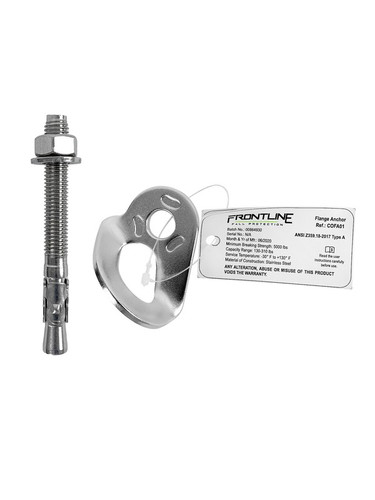
Three Stainless Flange Anchors with Bolts, One Checkout
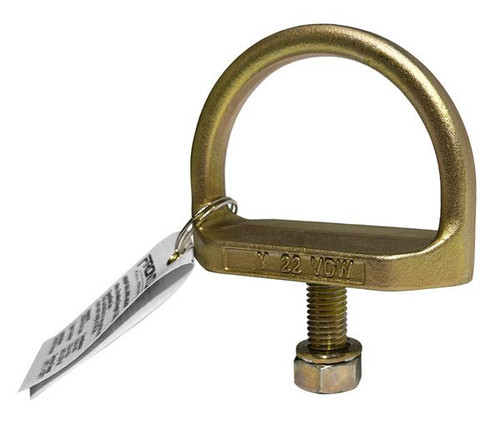
The Frontline COFA01 is a stainless steel flange anchor, a single-point anchorage connector that fixes to walls, ceilings, roof tops, and steel structures and gives one worker a 5,000 lb rated tie-off point. It is suited to temporary or permanent installation in cured concrete or steel, and the stainless steel construction resists corrosion in open and outdoor locations. The bolt is included, so each anchor arrives ready to set.
Each anchor carries a 5,000 lb minimum breaking strength and a 130 to 310 lb user capacity range, and is marked ANSI Z359.18-2017 Type A with OSHA 1926 and 1910 in its compliance data. The anchor was dynamic and static tested in concrete by Intertek, and the test report is linked below. Sold as a 3-pack: three COFA01 flange anchors with bolts ship together.
Who Needs This Product
This product is an anchorage connector, the fixed tie-off point of a personal fall protection system. The concrete or steel it is fastened to is the anchorage; the worker wears a full body harness; a lanyard or self-retracting lifeline connects the two. The COFA01 supplies the rated connection point, one worker per anchor, and this 3-pack gives a crew a set of points to install on a wall, deck edge, roof, or steel frame in one order.
Features
Stainless steel plate
Polished stainless steel construction for better corrosion resistance in open and outdoor areas.
5,000 lb breaking strength
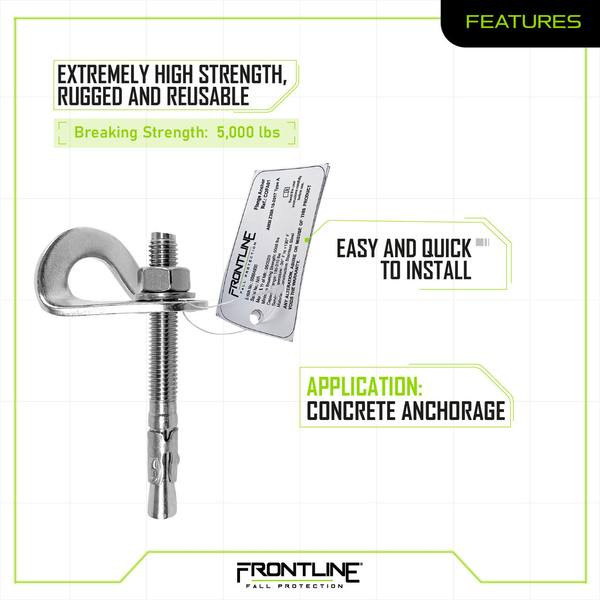
Frontline describes the anchor as extremely high strength, rugged, and reusable, with a 5,000 lb minimum breaking strength.
Walls, ceilings, roofs, steel
One anchor style for walls, ceilings, roof tops, and steel structures, in temporary or permanent installations.
Bolt included
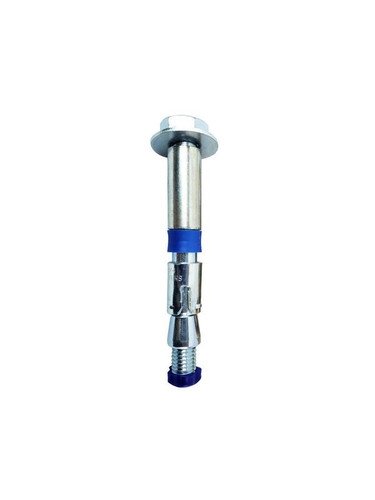
Each anchor ships with its bolt, nut, and washer, so there is no separate fastener to source for the install.
Easy and quick to install
Set the bolt, seat the flange plate over it, and tighten the nut. Frontline lists a chemical or mechanical fastener install.
Lab tested
Intertek dynamic and static strength testing in concrete to ANSI/ASSP Z359.18-2017, with all samples passing.
Technical Specifications
| SKU | COFA01-3PK (3 anchors with bolts) |
|---|---|
| Frontline part numbers | COFA01 flange anchor + COFA01RB bolt |
| Type | Single-point flange anchorage connector, ANSI Z359.18-2017 Type A |
| Minimum breaking strength | 5,000 lbs / 23 kN |
| Capacity range | 130 to 310 lbs (one worker per anchor, including tools and clothing) |
| Material | Stainless steel |
| Finish | Polished |
| Net weight | 0.13 lbs per flange anchor |
| Fastener | Compatible with a 1/2 in bolt and nut; bolt included |
| Service temperature | -30 F to +130 F (-34 C to +54 C) |
| Substrates | Cured concrete (9 in minimum thickness, 11 in minimum edge distance per the manual); steel structures with an M12 mechanical fastener per the manual |
| Estimated lifespan | 10 years from date of manufacture (manual) |
| Standards | ANSI Z359.18-2017 Type A; OSHA 1926.502; OSHA 1910.140 |
| Third-party testing | Intertek report 105938082CRT-001, September 30, 2024 |
| Package | 3 flange anchors with bolts per pack |
The anchor is only as strong as what it is fastened to. ANSI testing covers the hardware, not the concrete or steel it is installed in. The substrate must withstand 5,000 lbs per attached worker or be certified by a qualified person, and a competent person should verify the concrete, the hole, and the installation before anyone ties off. One worker per anchor, 310 lbs maximum including tools.
Compliance Standards
ANSI Z359.18-2017 Type A
The anchor is marked ANSI Z359.18-2017 Type A. Intertek tested it in concrete: dynamic strength from a 3 ft free fall, residual dynamic strength, and a 5,000 lb static load held for 3 minutes, all passing. Third-party test report linked in Submittals.
OSHA 29 CFR 1926.502
Federal construction fall protection criteria. Frontline lists 1926.502 on the spec sheet.
OSHA 29 CFR 1910.140
General industry personal fall protection systems. Frontline lists 1910.140 on the spec sheet.
Marking and Instructions
The test report records a pass on product marking and user instruction requirements, including a tag with batch traceability on every anchor.
Typical Applications
Installation Overview
Follow the manufacturer's manual. The sequence below is an overview only.
- Verify the substrate. A competent person confirms the concrete or steel can support 5,000 lbs per attached worker. For concrete, the manual calls for at least 9 in of thickness and at least 11 in from the hole to the edge.
- Drill and clean the hole. Drill to the diameter and depth given in the manual, then blow out the dust and standing water so the hole is free of dust, water, ice, oil, and other contaminants.
- Set the fastener. Per the manual, a chemical fastener is set with the setting tool and left for a minimum of 24 hours to cure before loading.
- Mount the flange anchor. Slip the flange anchor over the bolt, add the washer, and tighten the nut fully.
- Steel structures. On steel, use an M12 mechanical fastener of appropriate length for the steel thickness, as the manual specifies.
- Connect. Attach the lanyard or SRL connector to the eye of the flange anchor; one worker per anchor, with a rescue plan ready.
Inspection and Retirement
Inspect before each use, with a documented competent-person inspection at least every 6 months. The anchor has an inspection grid on its tag for recording dates. Pull the equipment from service for any of the conditions below.
- Plate and eye: cracks, bends, deformation, nicks, or corrosion.
- Bolt, nut, and washer: damaged threads, loosening, movement, or pull-out from the substrate.
- Substrate: cracking or spalling of the concrete, or damage around the anchor.
- Markings: tag and rating legible.
- Seating: flange plate seated firmly with the nut fully tightened.
Retire the equipment immediately after any fall arrest event or if any inspection point fails; Frontline gives an estimated lifespan of 10 years from manufacture. Destroy retired anchors so they cannot return to service.
 Fall Protection
Distributors, LLC Free Tool · No Signup · OSHA 1926.502 Free Interactive Tool Fall Protection Calculator Pick your system. Run the math. Generate a plan. 1Pick Your SystemDetermine fall restraint vs. fall arrest based on your work surface, edge access, and clearance. 2Run the MathCalculate exact fall clearance required below the work surface for your SRL or lanyard setup. 3Generate a PlanGet a printable OSHA-compliant Fall Protection Plan structured around 29 CFR 1926.502(k).
Frequently Asked Questions
Frontline COFA01 Submittals and Documentation
Frontline COFA01 Spec Sheet (PDF)Design specifications, material, breaking strength, net weight, and relevant standards. Frontline COFA01 Test Report (PDF)Intertek report 105938082CRT-001 to ANSI/ASSP Z359.18-2017. Frontline COFA01 User Manual (PDF)Installation, use, inspection, maintenance, and retirement procedures.Compatible and Related Products
- Frontline COM345K MEGA Swivel 5k Concrete Anchor. A 5,000 lb swivel anchor for concrete.
- Frontline STB01 Steel Bolt Threaded Anchor (3-Pack). A reusable bolt-on anchor for structural steel.
- Frontline SBW01 Weld/Bolt-on Steel and Concrete Anchor. A dual-substrate plate anchor for steel or concrete.
- Frontline 100CTB Combat Construction Harness. The full body harness the worker wears with the anchor.
Specifying Anchorage for Your Crew?
Anchors, harnesses, and connectors have to match the substrate and the work. Confirm your application, anchorage, and clearance with us and we will walk through the kit list so the right equipment ships together.
Call 863-703-4522 to talk to a fall protection specialist.