

OTP21 Overhead Tripod Anchor
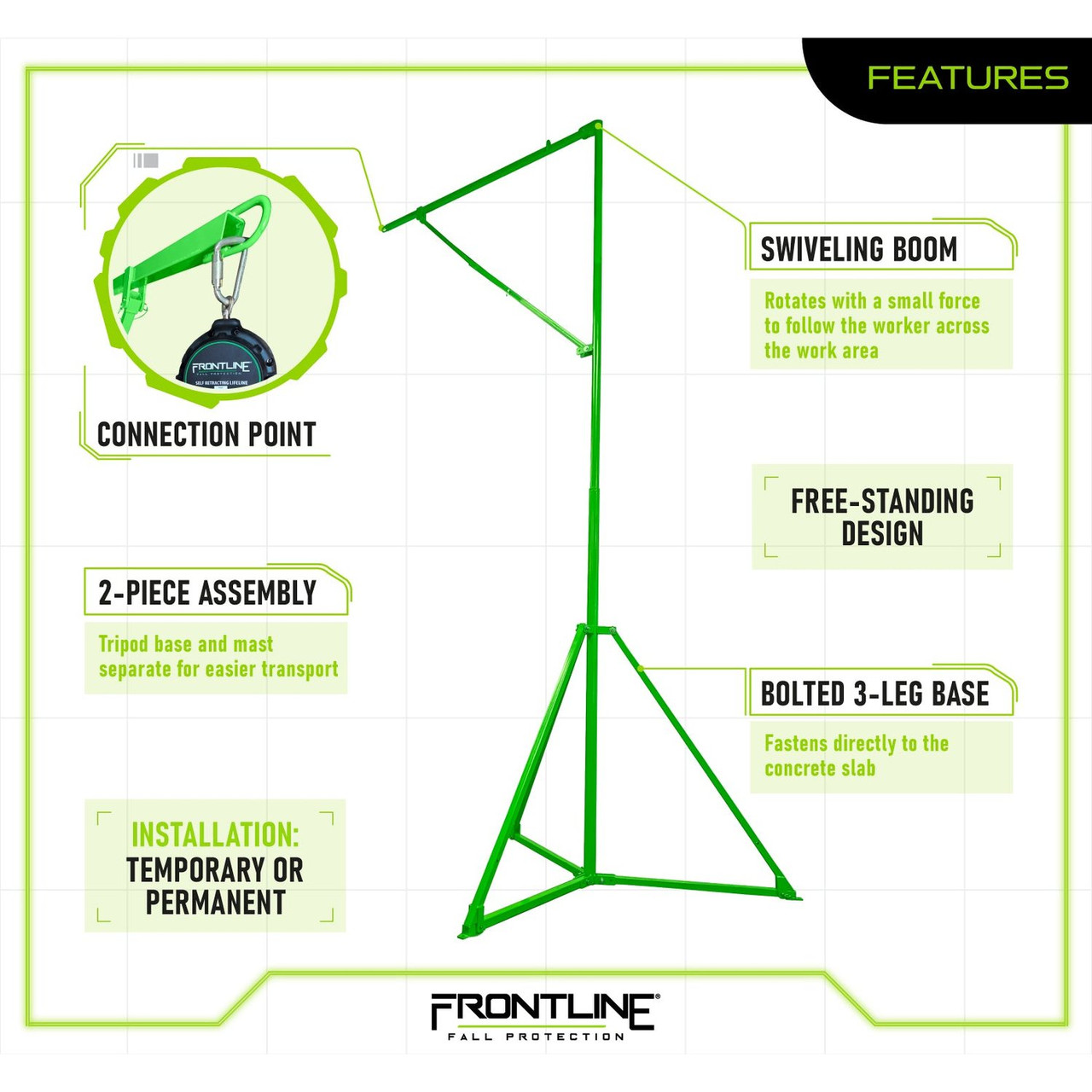
The Frontline OTP21 is a free-standing overhead anchorage connector for one person, built for the places where there is nothing above the worker to tie off to: open slabs, decks, yards, and loading areas. A three-legged tripod base fastens to a concrete slab with three expansion anchors, and a mast with a horizontal boom seats into the central post of the base. The anchor point at the end of the boom sits 20 ft 6-1/2 in above the base, well above the worker's dorsal D-ring.
The boom reaches 8 ft 8 in from the mast and swivels with a small force, so the anchor point follows the worker across the work area. Frontline requires a Class 1 or Class 2 self-retracting lifeline (SRL) on the anchor point. The tripod base and mast separate into two assemblies for transport, and the unit can be relocated to a new slab with new concrete anchors.
What is included: tripod base, mast assembly with boom and gas-spring strut, three Hilti KB-TZ2 5/8 in x 6 in concrete anchors, and the user instruction manual. The SRL, harness, and tag line shown in some photos are sold separately.
Who Needs This Product
This product is an anchorage connector, the part of a personal fall arrest system that gives the worker a rated place to tie off. It is for sites that have a sound concrete slab but no overhead structure: loading and unloading flatbed trailers, precast and laydown yards, equipment pads, and open decks. A qualified person must verify the slab before installation, and each worker still needs a full body harness and a Class 1 or Class 2 SRL. The OTP21 is not a complete fall arrest system on its own.
Features
Swiveling boom
The boom rotates on the mast with a small force and follows the worker across the work area. The manual instructs users to stay beneath the anchor point at all times.
True overhead tie-off
The anchor point sits 20 ft 6-1/2 in above the base, above the dorsal D-ring, which reduces swing fall and the fall clearance needed compared with foot-level tie-off.
Free-standing on concrete
Creates an overhead anchor where no suitable structure exists. The three foot plates bolt to a concrete slab; no beam, column, or roof framing is required.
Two-piece assembly
The tripod base (about 209 lb) and mast assembly (about 165 lb) separate for transport, handling, and storage, and go together in the field with leg pins, a strut pin, and clip pins.
Concrete anchors included
Ships with three Hilti KWIK BOLT TZ2 5/8 in x 6 in carbon steel expansion anchors, one per foot plate, torqued to 40 ft-lb.
Temporary or permanent
Approved for temporary or permanent installation and fully reusable. The concrete anchors are single-use, so each new location needs a new set of three.
Integrated lifting eyes
Lifting eyes on the boom are provided for hoisting the mast into the central post during installation. They are not anchor points.
Powder-coated steel
ASTM rated steel with a safety green powder-coated finish for jobsite exposure. Frontline lists a service temperature range of -30 F to +130 F.
Technical Specifications
| Type | Free-standing overhead anchorage connector |
|---|---|
| SKU | OTP21 |
| Approved applications | Personal fall arrest and restraint; work positioning and rescue are not approved |
| Users | 1 person |
| User capacity | 310 lb (140 kg) including clothing and tools |
| Minimum breaking strength | 5,000 lb (22.2 kN) per attached person |
| Connecting device | Class 1 or Class 2 SRL meeting ANSI/ASSP Z359.14 (not included) |
| Connection point | One: the load rod at the end of the boom |
| Overall height | 20 ft 9 in (6,331 mm) |
| Anchor point height above base | 20 ft 6-1/2 in (6,261 mm) |
| Boom reach | 8 ft 8 in (2,647 mm), mast to boom end |
| Base footprint | 103.5 in x 89.6 in; feet on a 9 ft 11 in diameter circle, legs 120 degrees apart |
| Working angle | SRL within 25 degrees of vertical on all sides |
| Anchor point deflection | 12 in (30 cm); add to fall clearance |
| Weight | Tripod base approx. 209 lb; mast assembly approx. 165 lb; total approx. 374 lb (170 kg) |
| Approved substrate | Normal-weight concrete, 3,000 psi minimum, 6 in minimum thickness, flat and level |
| Fasteners (included) | 3 Hilti KB-TZ2 5/8 in x 6 in carbon steel expansion anchors; 4-1/2 in minimum embedment; 40 ft-lb |
| Minimum edge distance | 8-3/4 in from any slab edge, joint, crack, opening, or embedded item |
| Wind limits | Do not install or remove above 20 mph; do not use above 28 mph or when lightning is possible |
| Service temperature | -30 F to +130 F |
| Material and finish | ASTM rated steel, powder coated safety green |
| Standards | OSHA 29 CFR 1926.502; OSHA 29 CFR 1910.140 |
| Warranty | Frontline 1-year limited warranty |
Slab verification and lifting. Before installation, a qualified person must verify that the slab and its supporting structure can resist the loads from the OTP21, including uplift and shear on the anchors. Installing the unit means hoisting a tall, heavy mast: Frontline requires trained personnel under a competent person, rated lifting equipment and rigging run by a qualified operator, and at least 20 ft of clearance from overhead power lines. Never leave the tripod base standing unattended until all three anchors are installed and torqued. The anchor point is not approved for rescue loads, so the rescue plan must include another way to reach a worker suspended below the boom.
Compliance Standards
OSHA 29 CFR 1926.502
Construction fall protection system criteria. The anchorage must support at least 5,000 lb per attached employee, or be used under a qualified person as part of a complete system with a safety factor of at least two.
OSHA 29 CFR 1910.140
General industry personal fall protection systems. The OTP21 product label is marked for conformance with 1910.140 and 1926.502.
ANSI/ASSP Z359.14 SRL required
Frontline specifies a Class 1 or Class 2 SRL meeting Z359.14 as the connecting device. A lanyard may be used only if the required fall clearance can be met.
Qualified person verification
A qualified person verifies the concrete and location, and a competent or qualified person must inspect and record each completed installation before anyone uses it.
Typical Applications
Installation Overview
Installation must follow the Frontline user instruction manual and be supervised by a competent person. The sequence below is an overview only. You will need a rotary hammer drill with a 5/8 in carbide bit, a calibrated torque wrench, a tag line, and lifting equipment and rigging rated for the mast assembly.
- Verify and plan. Confirm a qualified person has verified the slab and location. Place the tripod so the anchor point will be over the work area, check for overhead power lines and traffic, and barricade the installation area.
- Open and stand the base. Swing out each leg and leg brace, install the leg pins, and lock them with the clip pins. Stand the base on its three feet and hold or brace it until it is anchored.
- Anchor to the concrete. Check that all three foot plates sit flat and each hole is at least 8-3/4 in from any edge, joint, or crack. Drill through each foot plate to at least 4-3/4 in deep, clean the holes, drive the KB-TZ2 anchors, and torque each nut to 40 ft-lb.
- Assemble the mast on the ground. Swing the boom out, install the strut pin and clip pin, then connect the SRL to the anchor point and attach a tag line to the SRL snap hook. Keep clear of the boom and gas-spring strut.
- Lift and seat the mast. Rig to the lifting eye on top of the boom, never to the anchor point or SRL. Lift the mast slowly to vertical under the qualified rigger's lift plan and lower it into the central post until the mast seat rests fully on the post.
- Check and sign off. Confirm the mast is plumb, the boom is level and swivels freely, and all pins and anchor nuts are in place. A competent or qualified person inspects the installation and records it in the log before first use.
Inspection and Retirement
Before each use, inspect the OTP21 from the ground and do a functional pull test: pull the SRL line down with the tag line and give it a firm, quick pull. The SRL must lock and the boom and anchor point must hold. A competent or qualified person must inspect the anchor point, boom, strut, and pins up close from an aerial lift at least once a month, and a competent or qualified person other than the user must perform a documented inspection at least every 6 months. Frontline assigns no fixed service life; the unit stays in service only while it passes inspection.
- Position: the unit has not moved or been struck, the mast is plumb, and the boom is level at 90 degrees to the mast.
- Pins: leg pins, strut pin, and all clip pins are installed, secured, and undamaged.
- Boom and strut: boom swivels freely; strut is not bent or damaged and shows no oil leaks.
- Anchor point and lifting eyes: no bends, cracks, wear, or corrosion.
- Concrete anchors: nuts tight, foot plates flat, and no cracks or spalling around the feet.
- Labels: present and legible on the central post.
Retirement triggers: any fall arrest or impact loading, vehicle or equipment impact, a damaged or leaking strut, a boom that does not stay level, corrosion, a failed inspection item, or missing or illegible labels. An anchor that has arrested a fall must be removed from service once the worker is recovered.
 Fall Protection
Distributors, LLC Free Tool · No Signup · OSHA 1926.502 Free Interactive Tool Fall Protection Calculator Pick your system. Run the math. Generate a plan. 1Pick Your SystemDetermine fall restraint vs. fall arrest based on your work surface, edge access, and clearance. 2Run the MathCalculate exact fall clearance required below the work surface for your SRL or lanyard setup. 3Generate a PlanGet a printable OSHA-compliant Fall Protection Plan structured around 29 CFR 1926.502(k).
Frequently Asked Questions
Frontline OTP21 Submittals and Documentation
Frontline OTP21 Spec Sheet (PDF)Features, design specifications, dimensions, and relevant OSHA standards. Frontline OTP21 User Instruction Manual (PDF)System specifications, substrate and fastener requirements, installation, working angle, inspection log, and warranty.Compatible and Related Products
- Frontline RSBC Sealed Block Stainless Steel SRL. Sealed stainless steel SRL in 50 ft and 80 ft lengths for corrosive environments.
- Frontline RPGC Cable Single Leg SRL with Carry Handle and Tagline. Cable SRL with a tagline, useful for pulling the line down from an overhead anchor.
- Frontline 100CTB Combat Construction Full Body Harness. Full body harness with a dorsal D-ring for connection to the SRL.
- Frontline CMT04 Commando Tank Non-Penetrating Fall Protection Cart. Mobile non-penetrating anchor cart for flat roofs and decks where bolting to concrete is not an option.
Planning an Overhead Anchor for a Slab or Loading Area?
Slab strength, anchor edge distance, SRL selection, and fall clearance all have to line up before the tripod goes up. Tell us about your work area and we will help you confirm the OTP21 is the right fit and ship the SRL and harness with it.
Call 863-703-4522 to talk to a fall protection specialist.