ABCs of Fall Arrest (Talk #7)
Posted by Howie Scarboro - COO- Fall Protection Distributors, LLC on Sep 08, 2026
By Howie Scarboro, COO, Fall Protection Distributors, LLC · Last verified against the eCFR and osha.gov: September 2, 2026
For information purposes only. This page supports your safety planning; it does not replace professional judgment. All safety plans and fall protection decisions for the task must be reviewed and approved by a Competent Person or a Qualified Person before work begins, as required by OSHA.
What Are the ABCs of Fall Protection? The Quick Answer
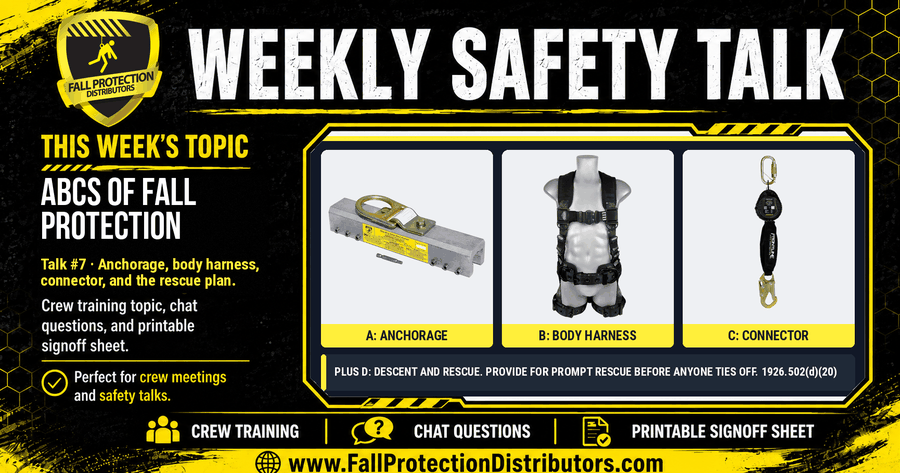
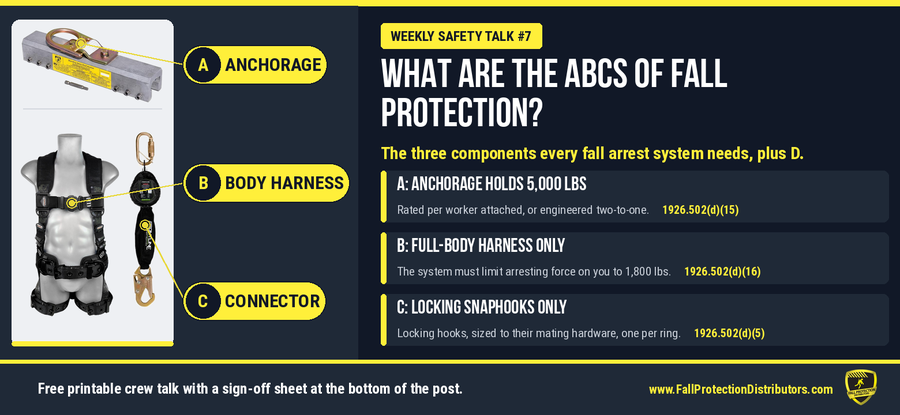
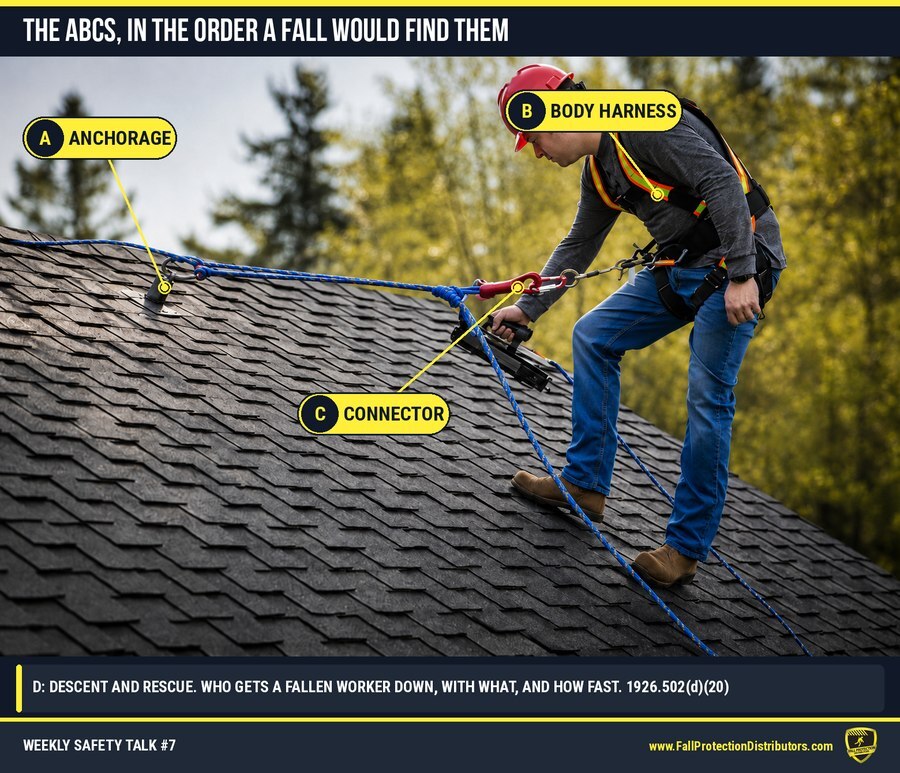
The ABCs are the three components every personal fall arrest system needs: A is the Anchorage, rated for 5,000 pounds per worker or engineered with a two-to-one safety factor under a Qualified Person (29 CFR 1926.502(d)(15)); B is the Body harness, the only body support allowed for fall arrest, which must limit the force on you to 1,800 pounds (1926.502(d)(16)); and C is the Connector, the lanyard or self-retracting lifeline plus the hardware joining it all, built to 5,000-pound tensile strength with locking snaphooks only (1926.502(d)(3) and (d)(5)). The bonus letter that can save lives after the fall adds a D for Descent and rescue, because OSHA requires you to provide for prompt rescue before anyone ties off (1926.502(d)(20)), and a worker hanging in a harness is on a clock.
This is Talk #7 in our Weekly Safety Talk series, and it is one of the most critical lessons for a new hire. Talk #4 went deep on anchor points, Talk #5 on arrest versus restraint, and Talk #6 on the clearance math.
A Is for Anchorage: The Component That Secures Everything
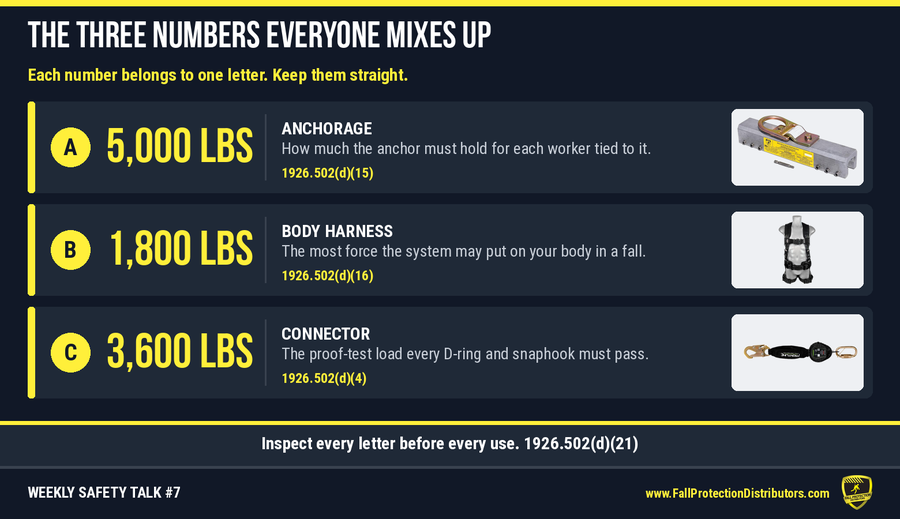
The anchorage is the secure point of attachment for the rest of the system (29 CFR 1926.500(b)). It must support at least 5,000 pounds per employee attached, or be designed as part of a complete system with at least a two-to-one safety factor under the supervision of a Qualified Person (29 CFR 1926.502(d)(15)). It must be independent of anything supporting or suspending your work platform, and it can never be a guardrail or a hoist (1926.502(d)(23)). On standing seam metal, a seam anchor like the SSRA1 grips the seam without penetrations and carries published test data. On shingles, a nail-on peak anchor that is mechanically fastened into framing. On exposed-fastener metal, an anchor made for that panel profile, installed through the panel into the structure underneath per the manufacturer's instructions. The full anchor conversation, including what never qualifies, is in Talk #4.
B Is for Body Harness: The Letter You Wear
Fall arrest requires a full-body harness, period. Body belts have been prohibited for fall arrest since 1998 (1926.502(d) and 1910.140(d)(3)) because a belt concentrates arrest force on the abdomen, while a harness distributes it across the thighs, pelvis, chest, and shoulders. The system must limit the maximum arresting force to 1,800 pounds (1926.502(d)(16)), and the harness's dorsal D-ring is the required attachment point. Three rules of thumb: First, since January 13, 2025, OSHA's construction PPE rule requires equipment to fit each worker who wears it properly (29 CFR 1926.95(c)), so the days of one universal harness for a five-person crew are legally over. Second, inspect it before every use (1926.502(d)(21)); Talk #3 discusses the entire inspection process. Third, adjust the harness for a perfect fit: leg straps snug, chest strap at mid-chest, dorsal D-ring centered between the shoulder blades. A perfect harness worn loose turns an arrest into an injury, and a worker can slide out if too loose. Our harness lineup covers sizes from small through the big-and-tall range for exactly that reason.
C Is for Connector: The Letter That Locks Everything Together
The connector is everything between the anchorage and the harness: the lanyard, SRL, or lifeline doing the attachment, and the hardware on its ends. D-rings and snaphooks must have a minimum tensile strength of 5,000 pounds (1926.502(d)(3)), and each one must also pass a proof test at 3,600 pounds without cracking, breaking, or taking permanent deformation (1926.502(d)(4)). Since January 1, 1998, only locking-type snaphooks are allowed (1926.502(d)(5)). Connecting devices come in two main categories, and choosing between them is as much a clearance decision as a preference: a shock-absorbing lanyard allows up to 6 feet of free fall and needs roughly 19.5 feet of clearance below a foot-level anchor. At the same time, a self-retracting lifeline keeps the line near-taut and dramatically reduces the fall clearance requirement. Talk #6 covered the fall clearance calculations in depth, so check it if you need a quick refresher on this topic.
The Compatibility Trap: When Good Components Make a Bad System
Each component can be properly rated and individually inspected, yet the assembled system can still fail because the connectors are incompatible. The OSHA standard addresses this directly: snaphooks must be sized to be compatible with the member they connect to, to prevent unintentional disengagement (1926.502(d)(5)), and unless designed for it, a snaphook cannot be engaged directly to webbing or rope, to another snaphook, to a D-ring that already has another connector in it, to a horizontal lifeline, or to any object shaped so the hook could roll off it (1926.502(d)(6)). This type of connector failure is known as roll-out. Side pressure on a non-compatible connection can force the gate open. Workers need training in proper connections to prevent roll-out: one connector per D-ring; never hook a snaphook back onto its own lanyard webbing unless the lanyard is built for tieback connection; never daisy-chain hooks; and match connector sizes.
D Is for Descent and Rescue: The Letter That Saves Lives
The ABCs describe the system needed to survive a fall. D is about surviving after the fall arrest. The rule is simple: "The employer shall provide for prompt rescue of employees in the event of a fall or shall assure that employees are able to rescue themselves" (1926.502(d)(20)). The reason for the urgency is physiological: a motionless worker hanging in a harness has leg straps compressing the veins that return blood to the heart, and suspension trauma can turn an arrest fall into a tragedy in minutes. A safety plan answers three questions at the safety meeting: who gets a fallen worker down, with what equipment, and how fast. Ladders staged and tall enough, an aerial lift on site, a rescue-rated descent device, trauma relief straps on the harnesses so a hanging worker can stand in loops and buy time, and a phone call to 911. Rescue and suspension trauma deserve a full talk of their own, and one is planned later in the series.
Building the Kit by Trade
| Crew | A: Anchorage | B: Body harness | C: Connector | D: Descent and rescue |
|---|---|---|---|---|
| Standing seam metal roofer | Seam clamp anchor (SSRA1), moved above the work area | Sized harness per worker, fit-checked under the 2025 PPE rule | Rope grab on a vertical lifeline, or SRL; run the clearance math first | Ladder staged, trauma straps, crew rescue walk-through |
| Shingle and steep-slope residential | Nail-on peak anchor into framing per instructions | Same; leg straps snug every time | Rope grab on a lifeline is the working standard; restraint rigging on low eaves | Same, plus a second ladder for the far slope |
| Low-slope commercial | Deck-rated anchors or horizontal lifeline under a Qualified Person | Same | SRL for mobility along the edge; watch swing fall at corners | Aerial lift or rescue device on site |
| Maintenance tech, general industry | Certified building anchors or overhead structure per 1910.140 | Same | Class 1 SRL from overhead where possible | Facility rescue plan, documented and drilled |
Each situation requires the same ABC guidelines; the hardware changes depending on the situation. And every row assumes the trigger-height rules from Talk #1: 6 feet in construction federally, 4 feet in general industry, and stricter in some states, with the full map in our regulations database.
The Two-Minute ABC Check
Let's start at A: what is the anchor today, who installed it, and does the documentation cover this roof type? Then B: every worker's own harness inspected, buckles worked, straps snug, D-ring centered; a two-minute routine that Talk #3 breaks down step by step. Then C: the connecting device inspected the same way, the shock pack intact or the SRL retracting cleanly, connectors properly locking, one connector per ring, and the fall clearance math already run for this device on this roof. Then D: if somebody falls today, who does what, with what equipment, and how fast. The crews that do a daily safety check prevent issues before they arise.
ABC Violations Are Costly
Fall protection has topped OSHA's most-cited violations list for over a decade, and citations are usually for simple issues: using a body belt instead of a full-body harness, a non-locking hook, or one D-ring carrying two connectors. In 2026, a serious violation can run up to $16,550, and a willful or repeat violation up to $165,514 (OSHA penalties). A complete, compliant ABC kit for one worker costs a few hundred dollars.
Frequently Asked Questions
What do the ABCs of fall protection stand for?
A is Anchorage, the rated attachment point. B is Body harness, the full-body support that distributes arrest forces. C is Connector, the lanyard or self-retracting lifeline and its hardware. Safety trainers increasingly add D for Descent and rescue, since OSHA requires employers to provide for prompt rescue under 29 CFR 1926.502(d)(20).
What are the components of a personal fall arrest system?
An anchorage rated at 5,000 pounds per worker or engineered two-to-one, a full-body harness that limits arresting force to 1,800 pounds, and a connecting device with locking snaphooks of 5,000-pound tensile strength. All three must be inspected before each use under 1926.502(d)(21).
Can I use a body belt for fall arrest?
No. Body belts have been prohibited as part of a personal fall arrest system since 1998, under both 1926.502(d) and 1910.140(d)(3). Fall arrest requires a full-body harness. Belts are used only for positioning and some restraint applications.
What is snap hook roll-out?
Roll-out is when side pressure on an incompatible connection forces a snap hook's gate open and the hook releases without anything breaking. It is why 1926.502(d)(5) and (d)(6) require locking hooks sized to their mating hardware, one connector per D-ring, and no hook-to-hook or hook-to-webbing connections unless the equipment is designed for them.
Do fall protection components from different brands work together?
Legally, yes, there is no single-brand rule. Compatibility means hook throat sizes, D-ring dimensions, and energy absorber ratings must match as a mated pair, so a Competent Person should verify any mixed-brand connection against both manufacturers' instructions before using it or approving it for use on the jobsite.
What is the D in the ABCDs of fall protection?
Descent and rescue. 29 CFR 1926.502(d)(20) requires the employer to provide for prompt rescue of a fallen worker or ensure self-rescue, and suspension trauma makes speed a medical requirement, not a preference. The plan names the rescuers, the equipment on this site, and the timeline before anyone ties off.
Does a new hire need fall protection training before working at height?
Yes. 29 CFR 1926.503 requires training by a competent person on the fall hazards of the work and the systems in use, with written certification of that training. Retraining is required when equipment changes, the site changes, or the worker shows they did not retain it.
How do I know if my harness fits correctly?
Leg straps snug enough to slide a flat hand under but not a fist, chest strap across mid-chest, dorsal D-ring centered between the shoulder blades, and no excessive slack. Since January 13, 2025, 29 CFR 1926.95(c) requires PPE to fit each worker properly, so fit is a compliance item, not a comfort item.
What is a safety harness?
A safety harness is the body support of a personal fall arrest system: an arrangement of straps that fits around the thighs, pelvis, chest, and shoulders so the force of stopping a fall spreads across the strongest parts of the body instead of concentrating on the abdomen. The system must limit the arresting force on the worker to 1,800 pounds (29 CFR 1926.502(d)(16)), and the dorsal D-ring between the shoulder blades is the normal fall-arrest attachment point.
How does a safety harness work?
The harness does not stop the fall by itself; the system does. The anchorage provides the foundation for the connecting device to catch the fall and absorb energy, and the harness holds your body, spreads that arrest force across the thighs, pelvis, chest, and shoulders, and keeps you upright for rescue.
What is the D-ring on a safety harness used for?
The dorsal D-ring, centered between the shoulder blades, is the fall arrest attachment point; connecting your lanyard or self-retracting lifeline there keeps you upright during and after an arrest (29 CFR 1926.502(d)(17)). Other rings have other jobs: side D-rings are for positioning, and a front ring is for ladder climbing systems or controlled descent, per the manufacturer's instructions. Fall arrest connects at the dorsal ring unless the manufacturer says otherwise.
What are fall protection systems?
Fall protection systems come in two families. Passive systems protect everyone without any action by the worker: guardrails, safety nets, and covers. Active systems require equipment on the worker: personal fall arrest, which is the ABC system in this talk, and travel restraint, which keeps you from reaching the edge. OSHA's menu of options for construction is in 29 CFR 1926.501(b)(1), and the ABCs apply to the active side of the list.
Toolbox Quiz: Test Your Crew
Five questions from this week's talk. Discuss these questions at the safety meeting, let the crew argue, then score it. The one-page printable ABC crew talk lets the foreman run this talk at any safety meeting, with a crew sign-off table for your training records (29 CFR 1926.503(b) requires written certification). It's free, and you don't have to give us an email address to get it.
That is the ABCs: an anchorage that holds, a harness that fits, connectors that lock and match, and a rescue plan that exists before the fall instead of after it. Teach it to every new hire in this order, with these numbers, and the deep-dive talks linked above are there when they are ready for the next layer. If you have a question about your own kit or a component pairing you are not sure about, send it through our contact page; we read every one, and answers may become future talks.
Work safe up there.