Fall Protection Strategies For Imetco Standing Seam Roofs
Posted by Howie Scarboro - CEO Fall Protection Distributors, LLC on Apr 22nd 2026

See the Roof Anchor Compatibility Chart for IMETCO Standing Seam Panels.
Who Is IMETCO?
Since 1994, IMETCO (Innovative Metals Company, Inc.) has been a driving force in the high-performance building envelope industry. Based in Norcross, Georgia, they have built a reputation for engineering metal roof and wall systems that handle the most extreme environmental loads while maintaining a high-end architectural aesthetic. Imetco acquired Martin Fireproofing in 2015. This strategic move allowed IMETCO to become one of the first manufacturers to offer a truly integrated, engineered roofing assembly. As a 100% employee-owned company, they maintain a hands-on approach to engineering and produce roof panels, decking, rain screens, retrofit framing, and sound management systems.
Non-Penetrating Fall Protection is Critical for IMETCO Standing Seam Roofs
IMETCO systems, such as the Series 300 and ZIP-RIB, use concealed fasteners and floating clips to allow panels to expand and contract with changing temperatures. If you use traditional penetrating anchors that screw through the panel and into the deck, you are effectively "pinning" the roof. Older anchoring methods can create structural stress, leading to unappealing "oil-canning" or buckling, hidden water leaks, and almost certainly voiding that valuable roof warranty.
The goal here is simple: protect the worker without compromising the roof system. In 2026, the only way to achieve both is with non-penetrating fall protection. Using non-penetrating anchors maintains the building's weathertight integrity while remaining fully compliant with OSHA regulations. The following products provide a complete safety solution for IMETCO profiles:
- SSRA1 Standing Seam Roof Anchor: The foundation of this system. Weighing only 4.5 lbs, this is the lightest 5,000-lb certified anchor on the market. It uses a patented design featuring 12 stainless steel set screws to grip the seam without bulky, damaging compression plates.
- SSRA2 Adjustable Roof Jack Adapters: Brackets that mount to SSRA1 anchors with the D-ring removed to support 2x10 walkboards, providing a level working surface on sloped metal.
- SSRA3 Anchor Plate: A heavy-duty plate that spans two SSRA1 anchors to create an attachment point for horizontal lifelines tested to over 10,000 lbs.
- SSRA HLL 100-foot Temporary Horizontal Lifeline Kit: A portable rope-based lifeline system for up to two workers, allowing lateral movement across wide roof sections.
- Super Anchor 120-foot Permanent Horizontal Lifeline Kit: A long-term safety solution with 3/8-inch galvanized steel cable and non-penetrating riser posts for recurring maintenance access.
- Ridge Pro Steep Assist Anchor: A ridge-mounted anchorage device that hooks over the peak to provide safe vertical lifeline access on pitches from 6:12 to 12:12.
Keep in mind that OSHA 1926.501(b)(11) limits horizontal lifeline systems to a maximum pitch of 4:12. Anything steeper is classified as a "Steep Roof" by OSHA. As the roof pitch increases, workers have fewer anchorage options, necessitating stronger anchors for steeper roofs. OSHA recognizes that workers can lose their footing and slide on steeper roofs, leading to dangerous swing falls and increased fall arrest loads that are not suitable for horizontal lifeline setups.
Proper Attachment: Set-Screws and Torque Requirements
For standard 22-gauge steel IMETCO panels, you have the choice of cupped-tip stainless steel set screws torqued to 90 in-lbs or nylon-tip set screws torqued to 180-200 in-lbs. For 24-gauge steel panels, use the nylon-tipped set screws with 180-200 in-lbs of torque.
- Cupped-Tip Stainless Steel Set-Screws: Use these exclusively on 22-gauge steel panels. Torque these screws to 90 inch-pounds.
- Nylon-Tipped Set-Screws: Apply these tips to 22-gauge or 24-gauge steel panels. Torque these screws to 180-200 inch-pounds.
- Maintenance: Treat nylon tips as consumables. Replace these tips every 3 to 5 uses to maintain maximum grip strength.
CRITICAL WARNING: NO IMPACT GUNS
Warning: Always use a calibrated torque wrench for final installation. Never use an impact gun to install set-screws. The aggressive force of an impact driver crushes the standing-seam rib, causing permanent panel deformation and compromising the anchor's certified holding power. This error damages the anchor hardware and voids the manufacturer's warranty.
ZIP-RIB Structural Bulb Panel (SSRA Compatible 22/24 ga. Steel)
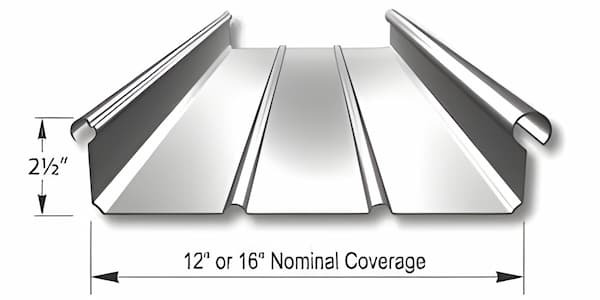
The IMETCO ZIP-RIB is a popular structural panel designed for high-performance applications on slopes as shallow as 1/4:12. These panels are typically available in 12, 16, and 18-inch widths. However, IMETCO can produce custom widths up to 22 inches for specific project requirements. What makes the ZIP-RIB system a favorite for complex architectural projects is its extreme versatility in manufacturing. It can be produced in continuous lengths exceeding 460 feet, removing the need for end laps on long panel runs. It also supports architectural designs like conical tapers and both convex and concave curves. Whether the project involves plywood, metal decking, re-roof framing, or even installation over open purlins, the ZIP-RIB adapts to the structure. You'll find it fabricated in everything from 18-, 20-, 22-, and 24-gauge steel to aluminum, copper, zinc, and stainless steel. See the Roof Anchor Compatibility Chart for IMETCO 22 Gauge and 24 Gauge ZIP-RIB Structural Bulb Standing Seam Panels.
Fall Protection for ZIP-RIB Panels
- For crews working on non-curved 22- and 24-gauge galvanized steel, the SSRA1 Seam Anchor is the ideal non-penetrating solution, providing a certified 5,000-lb tie-off point.
- When the job requires material staging or stable footing, the SSRA2 Adjustable Roof Jacks mount directly to the SSRA1 anchors to support 2x10 walkboards.
- For larger roof systems, workers can mount SSRA3 Anchor Plates atop two SSRA1 anchors for use with the SSRA HLL 100-foot temporary HLL kit or the Super Anchor 120-foot permanent lifeline kit.
- Ridge Pro Recommendation: For aluminum, zinc, or copper ZIP-RIB panels with 6:12 to 12:12 pitch, the Ridge Pro Steep Assist is the best choice. This strategy provides immediate, secure access from the moment a worker steps off the ladder, relying on the roof's structural stability rather than on the panel seams.
- CRITICAL WARNING: Curved ZIP-RIB panels pose unique challenges when attaching fall protection anchors. Because of variable angles and the potential for swing-fall hazards, we do not recommend using the standard SSRA system or the Ridge Pro on curved sections. These specific applications require an on-site inspection by a trained safety professional to determine the most effective fall protection strategy.
Series 300 Symmetrical T-Panel (SSRA Compatible 22/24 ga. Steel)
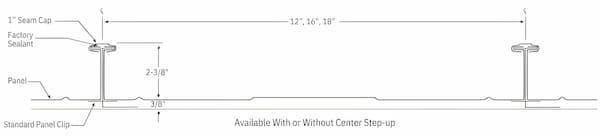
IMETCO's Series 300 is a structural standing seam panel, engineered to deliver decades of weathertight performance. What makes this system truly unique is its symmetrical 2⅜-inch tall seam. Because the panel legs are identical, the snap-on seam cap simplifies installation and allows for individual panel replacement. The design utilizes a one-piece clip that facilitates "unlimited" thermal movement. See the Roof Anchor Compatibility Chart for IMETCO 22 Gauge and 24 Gauge Series 300 Symmetrical T-Panel Standing Seam Panels. This panel has passed the ASTM E-1592 for wind uplift and FM 4471 for fire, wind, and impact resistance. It is available in 12, 16, and 18-inch widths and can be 20, 22, or 24-gauge steel, heavy-duty .063" aluminum, zinc, copper, or stainless steel. For high-end architectural designs, it can even be tapered or field-curved into convex, concave, or even "S"- shaped forms.
Fall Protection for Series 300 Panels
- For non-curved 22- and 24-gauge steel installations, the SSRA1 Seam Anchor provides a 5,000-lb tie-off point that won't interfere with the panel's thermal expansion.
- If you need to stage tools or materials, the SSRA2 Adjustable Roof Jacks mount directly to the anchors to create level 2x10 walkboards. For larger crews, the SSRA3 Anchor Plates allow you to run temporary or permanent lifelines.
- Ridge Pro Recommendation: For panels made from aluminum, zinc, copper, or stainless steel, or for projects with a steep pitch of 6:12 to 12:12, the Ridge Pro provides a safer alternative by hooking over the ridge. This device ensures 100% tie-off from the moment the user steps onto the roof.
- CRITICAL WARNING: The changing panel shapes of a curved roof can create unpredictable swing-fall hazards that are incompatible with standard seam anchors. For curved roof systems, an on-site inspection by a qualified safety professional is mandatory. They will help you engineer a custom fall protection plan that keeps your workers safe.
TwinLok Mechanical Panel (SSRA Compatible 22/24 ga. Steel)
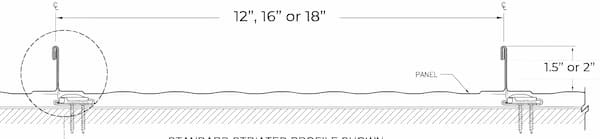
The TwinLok panel is a mechanically double-locked standing seam system engineered for long-term durability on slopes of 2:12 and above. Architects can customize the panel with either a striated or a flat design in 12-, 16-, or 18-inch widths. This system can survive extreme weather, backed by UL-580 Class 90 windstorm ratings and ASTM E-1592 testing. Fabricated from 22- and 24-gauge steel, as well as aluminum and zinc, the TwinLok panel is designed for the long haul and often carries a 20-year Kynar finish warranty. See the Roof Anchor Compatibility Chart for IMETCO 22 Gauge and 24 Gauge TwinLok Mechanical Standing Seam Panels.
Fall Protection for TwinLok Panels
- For 22 and 24-gauge steel TwinLok profiles, the SSRA1 Seam Anchor is the standard for secure, clamp-on fall protection. These anchors provide a certified 5,000 lb. tie-off point without piercing the double-locked seams.
- For staging materials, the SSRA2 Adjustable Roof Jacks mount directly to the anchors. For temporary lifeline needs, the 100-foot SSRA HLL Kit uses SSRA3 Anchor Plates. For buildings requiring permanent maintenance access, the 120-foot Super Anchor Permanent HLL Kit is the superior choice.
- Ridge Pro Recommendation: If your TwinLok project features aluminum or zinc panels, or if the roof pitch is between 6:12 and 12:12, the Ridge Pro Steep Assist is required. This ridge anchor provides immediate 100% tie-off from the second a worker leaves the ladder.
PermLok Snaplock Panel (SSRA Compatible 22/24 ga. Steel)
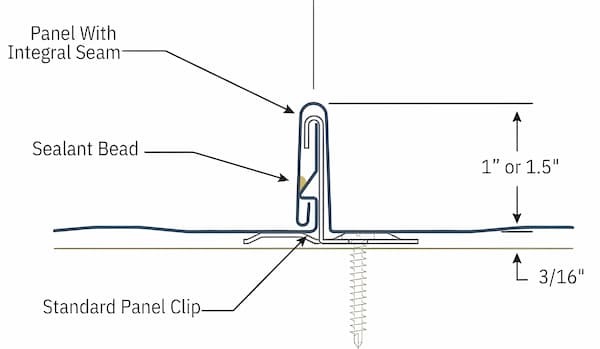
IMETCO's PermLok series is a high-performance snaplock system that delivers a clean, architectural look. Available in both 1.0-inch and 1.5-inch seam heights, this panel is a good choice for high-slope roofing applications featuring a pitch of 3:12 or greater. The PermLok 1.0 is available in 13- and 17-inch widths, while the PermLok 1.5 is available in 12- and 18-inch widths. PermLok is engineered with heavy 18-gauge concealed clips and factory-installed seam sealant to ensure it remains watertight and secure under pressure. Typically fabricated from durable 22 or 24-gauge steel or architectural aluminum. See the Roof Anchor Compatibility Chart for IMETCO 22 Gauge and 24 Gauge PermLok SnaplockStanding Seam Panels.
Fall Protection for PermLok Panels
- For 22 and 24-gauge steel installations, the SSRA1 Seam Anchor, SSRA2 Adjustable Roof Jacks, and SSRA3 Anchor Plates provide the most compatible safety solution. These anchors attach securely along the panel seams without compromising the roof's structural floating design.
- For temporary installations, the 100-foot SSRA HLL Kit is the best option. For regular maintenance, the 120-foot Super Anchor Permanent HLL Kit is designed for long-term attachment with 5-inch riser posts to keep the galvanized steel cable elevated above the PermLok seams.
- Ridge Pro Recommendation: For PermLok roofs made from aluminum, or for any project with a steep slope between 6:12 and 12:12, the Ridge Pro Steep Assist is a much better option to ensure 100% worker tie-off without seam attachment.
Batten-Tite Panel (Ridge Pro Only)
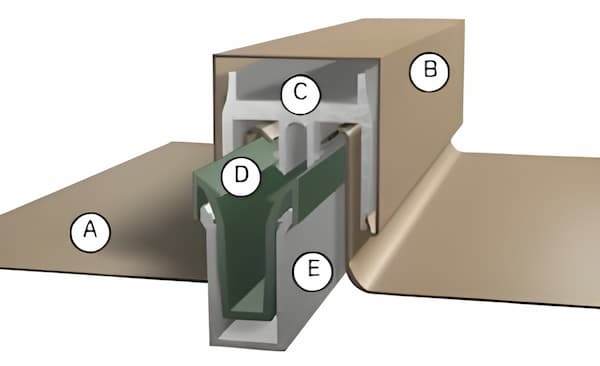
The Batten-Tite panel is IMETCO's premium architectural batten system. With a seam height of 1-7/8 inches and custom widths up to 44-1/2 inches, it's available in 20, 22, and 24-gauge steel, as well as aluminum, zinc, and copper. This rugged panel system has been thoroughly tested for structural integrity and water penetration. Installation crews can curve Batten-Tite panels to meet advanced architectural designs. See the Roof Anchor Compatibility Chart for IMETCO Batten-Tite Standing Seam Panels.
Fall Protection for Batten-Tite Panels
- This panel is not compatible with the SSRA product line. The width and shape of the batten cap prevent seam-mounted anchors from achieving sufficient grip without compromising the architectural profile.
- Ridge Pro Recommendation: For non-curved roofs with a slope between 6:12 and 12:12, the Ridge Pro Steep Assist is the only recommended solution. The Ridge Pro hooks securely over the roof peak using a lightweight extension pole, providing a reliable tie-off point.
- CRITICAL WARNING: Curved Batten-Tite panels require additional expertise in fall protection. Neither the SSRA products nor the Ridge Pro are compatible with curved metal roofs unless a trained safety expert has performed a comprehensive on-site inspection and authorized the setup.
SS Panel Batten-Cover Seam (Ridge Pro Only)
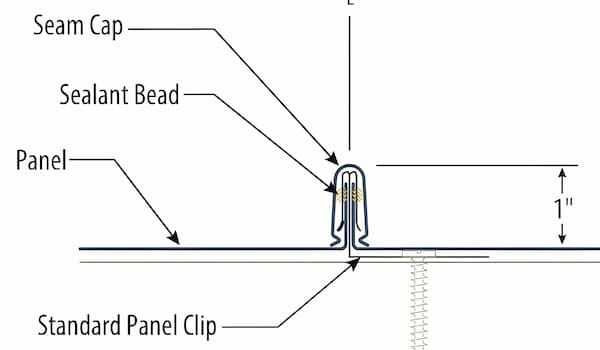
The IMETCO SS Panel features a 1-inch snap-on seam cap. This symmetrical design simplifies complex miter cuts at valleys, hips, and dormers. Designed for installation over a solid substrate with high-quality underlayment, it requires a minimum pitch of 3:12. Typically fabricated from 22 or 24-gauge galvanized steel or aluminum. See the Roof Anchor Compatibility Chart for IMETCO SS Panel Batten-Cover Standing Seam Panels.
Fall Protection for SS Panel (Snaplock)
- The SS Panel system is not compatible with SSRA products due to its batten-cover design.
- Ridge Pro Recommendation: The Ridge Pro allows you to bypass the seams entirely by hooking securely over the roof peak on non-curved panels. This option gives your crew a reliable, non-penetrating tie-off point from the moment they step off the ladder while avoiding damage to the caps.
- CRITICAL WARNING: Curved SS Panel installations add complexity to any fall protection plan. Generally, standard SSRA and Ridge Pro products are not suitable for curved sections due to variable angles and swing-fall risks. For any curved roof, a thorough on-site inspection by a trained safety professional is mandatory.
Standing Seam Metal Roof Anchor Panel Compatibility For 18-22 Gauge IMETCO Panels
| ZIP-RIB (18-22 Ga.) | Series 300 (20-22 Ga.) | TwinLok (22 Ga.) | PermLok (22 Ga.) | |
|---|---|---|---|---|
SSRA 1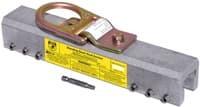 |
YES | YES | YES | YES |
SSRA1 Nylon Tip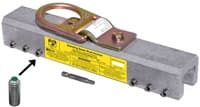 |
YES | YES | YES | YES |
SSRA2 Roof Jack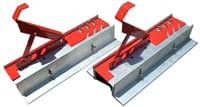 |
YES | YES | YES | YES |
SSRA3 Anchor Plate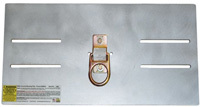 |
YES | YES | YES | YES |
The Ridge Pro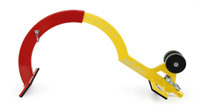 |
YES | YES | YES | YES |
Standing Seam Metal Roof Anchor Panel Compatibility For IMETCO Panels Cont.
| ZIP-RIB (24 Ga.) | Series 300 (24 Ga.) | TwinLok (24 Ga.) | PermLok (24 Ga.) | Batten-Tite | SS Panel Batten-Cover | |
|---|---|---|---|---|---|---|
| SSRA 1 |
NO | NO | NO | NO | NO | NO |
| SSRA1 Nylon Tip |
YES | YES | YES | YES | NO | NO |
| SSRA2 Roof Jack |
YES | YES | YES | YES | NO | NO |
| SSRA3 Anchor Plate |
YES | YES | YES | YES | NO | NO |
| The Ridge Pro |
YES | YES | YES | YES | YES | YES |
Certified Protection: American-Made Stability vs. Cheap Imports
Protecting an architectural IMETCO roof requires hardware with a verifiable engineering pedigree. Generic, low-cost imports frequently lack traceable test data and use inferior alloys that compromise life safety. These unbranded alternatives are a liability to both the crew and the roof's structural integrity.
The American-made SSRA1 Standing Seam Roof Anchor provides a documented contrast. Precision-machined from solid 6061-T6 aluminum, the SSRA1 is validated at independent ISO 17025-accredited laboratories. Although OSHA requires a 5,000-pound breaking strength, our system has withstood ultimate loads exceeding 14,500 pounds without structural failure. By selecting certified domestic hardware, contractors prioritize data-driven reliability over high-risk guesswork. Review our full technical results in our independent laboratory testing reports.
Contact Us for Expert Standing Seam Fall Protection Advice
For expert guidance on standing-seam roof anchors, lifeline kits, and fall-protection systems that protect both your crew and your panels, contact us today at 863-703-4522 or visit www.StandingSeamRoofAnchor.com. Our safety specialists can help you match the right non-penetrating anchor to your specific roof profile and slope. Let's make your next metal roofing project safe, compliant, and built to last. For continued learning, download OSHA's 48-page Fall Protection Manual and our free Anchor Inspection Form once you've selected the ideal anchors for your roof system. Together, we'll help you stay ahead of OSHA standards while preserving your roof's weather-tight seal.
10 Bonus Metal Roof Safety Tips for You and Your Crew
Staying safe on an IMETCO roof requires more than just the proper anchors; it requires a total commitment to safety culture. Here are ten essential strategies to keep your team protected while preserving the integrity of these high-performance systems.
Take Precautions for Curved Metal Panels
Seam-mounted anchors are generally not compatible with curved panels. Always consult with a fall protection specialist to develop a custom plan that accounts for the building's unique design.
Establish OSHA-Compliant Safety Plans
Before anyone even puts on a harness, a thorough safety plan is critical for keeping the project moving forward safely. An OSHA-compliant safety plan defines tie-off anchor and lifeline locations and details exactly how fellow workers will perform a rescue if someone falls.
Utilize Specialized Roof Anchor Systems
On an IMETCO roof, you need systems designed to clamp onto the rib without piercing the metal. Avoid selecting seam anchors that must be mounted on top of hidden clips, as these are nearly impossible to locate on existing roofs.
Implement Permanent Roof Anchor Systems
Permanent lifeline systems are a wise investment for roofs that will require routine maintenance throughout their lifespans. Installing a galvanized cable system, such as the Super Anchor 120-foot Permanent HLL kit, provides a "ready-to-use" safety solution that stays in place to protect maintenance workers for decades.
Ensure Stable Access Points
The most dangerous moment on a job is often the transition from the ladder to the roof. You've got to make sure your access points are rock-solid and free of debris. Reinforce the 4-to-1 ratio rule with your crew and ensure every ladder is tied off at the top to prevent a kick-out during that critical step-off.
Foster a Safety-First Workplace Culture
Safety isn't a one-time meeting; it's a daily mindset of communication and teamwork. By conducting frequent training sessions and performing hands-on equipment inspections, you build a culture where workers feel empowered to speak up when they see a hazard. A proactive team is always more effective than a reactive one.
Encourage Regular Use of Trauma Straps
A successful fall arrest is only the first half of the battle. Suspension trauma can become life-threatening in minutes if a worker is hanging in a harness. Equip every member of your crew with trauma straps and make sure they know how to deploy them so they can "stand up" in their harness and maintain circulation while waiting for rescue.
Secure Work Areas with Protective Barriers
On low-slope IMETCO roofs, passive protection is often your best friend. Setting up guardrails or warning lines creates a physical and visual boundary that allows your crew to focus on their work without constantly looking over their shoulder at the leading edge.
Wear Appropriate Footwear
Metal roofs can become incredibly slick with just a few drops of water, morning condensation, sawdust, or pollen. Make sure your team is wearing footwear with soft, slip-resistant soles designed for traction on metal. If the metal panels are wet, it's best to avoid walking on them to prevent slips and falls.
Equip Workers with High-Quality Safety Gear
When it comes to harnesses and shock-absorbing lanyards, don't cut corners. High-quality gear isn't just safer; it's more comfortable, which means your crew is more likely to wear it correctly. Modern, lightweight equipment reduces fatigue and effectively manages impact forces in the event of a fall. In 2025, OSHA reinforced the importance of providing properly-fitting fall protection equipment to workers.
Disclaimer: The views, recommendations, and information presented in this blog are solely those of the author and do not necessarily reflect the opinions or positions of the featured panel manufacturer, its brands, subsidiaries, or parent companies. Customers are strongly encouraged to contact the roof panel manufacturer directly for inquiries about fall-protection compatibility with their products and to address any potential warranty issues that may arise after installing our products.