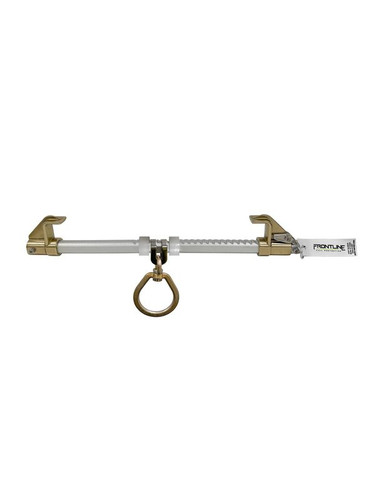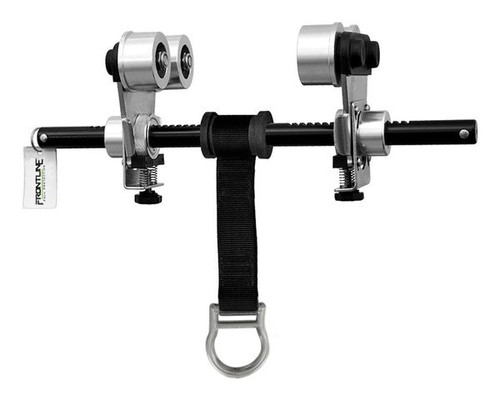


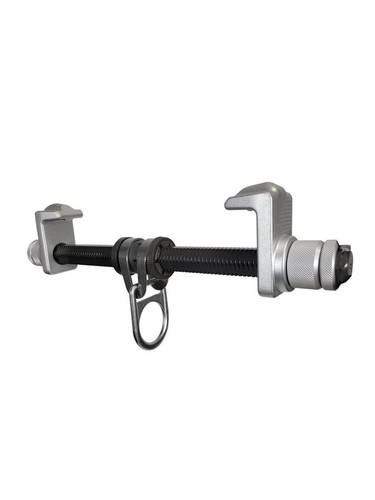
ST-AH Aluminum I-Beam Slider Anchor
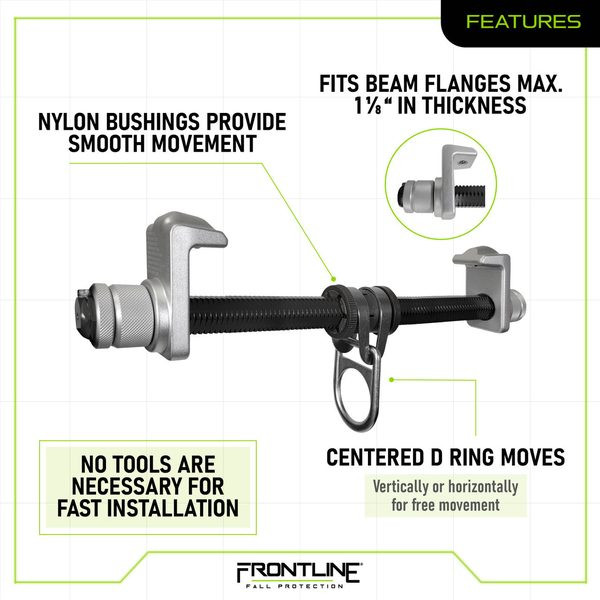
The ST-AH is a horizontal sliding beam anchor that is easy to place, install, and quickly remove for the next location. Nylon bushings and ball bearings let the anchor glide along the beam flange while trailing the worker - the anchor point stays overhead for added safety and productivity - and the rotating D-ring centered on the anchor keeps the connecting device moving tangle-free and hassle-free.
Built from aluminum alloy with an alloy steel D-ring assembly, the slider is lightweight to carry but rugged on the steel, with a 5,000 lb tensile strength and a 425 lb maximum capacity. No tools are necessary for fast installation, and the anchor adjusts from both sides for a secure fit on flanges up to 1 inch thick. Two sizes cover the steel: the ST12AH spans 3.5 to 12 inch flanges at 4.81 lbs, the ST18AH spans 3.5 to 18 inch flanges at 5.64 lbs. Conforms to ANSI Z359.18 and aligns with OSHA 1926 and 1910.
Who Needs This Product
This product is a sliding I-beam anchorage connector - a trailing anchor point that follows the worker along overhead steel. Crews choose the ST-AH when the work walks the beam: the bushings glide instead of drag, the aluminum build keeps the carry weight near 5 lbs, and two flange ranges mean one SKU family covers nearly any building section. Suitable for a single user connection - each worker still needs a full body harness and a compatible connecting device attached to the D-ring.
Features
Glides with the worker
Nylon bushings and ball bearings slide the anchor smoothly along the flange while trailing the user.
Two flange ranges
ST12AH covers 3.5 to 12 inch flanges; ST18AH stretches the same design to 18 inches.
Tool-free installation
No tools are necessary - place it, adjust it, and remove it for the next location in moments.
Adjusts from both sides
Run the adjusters in from either side of the beam for a secure fit on flanges up to 1 inch thick.
Rotating centered D-ring
The D-ring moves with the worker for easy, tangle-free access to different work areas.
Lightweight aluminum build
Aluminum alloy hex bar and jaws with an alloy steel D-ring assembly - 4.81 or 5.64 lbs total.
Configurations
| Length | SKU | Price |
|---|---|---|
| 3.5" - 12" | ST12AH | $238.99 |
| 3.5" - 18" | ST18AH | $267.99 |
Technical Specifications
| SKUs | ST12AH (3.5 - 12 in flanges); ST18AH (3.5 - 18 in flanges) |
|---|---|
| Type | Sliding I-beam anchorage connector, horizontal, removable and reusable |
| Connection | Single user; rotating centered D-ring |
| Tensile strength | 5,000 lbs |
| Max capacity | 425 lbs |
| Flange width | 3.5 in to 12 in (ST12AH); 3.5 in to 18 in (ST18AH) |
| Flange thickness | Up to 1 in maximum per the spec sheet |
| Hex bar | Aluminum alloy |
| Jaws | Aluminum alloy |
| D-ring assembly | Alloy steel |
| Weight | 4.81 lbs (ST12AH); 5.64 lbs (ST18AH) |
| Standards | ANSI Z359.18; OSHA 1926; OSHA 1910 |
The beam carries the load. The I-beam must be verified by a qualified person for the intended fall protection load, and the adjusters must be set snug to the actual flange width and thickness before each use. One worker per anchor at 425 lbs maximum - keep the anchor overhead where possible and calculate fall clearance before tying off.
Compliance Standards
ANSI Z359.18
American National Standards Institute standard for anchorage connectors.
OSHA 29 CFR 1926
Federal construction fall protection criteria, including anchorage requirements.
OSHA 29 CFR 1910
General industry walking-working surfaces and personal fall protection rules.
Qualified-Person Anchorage
The supporting beam must be qualified for the fall protection loads by a qualified person before use.
Typical Applications
Installation Overview
Follow the manufacturer's manual. The sequence below is an overview only.
- Inspect. Check the hex bar, jaws, bushings, adjusters, D-ring, and markings before each use.
- Verify the beam. Have a qualified person confirm the I-beam carries the intended fall protection load.
- Measure the flange. Confirm flange width is inside your model range (3.5 to 12 in for ST12AH, 3.5 to 18 in for ST18AH) and thickness is 1 inch or less.
- Mount. Seat the jaws over the flange and adjust from both sides for a secure fit per the manual - no tools required.
- Check the slide. Confirm the anchor is captive on the flange and glides smoothly through the work zone.
- Connect. Attach the SRL or shock-absorbing lanyard to the rotating D-ring and verify fall clearance before work begins.
Inspection and Retirement
Inspect before each use, with a documented competent-person inspection at least every 6 months. Pull the equipment from service for any of the conditions below.
- Nylon bushings and bearings: flat spots, cracking, binding, or rough glide.
- Jaws: deformation, cracks, or wear at the flange contact faces.
- Hex bar and adjusters: bending, stripped threads, or failure to hold position.
- D-ring assembly: bending, cracks, nicks, or restricted rotation.
- Markings: missing or illegible product label.
Retire the anchor immediately after any fall arrest event, any deformation or crack, or any condition where it cannot be verified as safe for service.
 Fall Protection
Distributors, LLC Free Tool · No Signup · OSHA 1926.502 Free Interactive Tool Fall Protection Calculator Pick your system. Run the math. Generate a plan. 1Pick Your SystemDetermine fall restraint vs. fall arrest based on your work surface, edge access, and clearance. 2Run the MathCalculate exact fall clearance required below the work surface for your SRL or lanyard setup. 3Generate a PlanGet a printable OSHA-compliant Fall Protection Plan structured around 29 CFR 1926.502(k).
Frequently Asked Questions
Frontline ST-AH Submittals and Documentation
Frontline ST-AH Spec Sheet (PDF)Both flange ranges, strengths, materials, and the compliance summary. Frontline ST-AH Test Report (PDF)Third-party test results documenting the rated performance. Frontline ST-AH User Manual (PDF)Mounting, adjustment, inspection, and retirement procedures.Compatible and Related Products
- Frontline ST18AV Aluminum I-Beam Fixed Anchor. The fixed sibling - same aluminum build, locked in one position.
- Frontline ST10HTK Aluminum Beam Trolley. The roller trolley for long runs of overhead steel.
- Frontline ST14SA Easy Slider Beam Walker. A lightweight slider for 3.5 to 14 inch flanges with single-side adjustment.
- Frontline RO4W Multifunction 4-Way Anchor. A multifunction anchor for concrete, metal, and wood substrates.
Sliding Along Overhead Steel?
Need help specifying the right system for your jobsite? Confirm your application, anchorage, and clearance with us and we will walk through the kit list so the right equipment ships together.
Call 863-703-4522 to talk to a fall protection specialist.