SRL vs Lanyard (Talk #8)
Posted by Howie Scarboro - COO- Fall Protection Distributors, LLC on Sep 10, 2026
By Howie Scarboro, COO, Fall Protection Distributors, LLC · Last verified against the eCFR, osha.gov, and the ANSI/ASSP Z359.14-2021 published summaries: September 8, 2026
For information purposes only. This page supports your safety planning; it does not replace professional judgment. All safety plans and fall protection decisions for the task must be reviewed and approved by a Competent Person or a Qualified Person before work begins, as required by OSHA.
SRL or Shock-Absorbing Lanyard: Which Should My Crew Use?
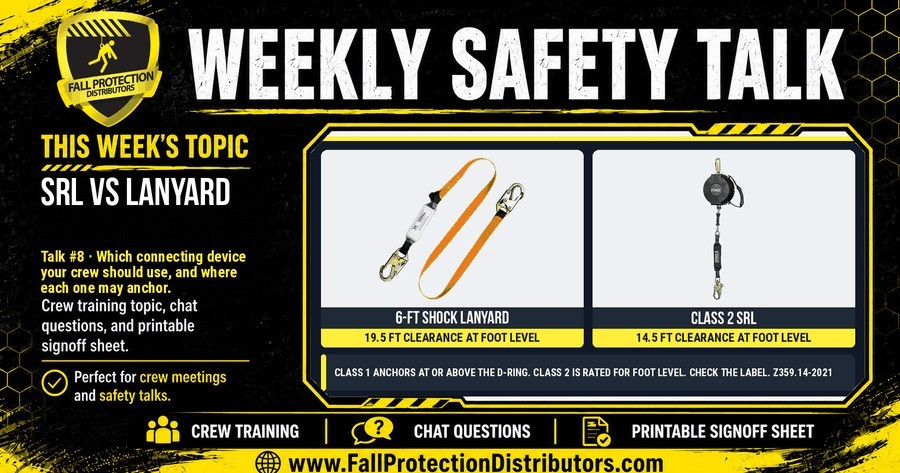
Both are legal connecting devices under 29 CFR 1926.502(d), but they have distinct features that can benefit workers depending on the safety plan. A shock-absorbing lanyard is simple, inexpensive, and tolerant of rough conditions. Still, it allows up to 6 feet of free fall and needs roughly 19.5 feet of clearance below the working surface when the anchor is at foot level. An overhead self-retracting lifeline keeps the line near-taut, engages within inches, and substantially reduces the clearance requirement, but its class rating dictates where you can deploy it. Under ANSI/ASSP Z359.14-2021, a Class 1 SRL must anchor at or above your dorsal D-ring, and only a Class 2 SRL is rated for foot-level anchors and leading edge work. For roofing crews, that comes down to this: on low roofs with foot-level anchors, a Class 2 SRL or a fall restraint setup beats a 6-foot lanyard on the clearance math alone. On tall structures with overhead anchorage, either device works, and the lanyard's cost and simplicity are legitimate reasons to choose it.
This is Talk #8 in our Weekly Safety Talk series. Talk #6 covered the fall clearance calculation this choice depends on, and Talk #7 covered the connector as the C in the ABC system. This talk is about choosing the connector.

What Each Device Does in a Fall
A shock-absorbing lanyard is a fixed-length line, usually 6 feet, with an energy absorber sewn into one end. In a fall, you drop until the lanyard comes taut, and then the absorber's stitching tears out progressively over as much as 3.5 feet, absorbing impact loads until the fall is arrested. Free fall is capped at 6 feet (29 CFR 1926.502(d)(16)(iii)) and deceleration distance is capped at 3.5 feet (1926.502(d)(16)(iv)). The arresting force on a worker in a full-body harness is capped at 1,800 pounds (1926.502(d)(16)(ii)).
An SRL, self-retracting lifeline, is a drum of cable or webbing under spring tension that pays out and retracts as you move. Walk across the roof, and the line follows you. However, the acceleration of a fall triggers the centrifugal brake to lock the drum, typically within just a few inches. Less free fall means less energy to absorb, which is why the SRL's advantage shows up in the clearance calculation. OSHA recognizes the difference in the strength rule for the device itself. An SRL that limits free fall to 2 feet or less must sustain a 3,000-pound tensile load, and one that does not must sustain 5,000 pounds, the same as a lanyard:
"Self-retracting lifelines and lanyards which automatically limit free fall distance to 2 feet (0.61 m) or less shall be capable of sustaining a minimum tensile load of 3,000 pounds (13.3 kN) applied to the device with the lifeline or lanyard in the fully extended position." (29 CFR 1926.502(d)(12))
The anchorage rule does not change with the device. Whatever you connect to it, the anchor must support 5,000 pounds per worker attached, or be part of an engineered system with a two-to-one safety factor under a Qualified Person (1926.502(d)(15)), which Talk #4 covered in full.
Lanyard and SRL Numbers Side by Side
| Factor | 6-foot shock-absorbing lanyard | Self-retracting lifeline |
|---|---|---|
| Free fall before the device engages | Up to 6 feet, the limit in 29 CFR 1926.502(d)(16)(iii) | Typically inches, because the brake locks as soon as the line accelerates |
| Deceleration distance | Up to 3.5 feet under 1926.502(d)(16)(iv) | Maximum arrest distance of 42 inches under ANSI/ASSP Z359.14-2021; our calculator plans 4.5 feet for a Class 2 device on a foot-level anchor |
| Clearance below the working surface, foot-level anchor | Roughly 19.5 feet | Roughly 14.5 feet or more with a Class 2 device |
| Clearance below the working surface, overhead anchor | About 12.5 feet | Often 6 to 9 feet, depending on the device |
| Where the device may be anchored | Any rated anchor; the clearance calculation decides whether the setup works | Class 1: at or above the dorsal D-ring only. Class 2: above or below the D-ring, including foot level |
| Mobility | Fixed radius; moving the work means unhooking and re-hooking | The line pays out and retracts as the worker moves across the work area |
| Slack on the roof | Up to 6 feet of webbing underfoot when the anchor is low | The line stays near-taut, so there is little slack to trip on |
| Cost and complexity | Inexpensive, no moving parts, tolerates rough handling | Several times the price, mechanical internals, service schedule set by the manufacturer |
Run the fall clearance calculator as you plan your next project. Anchor height and the specific device model change every number, and the device manual carries the binding figures.

Class 1 and Class 2 SRLs: Mounting Location Changes The Rules
The 2021 revision of the SRL standard, ANSI/ASSP Z359.14-2021, replaced the old Class A and Class B arrest-distance categories with two classes based on where the device is anchored. The worker must mount the Class 1 device at or above their dorsal D-ring. A Class 2 device is designed and tested for anchorage above or below the D-ring, including at foot level, and carries the leading-edge rating. The difference is the energy the device must absorb: a foot-level anchor adds several feet of free fall before the brake engages, so a Class 2 device pairs the drum with an energy absorber sized for heavier impact loads. The class is printed on the device label; the standard requires a separate warning card with every Class 2 device, and the standard took effect on August 1, 2023, so anything you have bought since then should carry the class marking. If your anchors sit at foot level, which is where nearly every roof anchor sits, the label must say Class 2. A Class 1 device on a foot-level anchor is outside its rating no matter how new it is.
OSHA addressed foot-level anchoring directly in a September 21, 2007 interpretation letter. The rules do not prohibit anchoring at your feet, but a 6-foot lanyard rigged that way produces about 10 feet of free fall by OSHA's own arithmetic, which exceeds the 6-foot limit. The letter points to two ways to comply: a restraint system that keeps the worker away from the edge, or a retractable device that limits the fall distance. That is the Class 2 SRL's job in one sentence.

Leading Edge Work Requires a Class 2 SRL
Leading edge work means the lifeline can contact a roof edge, a metal panel rim, or structural steel during a fall. Class 2 devices are built for this scenario, typically with a galvanized or stainless cable lifeline and an energy absorber tested over an edge, which is why the older market term "leading edge SRL" now lives inside the Class 2 designation. A swing fall over an edge is the worst-case scenario of this problem, and Talk #6 explains why: during the swing, the line can abrade sideways across the edge. Keep the anchor above the work, and treat corner exposure as its own hazard assessment. A horizontal lifeline system lets the SRL stay directly upslope of the worker's location.
Which Device to Use for Each Job
| Situation | Use | Why |
|---|---|---|
| Single-story roof, foot-level anchor | Neither device for arrest; rig for fall restraint | A single-story eave sits 10 to 12 feet above the ground, and even the Class 2 SRL needs roughly 14.5 feet. Restraint keeps the worker from reaching the edge, so there is no fall to arrest |
| Two-story steep-slope roof, anchor high on the slope | Class 2 SRL, or a rope grab on a vertical lifeline with the slack kept out | A two-story eave sits 18 to 20 feet up, so the clearance is there but the margin is thin; the SRL engages within inches and preserves margin that the lanyard uses up in free fall |
| Standing-seam metal roof, worker moving along the roof | Class 2 SRL on a seam anchor such as the SSRA1 | The line follows the work with no slack underfoot, and the anchor relocates along the seams in about two minutes; confirm the panel profile on the compatibility page first |
| Steel erection, overhead beam anchor | Class 1 SRL from overhead, or a twin-leg lanyard while climbing between points | Overhead anchorage is where the SRL performs best; the twin-leg lanyard keeps the worker connected at all times while moving from one anchor to the next |
| Short-duration task, verified clearance, tall structure | 6-foot shock-absorbing lanyard | With the clearance calculation done and the anchor above the worker, the simpler tool does the job |
| Any leading edge exposure | Class 2 SRL | Webbing or an unrated cable loaded over an edge during an arrest can be cut |
Whichever device you choose, good fall-arrest practice is the same as restraint: set up the work so you never put yourself in a position to get over the edge in the first place. On a standing-seam roof, that means the SSRA1 goes high in the field of the roof, at least 6 feet from the end of any panel and at least 6 feet from any fall hazard in all directions, with the SRL keeping the line snug below it.
Inspection and Service Differences
The inspection rule is the same for both devices:
"Personal fall arrest systems shall be inspected prior to each use for wear, damage and other deterioration, and defective components shall be removed from service." (29 CFR 1926.502(d)(21))
What differs is what the inspection includes. A lanyard is inspected end to end by hand and eye: webbing, stitching, the absorber cover intact, and both hooks locking; our lanyard inspection guide walks through it, and Talk #3 covers the documentation. An SRL adds function checks. Pull the line all the way out and let it retract fully. Give the line a sharp tug to confirm the brake locks. Check the cable or webbing for birdcaging, kinks, and cuts; check the housing for cracks, and confirm the load indicator has not deployed. SRLs also carry a manufacturer service schedule, and after any fall arrest, the device comes out of service the same way a harness does: "Personal fall arrest systems and components subjected to impact loading shall be immediately removed from service and shall not be used again for employee protection until inspected and determined by a competent person to be undamaged and suitable for reuse." (1926.502(d)(19)). The SRL costs several times what a lanyard costs up front, and it pays for itself through clearance, mobility, and the slack line your crew isn't tripping over. The lanyard pays for itself by tolerating jobsite abuse that would send an SRL back to the manufacturer. Retire both devices by condition, never by calendar.
Let's Run the Fall Clearance Numbers for a Residential Crew
Let's run the numbers for a four-person residential roofing crew. Outfitting everyone with 6-foot shock-absorbing lanyards costs well under $100 per worker. Outfitting everyone with quality Class 2 SRLs runs several hundred dollars each, so the difference across the whole crew is roughly the price of one insurance deductible. The SRL saves about 5 feet of clearance on a foot-level anchor, which on a two-story eave is the difference between a system that stops the fall and one that does not. It keeps the line taut instead of leaving 6 feet of webbing underfoot on a steep slope, and tripping is how many falls start. It stays connected as the work moves because there is no unhooking and re-hooking as the worker repositions. For most roofing crews, the right mix is Class 2 SRLs for workers moving on the roof, a couple of lanyards for short-duration tasks with verified clearance, and short lifelines rigged for single-story jobs where fall restraint is the right call anyway.
Choose Wisely: Device Selection Violations Are Costly
Avoid these errors: a lanyard on a low roof with no clearance to arrest the fall, a Class 1 device on a foot-level anchor, or webbing loaded over a leading edge. In 2026, a serious violation can run up to $16,550, and a willful or repeat violation up to $165,514 (OSHA penalties). The difference between the right device and the wrong one is a few hundred dollars. Investing five minutes with the clearance calculator during the safety planning phase prevents these risks.
Frequently Asked Questions
What is the difference between an SRL and a shock-absorbing lanyard?
A shock-absorbing lanyard is a fixed-length line, usually 6 feet, that allows up to 6 feet of free fall before its energy absorber tears out over as much as 3.5 feet. A self-retracting lifeline keeps the line near-taut, locks within inches of a fall starting, and needs far less clearance below the worker. Both must limit the arresting force on a worker in a full-body harness to 1,800 pounds under 29 CFR 1926.502(d)(16)(ii).
What does SRL stand for in fall protection?
SRL stands for self-retracting lifeline, also called a self-retracting lanyard or a self-retracting device. It is a drum of cable or webbing under spring tension that pays out and retracts as the worker moves and locks when it senses the acceleration of a fall. OSHA uses the term self-retracting lifelines and lanyards in 29 CFR 1926.502(d)(12) and (d)(13).
What is a lanyard on a safety harness?
The lanyard connects the harness to the anchorage; it is the C in the ABCs of fall protection. For fall arrest, it is a shock-absorbing lanyard with an energy absorber that limits force on the worker; positioning and restraint lanyards have no absorber and are not fall-arrest devices. The lanyard connects to the dorsal D-ring between the shoulder blades and to a rated anchorage.
How long is a safety harness lanyard?
The standard fall arrest lanyard is 6 feet long, which is the most free fall OSHA allows under 29 CFR 1926.502(d)(16)(iii). Shorter lanyards and adjustable restraint lanyards are common for restraint work. A 6-foot lanyard anchored at foot level produces about 10 to 11 feet of free fall, which exceeds the limit, so lanyards for that use must be designed and labeled for a 12-foot free fall.
Which needs less fall clearance, an SRL or a lanyard?
The self-retracting lifeline needs less clearance in every configuration. Below a foot-level anchor, a 6-foot shock-absorbing lanyard needs roughly 19.5 feet, while a Class 2 SRL requires about 14.5 feet or more. From an overhead anchor, an SRL often needs 6 to 9 feet compared with the lanyard's roughly 12.5 feet. The device manual carries the binding numbers for your model.
What is the difference between Class 1 and Class 2 SRLs?
Under ANSI/ASSP Z359.14-2021, workers must locate a Class 1 device at or above the dorsal D-ring. A Class 2 device is rated for anchorage above or below the D-ring, including foot level, and carries the leading-edge rating. The class is printed on the device label, and a roof-deck anchor requires Class 2.
Can I use any SRL at foot level?
No. A foot-level anchor adds several feet of free fall before the brake engages, so only a Class 2 device, which pairs the drum with an energy absorber sized for that harder catch, is rated for it. A Class 1 device on a foot-level anchor is outside its rating no matter how new it is.
What is a leading edge SRL?
A leading edge SRL is a device rated for falls where the lifeline may load over a roof edge, a metal panel rim, or structural steel, typically built with a cable lifeline and an energy absorber tested over an edge. Under Z359.14-2021, this capability is part of the Class 2 designation. Webbing or an unrated cable loaded over an edge during an arrest can be cut.
What does OSHA say about self-retracting lifelines?
OSHA treats the SRL as a connecting device in a personal fall arrest system. Under 29 CFR 1926.502(d)(12), an SRL that automatically limits free fall to 2 feet or less must sustain a tensile load of 3,000 pounds with the line fully extended; under (d)(13), an SRL that does not limit free fall to 2 feet must sustain 5,000 pounds. The anchorage rule in 1926.502(d)(15) does not change with the device: 5,000 pounds per worker, or an engineered system with a two-to-one safety factor under a Qualified Person.
Do SRLs expire or need annual service?
There is no fixed expiration date, like harnesses; retirement is based on condition and history. Inspect the device before each use under 1926.502(d)(21), including a retraction and brake-lock check; follow the manufacturer's service schedule, and remove it from service after any fall arrest or a deployed load indicator under 1926.502(d)(19).
How do you use a double lanyard on a safety harness?
A double lanyard, also called a twin-leg or Y lanyard, has one energy absorber at the harness and two legs. The worker keeps one leg connected while moving the other to the next anchor, so there is never a moment without a connection. Both legs connect at the dorsal D-ring through the shared absorber; the unused leg parks on the harness's break-away keeper, never on a side D-ring, because a fall on a leg hooked to the side ring would load the body sideways.
Is a rope grab on a vertical lifeline still acceptable?
Yes. A rope grab and lifeline is a legal, field-proven connecting arrangement, and rigged short, it doubles as restraint. Its clearance math resembles the lanyard's, so run it through the calculator for your roof. Washington state restricts rope grabs in restraint to models the manufacturer designed for that use under WAC 296-880-40025.
Toolbox Quiz: Test Your Crew
Five questions from this talk. Discuss these questions at the safety meeting, let the crew argue, then score it. The one-page printable SRL vs lanyard crew talk has the selection table and a crew sign-off block for your training records (29 CFR 1926.503(b) requires written certification), and it lets the foreman run this talk at any safety meeting. It's free, and you don't have to give us an email address to get it.
The lanyard is a simple tool that requires more clearance; the SRL is the mechanical tool that reduces clearance; the class label decides where the SRL may anchor; and on the lowest roofs, the right answer is restraint rigging from Talk #5 rather than either device. Check the labels on the SRLs you already own; more than one crew has found that the device on their deck anchor says Class 1. If you have a question about your own setup or a device you are considering, send it through our contact page; we read every one, and answers may become future talks.
Work safe up there.