
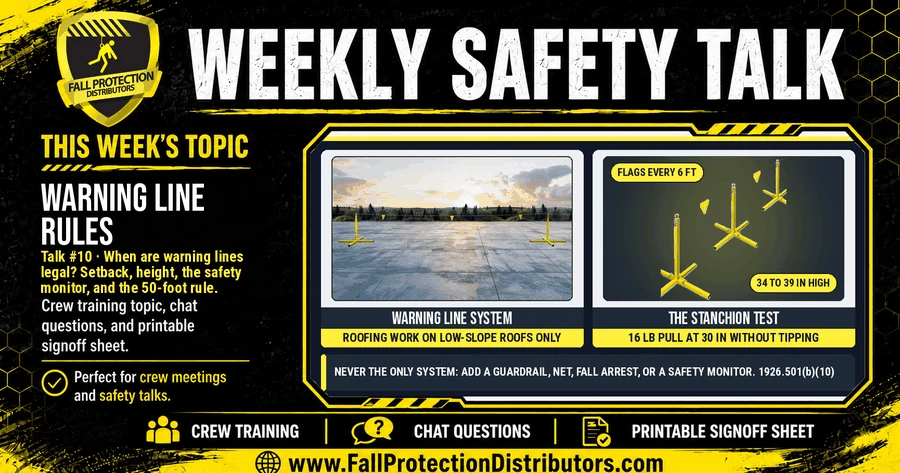
Warning Line Rules (Talk #10)
Posted by Howie Scarboro - COO- Fall Protection Distributors, LLC on Oct 9th 2026
By Howie Scarboro, COO, Fall Protection Distributors, LLC · Last verified against the eCFR and osha.gov: October 5, 2026
For information purposes only. This page supports your safety planning; it does not replace professional judgment. All safety plans and fall protection decisions for the task must be reviewed and approved by a Competent Person or a Qualified Person before work begins, as required by OSHA.
When Are Warning Lines Legal on a Roof?
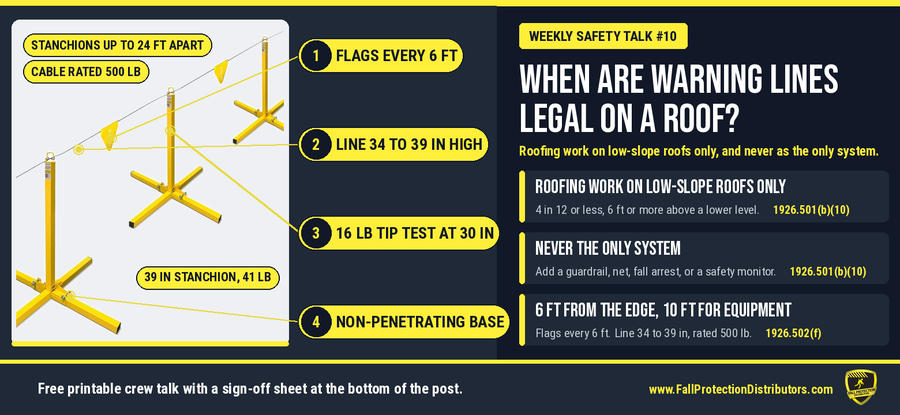
A warning line is legal in one particular situation under federal OSHA construction rules: roofing work on a low-slope roof, which is a roof with a slope of 4 in 12 or less, where the crew is 6 feet or more above a lower level (29 CFR 1926.501(b)(10)). The standard allows it in combination with a guardrail system, a safety net system, a personal fall arrest system, or a safety monitoring system. On a roof 50 feet or less in width, a safety monitor alone is permitted without the line.
Warning lines are not permitted on roofs steeper than 4:12. An HVAC crew or an electrician on a low-slope roof does not get to use the roofers' 6-foot line rules. A maintenance worker in general industry works under a separate rule called a designated area. This talk covers each, including the line specifications, the monitor's duties, and the 50-foot width rule crews most often misread.
This is Talk #10 in our Weekly Safety Talk series. Fall protection under 1926.501 has been the most-cited OSHA standard for 15 straight fiscal years, with 5,914 citations in the preliminary fiscal year 2025 count (OSHA top 10). Talk #1 covered the trigger heights, and Talk #2 covered steep roofs, where none of this applies. This talk covers the warning line itself, the safety monitor that usually goes with it, and the different lines that other trades and general industry crews use.
The Rule That Discusses Warning Lines: 1926.501(b)(10)
Every warning line question starts with the paragraph that permits the system. It is worth reading in full, because the combinations are written into it:
"Except as otherwise provided in paragraph (b) of this section, each employee engaged in roofing activities on low-slope roofs, with unprotected sides and edges 6 feet (1.8 m) or more above lower levels shall be protected from falling by guardrail systems, safety net systems, personal fall arrest systems, or a combination of warning line system and guardrail system, warning line system and safety net system, or warning line system and personal fall arrest system, or warning line system and safety monitoring system. Or, on roofs 50-feet (15.25 m) or less in width (see appendix A to subpart M of this part), the use of a safety monitoring system alone [i.e. without the warning line system] is permitted." (29 CFR 1926.501(b)(10))
Let's break this rule into two columns to better understand OSHA's rules. The left column is conventional fall protection: guardrails, safety nets, or a personal fall arrest system, any of which is complete by itself. The right column is the warning line, and each entry in that column is paired. The warning line marks where the protected zone begins; the companion system protects the worker who crosses it. The one exception is the monitor-alone option on a roof 50 feet or less wide, but it still requires a designated competent person whose only job is to watch the crew. This width of the roof and the dedicated OSHA Competent Person are the most overlooked requirements in this standard.
The definitions in 29 CFR 1926.500(b) help explain the warning line rules. A warning line system is "a barrier erected on a roof to warn employees that they are approaching an unprotected roof side or edge, and which designates an area in which roofing work may take place without the use of guardrail, body belt, or safety net systems to protect employees in the area." Roofing work is "the hoisting, storage, application, and removal of roofing materials and equipment, including related insulation, sheet metal, and vapor barrier work, but not including the construction of the roof deck." That definition is why the 6-foot line belongs to the roofing crew and nobody else: the deck framer, the mechanical contractor, and the electrician are not performing roofing work, and the standard gives them no warning line option at 6 feet.
The slope definition is just as important. A low-slope roof has a slope of 4 in 12 or less; anything steeper is a steep roof, and 1926.501(b)(11) requires guardrails with toeboards, safety nets, or a personal fall arrest system there. Most commercial membrane roofs, built-up roofs, and standing-seam metal roofs on warehouses and retail buildings are low-slope. Most residential roofs are not.
Warning Line Specifications Under 1926.502(f)
Once the system is permitted, 29 CFR 1926.502(f) sets out how to build it. The numbers are specific, and an inspector will measure them.
| Requirement | What it means on the roof | Cite |
|---|---|---|
| Around all sides of the work area | The line encloses the roofing work area, not just the edge the crew happens to be facing. | 1926.502(f)(1) |
| At least 6 feet from the roof edge | Measured from the edge to the line, on every side, when no mechanical equipment is in use. | 1926.502(f)(1)(i) |
| 10 feet where mechanical equipment runs toward the edge | Edges parallel to the equipment's direction of travel stay at 6 feet; edges perpendicular to it move out to 10 feet. | 1926.502(f)(1)(ii) |
| Access paths formed by two warning lines | Points of access, material handling, storage, and hoisting areas connect to the work area by a lined path. | 1926.502(f)(1)(iii) |
| Close the path when it is not in use | A rope, wire, chain, or barricade equal to the line goes across the path, or the path is offset so nobody can walk straight into the work area. | 1926.502(f)(1)(iv) |
| Flagged every 6 feet | High-visibility material at intervals of not more than 6 feet. | 1926.502(f)(2)(i) |
| 34 to 39 inches high, sag included | The lowest point of the line, including sag, is at least 34 inches above the roof surface; the highest point is no more than 39 inches. | 1926.502(f)(2)(ii) |
| Stanchion resists 16 pounds without tipping | With the line attached, a horizontal pull of at least 16 pounds, 30 inches above the roof surface, toward the edge, must not tip the stanchion. | 1926.502(f)(2)(iii) |
| Line rated to 500 pounds | The line must have a minimum tensile strength of 500 pounds and must carry the stanchion loads without breaking. | 1926.502(f)(2)(iv) |
| Attached so slack does not travel | Pulling one section cannot take up slack in the next section before the stanchion tips. | 1926.502(f)(2)(v) |
| Nobody between the line and the edge | Only an employee performing roofing work in that area may be there, and that worker needs the companion system. | 1926.502(f)(3) |
| Mechanical equipment stays protected | Use or store roofing carts and powered equipment only where a warning line, guardrail, or personal fall arrest system protects the crew. | 1926.502(f)(4) |
The line goes around all sides of the roofing work area, at least 6 feet from every edge. When mechanical equipment is in use, the rule splits by direction. Mechanical equipment means all motor or human propelled wheeled equipment used for roofing work, except wheelbarrows and mopcarts (1926.500(b)). A roofing cart or a powered membrane welder drives in one direction along the roof. The edges parallel to that direction keep the 6-foot line; the edges the equipment drives toward move out to 10 feet, because a worker pushing a cart is watching the cart, not the edge.
The line itself is rope, wire, or chain, never tape, with a minimum tensile strength of 500 pounds. It hangs between 34 and 39 inches above the roof, measured at the lowest point including sag, and carries high-visibility flags every 6 feet. The stanchion rule is the one most crews have never tested: with the line attached, each stanchion must resist a horizontal pull of at least 16 pounds, applied 30 inches above the roof surface and toward the edge, without tipping over. A stanchion that passes that test with a weighted base stays standing when a worker backs into the line.
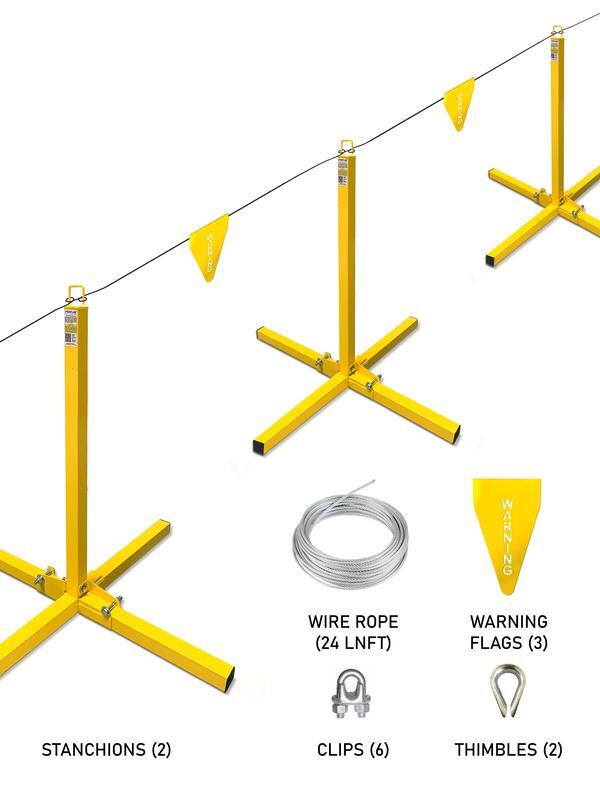
A purpose-built stanchion solves the tipping question before the crew gets on the roof. For example, the Frontline WLS16 warning line system is a 39-inch steel stanchion on a non-penetrating cross-leg base with rubber pads, weighing 41 pounds, strung with 3/16-inch galvanized cable rated to a 500-pound minimum, flagged at 6-foot intervals, and set no more than 24 feet apart. Intertek tested it to 1926.502(f)(2)(iii), the 16-pound tipping rule, in September 2024. The rubber pads matter on a membrane or a painted metal roof, where a bare steel base would scar the surface.
The rule that gets crews cited most often is the one about who may be inside the line:
"No employee shall be allowed in the area between a roof edge and a warning line unless the employee is performing roofing work in that area." (29 CFR 1926.502(f)(3))
The roofer who crosses the line to work the edge must be protected by the companion system named in 1926.501(b)(10): a guardrail, a net, a personal fall arrest system, or the safety monitor. The laborer who walks out to look over the edge may not be there at all. Points of access, material storage, and hoisting areas connect to the work area by a path formed by two warning lines. When the path is not in use, it is closed with a barricade equal to the line or offset so nobody can walk straight into the work area (1926.502(f)(1)(iii) and (iv)).
The Safety Monitor Is a Job, Not a Title
The safety monitoring system is the companion system most roofing crews pair with the warning line; it costs one worker's full attention. 29 CFR 1926.502(h)(1) requires the employer to designate a competent person to monitor the safety of other employees. That monitor must be competent to recognize fall hazards, must warn a worker who appears unaware of a hazard or is acting in an unsafe manner, must be on the same walking/working surface and within visual sighting distance of the worker being monitored, and must be close enough to communicate orally. The fifth duty is often overlooked on busy jobsites:
"The safety monitor shall not have other responsibilities which could take the monitor's attention from the monitoring function." (29 CFR 1926.502(h)(1)(v))
A monitor who is also tearing off, running the kettle, answering the phone, or operating the crane signal is not a monitor. The standard adds two limits on the system itself: mechanical equipment may not be used or stored in an area where a monitor is the protection for roofing on a low-slope roof (1926.502(h)(2)), and no employee other than the roofing crew, or an employee covered by a fall protection plan, may be in the monitored area (1926.502(h)(3)), and each employee working in a controlled access zone is directed to comply promptly with the monitor's warnings (1926.502(h)(4)).
Two points from OSHA's April 20, 2012, interpretation letter settle questions crews still argue about. First, an employer does not have to prove that guardrails, nets, or personal fall arrest systems are infeasible before choosing a monitor on a roof 50 feet or less in width; the options in 1926.501(b)(10) are all available. Second, the standard sets no minimum offset distance from the edge for a worker being monitored.
The 50-Foot Rule Measures Width, Not Length
The sentence that permits a monitor alone says 50 feet or less in width, and it points to Appendix A to Subpart M for how to measure. The appendix rule is that "the dimension selected to be the width of an area is the lesser of the two primary dimensions," as viewed from above. A roof 120 feet long and 60 feet wide is a 60-foot roof for this purpose, and it may not have a monitor alone. A roof 200 feet long and 48 feet wide qualifies. Irregular roofs are broken into rectangular subareas with the shortest possible dividing lines, and OSHA's January 16, 2001, interpretation letter confirms that a parapet wall of any height or any change in elevation divides one roof area from another for the measurement.
Over 50 feet, the monitor is still a legal option; it just needs a warning line. That combination, warning line and safety monitoring system, is the most common compliant setup on a large commercial roof, and it is the setup this talk's crew example uses.
Common Warning Line Mistakes To Avoid
Avoid these errors:
- The line is the only system. A crew sets the stanchions at 6 feet and goes to work with no monitor, no anchors, and no guardrail. Every option in 1926.501(b)(10) is a combination; the line alone is a citation under that paragraph.
- Warning lines on a steep roof. The option applies only to low-slope roofs. OSHA's September 26, 2003, interpretation letter states it directly: "The Standard does not permit the use of controlled access zones, warning lines, or other alternative fall protection methods for nonresidential roofing activities on steep roofs." On residential steep roofs, warning lines could appear only inside a written fall protection plan after conventional systems are shown infeasible, and OSHA rarely agrees that all other measures are infeasible.
- Other trades behind the roofers' line. A mechanical contractor sets a rooftop unit inside the roofers' 6-foot line and calls it covered. In the November 15, 2002, letter, OSHA said that "the standard does not permit the HVAC workers to rely on a warning line at 6 feet from the edge for fall protection." The same answer applies to electricians, plumbers, and anyone else not performing roofing work.
- The 15-foot line is used within 15 feet. For non-roofing work, OSHA's December 15, 2003, letter explains the policy: "At 15 feet from the edge, a warning line, combined with effective work rules, can be expected to prevent workers from going past the line and approaching the edge." OSHA treats that setup as a de minimis condition when the line meets the 1926.502(f)(2) specifications, no work takes place between the line and the edge, and the employer enforces a rule that nobody passes it. The January 3, 2005, letter declined to extend the 6-foot and 10-foot distances to other trades. Within 15 feet, those trades need guardrails, nets, or a personal fall arrest system.
- The monitor has a second job. The foreman monitors between phone calls, or the monitor carries a roll of membrane. 1926.502(h)(1)(v) does not allow it.
- Caution tape and buckets. Plastic tape has no rated strength, sags to the roof, and tears in wind. The line must be rope, wire, or chain with a minimum tensile strength of 500 pounds, and the stanchions must pass the 16-pound test.
- Mechanical equipment with a monitor-only crew. A roofing cart on a roof where the monitor is the protection violates 1926.502(h)(2). Add the warning line and use the 10-foot setback on the edges the cart drives toward.
- The 50 feet is measured along the long side. Width is the lesser dimension. A 100-foot by 40-foot roof qualifies for a monitor alone; a 60-foot by 60-foot roof does not.
Let's Set Up the Warning Line System for a Commercial Crew
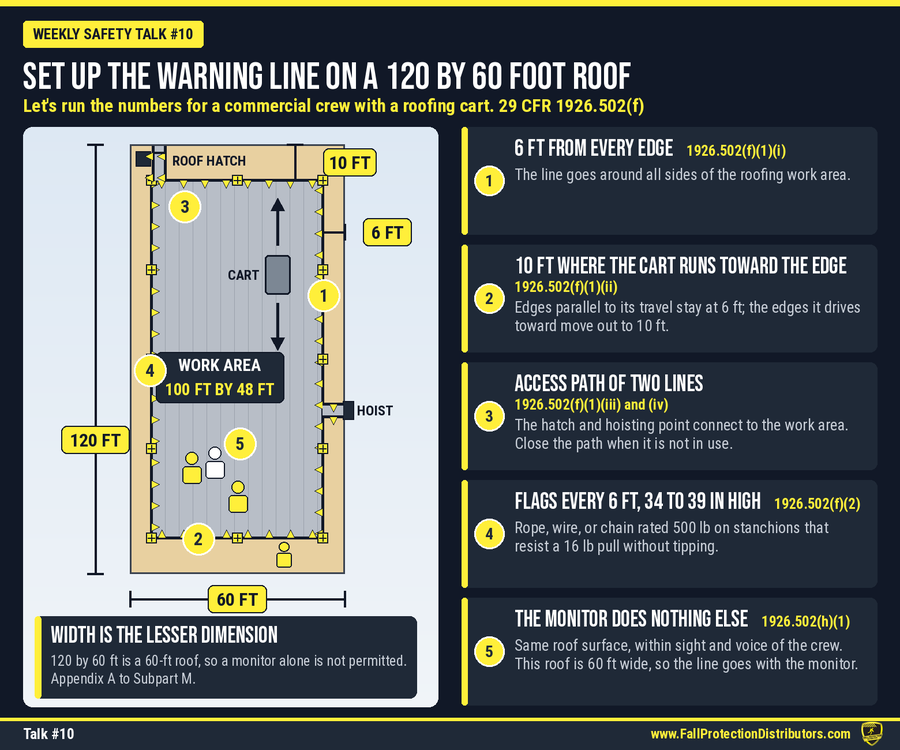
Let's run the numbers for a crew re-roofing a 120-foot by 60-foot low-slope standing-seam metal roof, 24 feet above grade, with a roofing cart working the length of the building. The width is 60 feet, so a monitor alone is not permitted; the crew pairs a warning line with a safety monitor, and the workers who finish the edge detail add a personal fall arrest system.
The cart runs east to west along the 120-foot dimension. The north and south edges are parallel to its travel, so the line sits 6 feet inside them. The east and west edges are perpendicular to its travel, so the line sits 10 feet inside them (1926.502(f)(1)(ii)). The lined work area measures 100 feet by 48 feet. With stanchions no more than 24 feet apart, the 296-foot perimeter requires 13 stanchions, and the cable between them is flagged every 6 feet. After the line is strung, the foreman checks the sag at the middle of the longest span: it must stay at or above 34 inches, with the top of the line no higher than 39 inches.
The roof hatch is in the northwest corner, outside the lined area. Two warning lines form a path from the hatch into the work area, and the material hoisting point on the south edge connects the same way. When the crew is not using the hatch path, a chain across the opening closes it (1926.502(f)(1)(iv)). The cart and the stored membrane stay inside the lined area, where 1926.502(f)(4) requires them.
The monitor is named on the fall protection plan, works on the same roof surface, stays within sight and voice of every worker, and does nothing else. The two roofers who terminate the membrane at the edge cross the line to work, so they wear harnesses and connect to anchors.
The roof type decides the anchor. On a standing-seam metal roof, the SSRA1 clamps the seam without penetrations, relocates along the seam in about two minutes, and must be installed at least 6 feet from the end of any panel and at least 6 feet from any fall hazard in all directions. Set it high in the field of the roof, upslope of the edge work, and rig for fall restraint where the lanyard length allows, because good practice in fall arrest is the same as in restraint: set up the work so you never put yourself in a position to get over the edge in the first place. Talk #5 covers that choice, Talk #4 covers the 5,000-pound anchor rule, and Talk #6 covers the clearance calculation. Everyone else on the crew works inside the line under the monitor's eye.
General Industry Uses a Different Line: The Designated Area
The building owner's maintenance crew servicing the rooftop units after the roofers leave is not in construction. They work under 29 CFR 1910.28(b)(13), which divides a low-slope roof into three zones. Within 6 feet of the edge, only a guardrail, safety net, travel restraint, or personal fall arrest system will do. From 6 feet to 15 feet, the same systems apply, but the employer may use a designated area if the work is both temporary and infrequent. At 15 feet or more from the edge, the employer may use a designated area, or no fall protection at all for work that is both temporary and infrequent, provided the employer enforces a work rule that nobody goes within 15 feet of the edge without fall protection.
A designated area is a distinct portion of the roof delineated by a warning line (1910.21(b)), and 1910.29(d) builds that line differently from the construction version. The general industry line may be tape, needs only a 200-pound breaking strength, and sits 15 feet from the edge for routine work. Workers stay inside the designated area while the work is underway.
| Question | Construction roofing work, 1926.502(f) | General industry, 1910.28(b)(13) and 1910.29(d) |
|---|---|---|
| Who may use it | Employees performing roofing work on a low-slope roof | Employees doing work that is both temporary and infrequent on a low-slope roof |
| Trigger height | 6 feet (1926.501(b)(10)) | 4 feet (1910.28(b)(1)(i)) |
| Distance from the edge | 6 feet; 10 feet on edges perpendicular to mechanical equipment travel | 6 feet for temporary and infrequent work, 15 feet for other work; 10 feet perpendicular to mobile mechanical equipment travel |
| Line height | 34 to 39 inches, sag included | 34 to 39 inches, sag included |
| Line strength | 500 pounds minimum tensile strength | 200 pounds minimum breaking strength |
| Visibility | Flagged every 6 feet with high-visibility material | Clearly visible from 25 feet away and from anywhere inside the designated area |
| Companion system | Always: guardrail, safety net, personal fall arrest system, or safety monitor | None inside the designated area; within 6 feet of the edge, only conventional systems |
The practical difference is the companion system. A roofer behind a construction warning line still has a monitor or an anchor; a maintenance worker inside a designated area has only the line and the work rule. That is why the general industry setback for routine work is 15 feet, not 6, and why the standard restricts the 6-foot designated area to work that is both temporary and infrequent, such as a filter change or a quarterly inspection.
Do State Rules Change the Warning Line Answer?
Several state plans set the line differently, and a crew crossing state lines should check before loading the truck. Washington sets the line between 36 and 45 inches, higher than the federal range, keeps the 500-pound line strength and the 16-pound stanchion test (WAC 296-880-40040), and adds rules for the monitor: no monitoring in adverse weather that creates additional hazards, high-visibility apparel that sets the monitor apart from the crew, no other duties, and no more than eight exposed workers per monitor (WAC 296-880-40045). California's roofing standard applies above 20 feet on slopes of 0:12 to 4:12 and places warning lines no closer than 5 feet from the edge at 34 to 45 inches high (Title 8 section 1730(b)). Oregon limits both warning lines and safety monitoring to roofing work on slopes of 2 in 12 or less, and requires the warning line with the monitor on any roof more than 50 feet wide (OAR 437-003-1502 and 437-003-2502, summarized in Oregon OSHA's fact sheet). A 3 in 12 roof that is low-slope under federal rules is a conventional-protection roof in Oregon. Our state-by-state regulations database covers all 50 states plus the Canadian provinces.
Warning Line Violations Are Costly
Citations after a warning line inspection are predictable: a warning line without a companion system, a line on a steep roof, other trades working behind the roofers' line, a monitor with a second job, and caution tape instead of a rated line. In 2026, a serious violation runs up to $16,550, and a willful or repeat violation up to $165,514 (OSHA penalties). The equipment that prevents most of these citations costs less than one serious citation: a tested warning line stanchion runs about $239, and a complete warning line kit with cable, flags, and hardware covers a work area for the life of the stanchions. Spending ten minutes setting up and naming the monitor before the first roll prevents these risks.
Frequently Asked Questions
What is a warning line system in OSHA?
A warning line system is a barrier of ropes, wires, or chains on stanchions, flagged every 6 feet, that warns workers they are approaching an unprotected roof edge (29 CFR 1926.500(b)). Under 1926.501(b)(10), it is one of the fall protection options for roofing work on a low-slope roof, and it is always combined with a guardrail system, safety net system, personal fall arrest system, or safety monitoring system. It is never a complete fall protection system by itself.
How far from the edge does a warning line have to be?
At least 6 feet from the roof edge on every side of the work area (29 CFR 1926.502(f)(1)(i)). When mechanical equipment is in use, the edges parallel to its direction of travel stay at 6 feet, and the edges perpendicular to its travel move out to at least 10 feet (1926.502(f)(1)(ii)). For work that is not roofing work, OSHA's interpretation letters put the line at 15 feet with a work rule that nobody passes it.
How high does a warning line have to be?
The lowest point of the rope, wire, or chain, including sag, must be at least 34 inches above the roof surface, and the highest point no more than 39 inches (29 CFR 1926.502(f)(2)(ii)). A stanchion with a 39-inch attachment point sets the top of that range, and the sag between stanchions must not drop below 34 inches.
Can a warning line be used alone for fall protection?
No. 29 CFR 1926.501(b)(10) lists every warning line option as a combination: warning line and guardrail, warning line and safety net, warning line and personal fall arrest system, or warning line and safety monitoring system. The only system permitted alone under that paragraph is a safety monitoring system on a roof 50 feet or less in width, and that still requires a designated competent person who does nothing but monitor.
Can warning lines be used on a steep roof?
No. The warning line and safety monitor options in 29 CFR 1926.501(b)(10) apply to low-slope roofs, which the standard defines as a slope of 4 in 12 or less. A steep roof requires guardrails with toeboards, safety nets, or a personal fall arrest system (1926.501(b)(11)). OSHA confirmed in a September 26, 2003, interpretation letter that warning lines and controlled access zones are not permitted for nonresidential roofing on steep roofs.
What is the 50-foot rule for safety monitors?
On a low-slope roof 50 feet or less in width, 29 CFR 1926.501(b)(10) permits a safety monitoring system alone, without the warning line. Width is the lesser of the roof's two primary dimensions, measured as viewed from above, and an irregular roof is broken into subareas (Appendix A to Subpart M). A 120-foot by 60-foot roof is 60 feet wide, so a monitor alone is not an option there.
What are the requirements for a safety monitor?
The employer designates a competent person who can recognize fall hazards, warns a worker who appears unaware of a hazard or is acting unsafely, stays on the same walking/working surface within visual sighting distance, stays close enough to communicate orally, and has no other responsibilities that could take attention from monitoring (29 CFR 1926.502(h)(1)). Mechanical equipment may not be used or stored where a monitor is the protection (1926.502(h)(2)), and nobody but the roofing crew may be in the monitored area (1926.502(h)(3)).
Can HVAC or other trades work behind a roofer's warning line?
No. In a November 15, 2002, interpretation letter, OSHA said HVAC installation is not roofing work, so the 6-foot warning line does not apply to those workers, even when roofers are on the same roof. Trades other than roofers on a low-slope roof need guardrails, safety nets, or a personal fall arrest system within 15 feet of the edge, and may rely on a warning line only at 15 feet or more with a work rule that nobody passes it.
What is the 15-foot rule for warning lines?
It is an OSHA enforcement policy from the December 15, 2003, and January 3, 2005, interpretation letters, not a provision of 1926.502(f). For work that is not roofing work, OSHA treats a warning line set 15 feet or more from the edge, built to the 1926.502(f)(2) specifications, with no work between the line and the edge and an enforced rule that nobody passes it, as a de minimis condition. Within 15 feet, conventional fall protection is required.
Can you use caution tape as a warning line?
No. The line must be a rope, wire, or chain with a minimum tensile strength of 500 pounds, supported 34 to 39 inches above the surface, on stanchions that resist a 16-pound horizontal pull without tipping (29 CFR 1926.502(f)(2)). Plastic caution tape tied to buckets meets none of those requirements. Tape can mark a designated area in general industry if it has a 200-pound breaking strength (1910.29(d)(2)(i)), but that is a different rule for different work.
What is the difference between a warning line and a designated area?
A warning line system is a construction rule for roofing work on low-slope roofs (29 CFR 1926.502(f)), always paired with another system. A designated area is a general industry rule (1910.28(b)(13) and 1910.29(d)) for work that is both temporary and infrequent on a low-slope roof, such as servicing a rooftop unit: the line sits 6 feet from the edge for temporary and infrequent work and 15 feet for other work, needs a 200-pound breaking strength, and nobody inside the designated area needs additional fall protection.
How much force must a warning line stanchion resist?
After the line is attached, each stanchion must resist a horizontal force of at least 16 pounds, applied 30 inches above the walking/working surface, perpendicular to the line and toward the roof edge, without tipping over (29 CFR 1926.502(f)(2)(iii)). The line itself must then carry that load without breaking (1926.502(f)(2)(iv)). Ask the stanchion manufacturer for the test report that proves it.
Toolbox Quiz: Test Your Crew
Five questions from this talk. Discuss these questions at the safety meeting, let the crew debate the answers, then score it. The one-page printable warning line crew talk has the setup checklist, the monitor duties, and a crew sign-off block for your training records (29 CFR 1926.503(b) requires written certification), and it lets the foreman run this talk at any safety meeting. It's free, and you don't have to give us an email address to get it.
Warning lines are legal for roofing work on low-slope roofs and nowhere else; they are always paired with a guardrail, a net, a personal fall arrest system, or a safety monitor; the line sits 6 feet from the edge and 10 feet where equipment drives toward it; the monitor does nothing but monitor; and the 50-foot rule measures width. Teach it to every new hire in this order. If you have a question about your own roof layout, send it through our contact page; we read every one, and answers may become future talks.
Work safe up there.