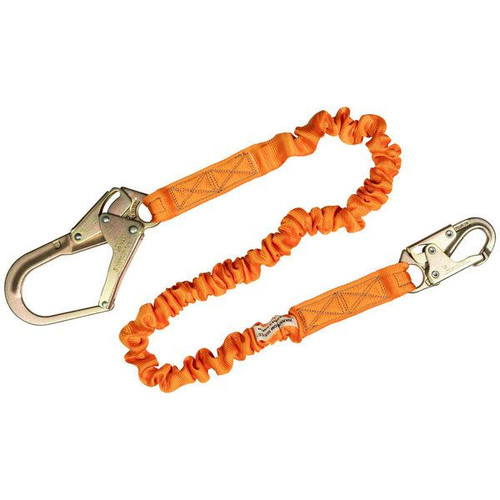


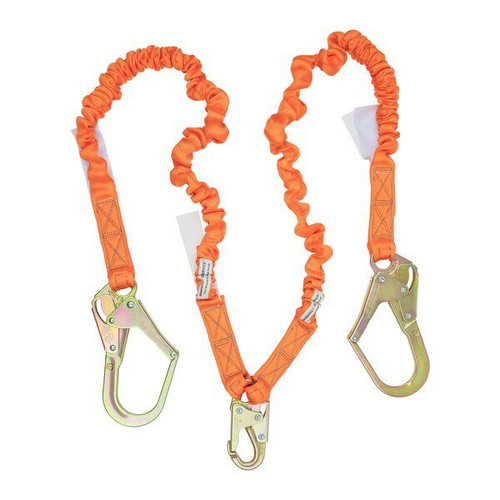
C5117 Double-Leg Stretch Internal Shock-Absorbing Lanyard with 2 Rebar Hooks and 1 Steel Snap Hook
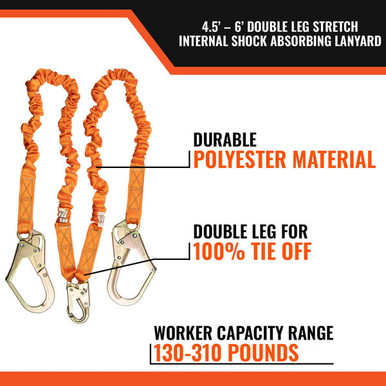
The Malta Dynamics C5117 is a double-leg energy-absorbing lanyard built for 100 percent tie-off around concrete reinforcement and structural steel. Each leg ends in a large-throat rebar hook that clips directly to rebar, scaffold tube, or structural members, while the harness end uses a steel snap hook. The elastic legs rest at 4.5 feet and stretch to 6 feet only when reach is needed.
A single internal shock absorber serves both legs, holding the maximum arresting force to 900 pounds or less while staying lightweight. All connectors are alloy steel with a 3,600 lb gate rating, and the assembly is third-party tested under ISO 17025 to ANSI Z359.13-2013.
Who Needs This Product
The C5117 is the connecting device in a personal fall arrest system, built for 100 percent tie-off around rebar and structural steel. Its two rebar-hook legs let a worker clip the next member before releasing the last, so they are never unprotected while repositioning. It suits crews on reinforced concrete, formwork, and steel where anchor points are structural. Each connected worker also needs an ANSI full body harness and anchorages rated for the load. Double-leg lanyards are intended for fall arrest, not fall restraint.
Features
100 percent tie-off
Two legs let a worker clip the next anchor before releasing the last, staying protected while moving between points.
Two rebar hooks
Large-throat self-closing rebar hooks clip directly to rebar, scaffold tube, and structural steel where snap hooks will not fit.
Steel snap hook end
A self-locking alloy steel snap hook with 3,600 lb gate strength connects to the harness dorsal D-ring.
Stretch legs
Both legs rest at 4.5 feet and extend to 6 feet only when needed, cutting loose lanyard that snags.
Shared internal shock absorber
A single energy absorber serves both legs, limiting maximum arresting force to 900 pounds or less.
Technical Specifications
| Base SKU | C5117 |
|---|---|
| Type | Double-leg stretch internal shock-absorbing lanyard |
| Connectors | 2 rebar hooks, 1 self-locking steel snap hook |
| Length | 4.5 ft at rest, stretches to 6 ft per leg |
| Maximum arresting force | 900 lb or less |
| Maximum free fall | 6 ft (per the user manual) |
| Tie-off | 100 percent (one leg always connected) |
| Worker capacity | 130 to 310 lb, including tools and equipment |
| Webbing | 1 in polyester, high-visibility orange |
| Connector tensile strength | Alloy steel, 5,000 lb minimum |
| Connector gate strength | 3,600 lb side and front load |
| Unit weight | 6.2 lb |
| Compliance | ANSI Z359.13-2013; ANSI A10.32-12; OSHA 1926 Subpart M; OSHA 1910; OSHA 1926.502 |
| Testing | Third-party tested under ISO 17025 accreditation |
| Warranty | 1 year limited (Malta Dynamics) against factory defects in workmanship and materials |
Keep one leg connected at all times. A double-leg lanyard provides 100 percent tie-off only when one leg is always clipped to a rated anchorage while you reposition. Never clip the unused leg back to your own harness D-ring unless it is a rated tie-back point. Verify fall clearance, keep free fall within 6 feet, and retire the lanyard after any fall-arrest event or shock absorber deployment.
Compliance Standards
ANSI Z359.13-2013
ANSI/ASSP standard for energy-absorbing lanyards and shock-absorbing connecting devices.
ANSI A10.32-12
ANSI/ASSP fall protection standard for construction and demolition operations.
OSHA 29 CFR 1926 Subpart M
Construction fall protection, including personal fall arrest system requirements under 1926.502.
OSHA 29 CFR 1910
General industry personal fall protection requirements for walking-working surfaces.
Typical Applications
Use Overview
Use per the Malta Dynamics lanyard user instruction manual. The sequence below is an overview only.
- Inspect. Check the webbing, stitching, shock absorber, and all connectors before each use.
- Verify the harness. Wear an ANSI-compliant full body harness, fitted and adjusted, with the dorsal D-ring centered between the shoulder blades.
- Verify the anchorage. Confirm the anchorage is rated for the personal fall arrest load and located to keep free fall within 6 feet.
- Calculate clearance. Add free fall, deceleration distance, harness stretch, and a safety margin, and confirm sufficient fall clearance below the work surface.
- Connect. Clip the snap hook to the dorsal D-ring, then keep one rebar hook clipped to a rated anchorage at all times while moving the other leg to the next member.
- Minimize swing falls. Keep the anchorage as directly overhead as possible to reduce pendulum swing.
Inspection and Retirement
Inspect before each use, with a documented competent-person inspection at least every six months or per your program. Remove the lanyard from service for any of the conditions below.
- Webbing: cuts, frays, abrasion, burns, chemical damage, or broken fibers.
- Stitching: pulled, cut, or broken threads anywhere on the assembly.
- Shock absorber: any sign of activation, deployment, or the warning label being exposed.
- Hooks: cracks, deformation, corrosion, or a gate that does not close and lock.
- Labels: must remain legible and intact.
Retirement triggers: any fall-arrest event, any sign the shock absorber has deployed, or any defect listed above. A lanyard exposed to a fall must be removed from service permanently.
 Fall Protection
Distributors, LLC Free Tool · No Signup · OSHA 1926.502 Free Interactive Tool Fall Protection Calculator Pick your system. Run the math. Generate a plan. 1Pick Your SystemDetermine fall restraint vs. fall arrest based on your work surface, edge access, and clearance. 2Run the MathCalculate exact fall clearance required below the work surface for your SRL or lanyard setup. 3Generate a PlanGet a printable OSHA-compliant Fall Protection Plan structured around 29 CFR 1926.502(k).
Frequently Asked Questions
Malta Dynamics C5117 Submittals and Documentation
C5117 Spec Sheet (PDF)Connectors, capacity, webbing, weight, and compliance summary. C5117 Lanyard User Instruction Manual (PDF)Use, fall clearance, free fall limits, inspection, and warranty. C5117 Declaration of Conformity (PDF)Conformity statement with ISO 17025 third-party test verification. C5117 Lanyard Inspection Form (PDF)Competent-person inspection checklist for your records.Compatible and Related Products
- Malta Dynamics C5106 Double-Leg Snap Hook Lanyard. A three-snap-hook version for 100 percent tie-off to D-rings and anchor points.
- Malta Dynamics C5115 Single-Leg Rebar Lanyard. A single-leg rebar lanyard for short-range tie-off.
- Malta Dynamics Javelina Full Body Harness. ANSI full body harness to complete the personal fall arrest system.
- Malta Dynamics A6304 4-Way Roof Anchor Plate. A rated roof anchorage to tie the lanyard off to.
Specifying Lanyards for Your Crew?
Need help matching the right lanyard, harness, and anchorage to your jobsite? Confirm your anchorage, free fall, and fall clearance with us and we will walk through the full kit list so the right equipment ships together.
Call 863-703-4522 to talk to a fall protection specialist.