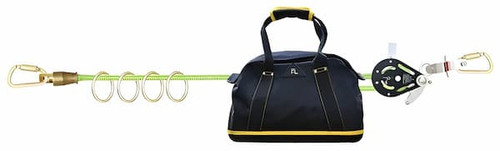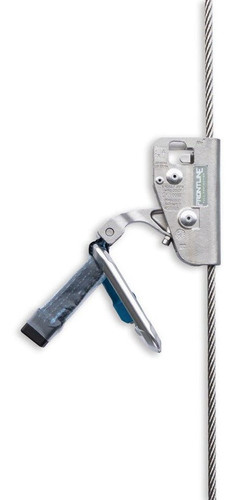


Two Person Cable Horizontal Lifeline with Plate Absorber
The HLC-MPA is Frontline's engineered, permanent-install cable horizontal lifeline: a 3/8 inch zinc-plated steel wire rope lifeline with an energy-absorbing metal plate absorber at the anchor end to reduce the fall forces carried through the line. One kit covers up to 2 workers in fall arrest, or up to 4 workers when configured for fall restraint, over spans of 60 ft or 100 ft.
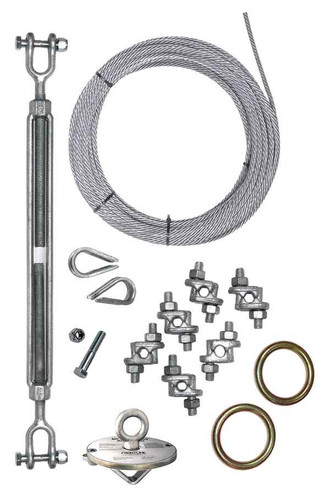
Each kit ships with the termination hardware to build the line: turnbuckle, thimbles, fist grip wire rope clips, steel shackles, and two 2-1/2 inch O-rings that ride the cable as connection points. Systems up to 60 ft use one plate absorber; the 100 ft kit adds a second absorber for the far end, as the manual requires for any span over 60 ft.
Let us provide a free custom quote for your Permanent Horizontal Lifeline project. HLL Quote Request Form
Who Needs This Product
This product is a horizontal lifeline (HLL), the anchorage portion of a fall protection system. Strung between two suitable anchor points, it lets workers move along the full span without disconnecting and re-anchoring. Each worker still wears a full body harness connected to the cable's O-ring by an energy-absorbing lanyard or self-retracting lifeline (SRL). The HLC-MPA is not a complete fall arrest system on its own, and Frontline requires the system to be designed and installed under the supervision of a Qualified Person.
Features
Metal plate energy absorber
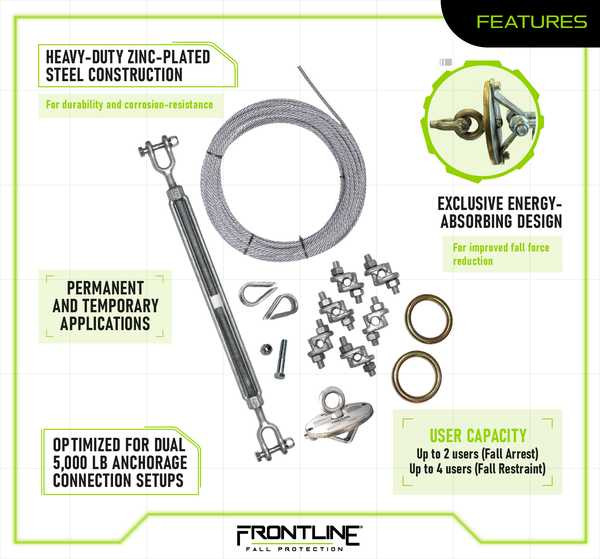
Frontline's exclusive energy-absorbing design reduces the fall forces transmitted through the lifeline. The absorber label lists a 2,500 lb peak and 2,000 lb average dynamic pullout load with 5,000 lb ultimate strength.
3/8 inch zinc-plated steel cable
Heavy-duty zinc-plated steel wire rope for durability and corrosion resistance. Frontline specifies 3/8 inch cable and warns against vinyl or plastic coated rope.
Permanent and temporary use
Engineered for permanent installations and also suited to temporary applications, with spans up to 100 ft for rooftops, platforms, and structural work.
2 arrest users, 4 restraint users
Supports up to 2 users in fall arrest or up to 4 users configured for fall restraint, for workers from 130 to 420 lbs with clothing, tools, and equipment.
Termination hardware included
Turnbuckle, thimbles, fist grip wire rope clips, steel shackles, bolt and nut, and two 2-1/2 inch O-rings for lanyard or SRL connection are supplied for the line.
Dual 5,000 lb anchorage
Optimized for setups with two end anchors that each meet the 5,000 lb per user requirement. Two HLL systems can share one anchor point to turn a 90 degree corner.
Technical Specifications
| Brand and series | Frontline, Horizontal Lifelines |
|---|---|
| Part numbers | HLC602-MPA (60 ft) and HLC1002-MPA (100 ft) |
| Users | Up to 2 in fall arrest; up to 4 in fall restraint |
| Worker capacity | 130 to 420 lb, including clothing, tools, and equipment |
| Lifeline | 3/8 in zinc-plated steel wire rope (do not use vinyl or plastic coated cable) |
| Lengths | 60 ft or 100 ft (maximum system span 100 ft) |
| Energy absorbers | Minimum 1 for systems up to 60 ft; minimum 2 for systems over 60 ft |
| Absorber ratings (label) | Peak dynamic pullout load 2,500 lb; average dynamic pullout load 2,000 lb; ultimate strength 5,000 lb |
| Anchorage strength | At least 5,000 lb per user in fall arrest; at least 1,000 lb in fall restraint |
| Installed slack | 6 in, measured vertically at the midpoint of the span |
| Maximum free fall | 6 ft, or up to 12 ft with equipment explicitly certified for it |
| Connection ring | Dorsal D-ring in fall arrest; 1 attachment per connection point |
| Hardware | Turnbuckle, steel shackles, thimbles, fist grip clips, bolt and nut, two 2-1/2 in O-rings |
| Kit weight | Approximately 11.3 lb (60 ft kit, per Frontline) |
| OSHA alignment | 29 CFR 1926.502; 29 CFR 1910.140 |
Anchorage, sag, and clearance. Both end anchors must meet the strength requirements in the Frontline manual. Never judge tension by eye: measure 6 in of slack at midspan, and never over-tighten the cable. A horizontal lifeline deflects during a fall, and the manual lists 71.00 in of deflection at a 40 ft span, 86.99 in at 60 ft, and 120.38 in at 100 ft. Add deflection to your fall clearance calculation, with a minimum 3 ft safety margin, before anyone ties off.
Compliance Standards
OSHA 29 CFR 1926.502
Construction personal fall arrest system criteria under Subpart M, including horizontal lifeline design and installation under the supervision of a qualified person per 1926.502(d)(8).
OSHA 29 CFR 1910.140
General industry personal fall protection systems. Frontline states the product meets or exceeds these requirements when used according to its instructions.
Qualified person design
The manual requires the entire HLL design and installation to be performed under a Qualified Person, with fall clearance calculated for each installation location.
Used with compatible components
Compliance applies in conjunction with other compatible fall protection equipment. Connectors must be self-closing, self-locking, and rated for at least 3,600 lbs.
Typical Applications
Installation Overview
Installation must follow the Frontline user manual and be supervised by a Qualified Person. The sequence below is an overview only. You will need 5/16 in, 3/4 in, and 19/32 in wrenches, an adjustable wrench, and a torque wrench.
- Plan the system. Confirm both anchorages meet the manual's strength requirements, calculate fall clearance with deflection, and place the line 6 to 10 ft back from the leading edge to limit swing fall.
- Anchor the absorber. Attach the plate energy absorber to the anchor point with the steel shackle and tighten until at least 1 full thread is visible. On spans over 60 ft, attach the second absorber at the opposite end.
- Set up the turnbuckle. Open the turnbuckle to its extended position, attach one end to the absorber, and tighten until at least 1 full thread is visible.
- Terminate the cable. Slide the O-rings onto the cable first. Loop the 3/8 in cable around a thimble at each end and secure each loop with fist grip clips. Frontline's torque table for 3/8 in rope calls for a minimum of 2 clips, 5-1/4 in of rope turned back, and 45 ft-lb of torque.
- Tension to 6 in of slack. Tighten the turnbuckle evenly until there is 6 in of slack measured vertically at midspan. Do not over-tighten.
- Connect workers. Each worker connects a lanyard or SRL from the harness dorsal D-ring to an O-ring after verifying fall clearance. Use an independent fall arrest system during installation above 6 ft.
Inspection and Retirement
Inspect every component before each use. A Competent Person other than the user must inspect the system at least every 12 months and record it in the manual's inspection log and on the equipment inspection grid label. Frontline lists the product life as indefinite as long as it passes pre-use and Competent Person inspections.
- Wire rope: broken wires, kinks, flattening, corrosion, or damaged terminations.
- Absorber, shackles, and turnbuckle: corrosion, deformation, pits, burrs, cracks, sharp edges, rust, or excessive heating.
- Fist grip clips and thimbles: tight, correctly seated, with at least 1 full thread visible on bolted connections.
- O-rings: smooth, round, and free of cracks, wear, or deformation.
- Labels: legible and intact, with the date of first use recorded.
Retirement triggers: any exposure to fall arrest forces, alteration, damaged or missing labels, or any condition where the inspector cannot verify the system is fit for service.
 Fall Protection
Distributors, LLC Free Tool · No Signup · OSHA 1926.502 Free Interactive Tool Fall Protection Calculator Pick your system. Run the math. Generate a plan. 1Pick Your SystemDetermine fall restraint vs. fall arrest based on your work surface, edge access, and clearance. 2Run the MathCalculate exact fall clearance required below the work surface for your SRL or lanyard setup. 3Generate a PlanGet a printable OSHA-compliant Fall Protection Plan structured around 29 CFR 1926.502(k).
Frequently Asked Questions
Frontline HLC-MPA Submittals and Documentation
Frontline HLC-MPA Spec Sheet (PDF)Features, design specifications, available lengths, and relevant OSHA standards. Frontline HLC-MPA User Instruction Manual (PDF)Limitations, fall clearance, installation, cable termination, inspection, and labels.Compatible and Related Products
- Frontline HCLL260 Elite 2-Person 60 ft Cable Horizontal Lifeline. Retractable temporary cable HLL with built-in winch tensioner.
- Frontline HLK1004 4-Person 100 ft Adjustable Horizontal Lifeline Kit. Kernmantle rope HLL for up to 4 workers with 6 ft anchor straps.
- Frontline RO4W Multifunction 4-Way Anchor. Fastened end anchorage option for metal, wood, and concrete per the manual.
- Frontline STM585K MEGA Swivel 5K Steel Anchor. 5,000 lb steel anchor for structural end connections.
Specifying a Horizontal Lifeline for Your Crew?
Span, anchorage strength, and fall clearance all have to line up before the system goes in. Confirm your application, anchorage, and clearance with us and we will walk through the kit list so the right equipment ships together.
Call 863-703-4522 to talk to a fall protection specialist.