
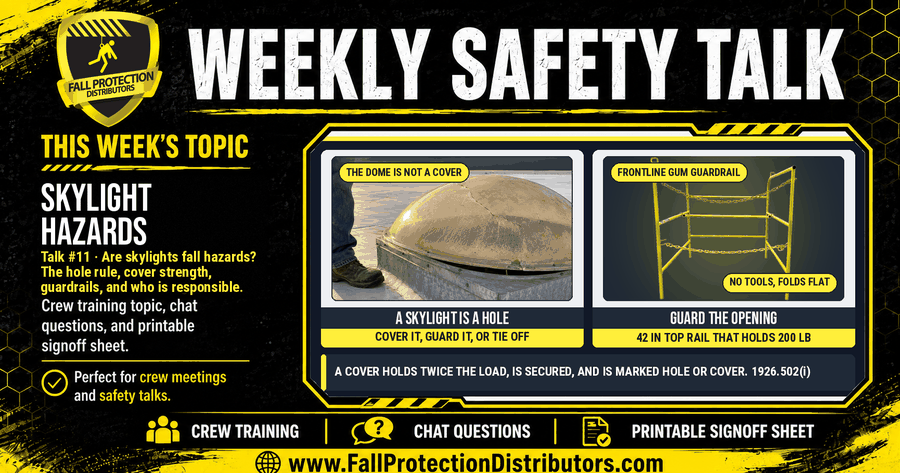
Skylight Hazards (Talk #11)
Posted by Howie Scarboro - COO- Fall Protection Distributors, LLC on Oct 21, 2026
By Howie Scarboro, COO, Fall Protection Distributors, LLC · Last verified against the eCFR and osha.gov: October 13, 2026
For information purposes only. This page supports your safety planning; it does not replace professional judgment. All safety plans and fall protection decisions for the task must be reviewed and approved by a Competent Person or a Qualified Person before work begins, as required by OSHA.
Are Skylights Fall Hazards?
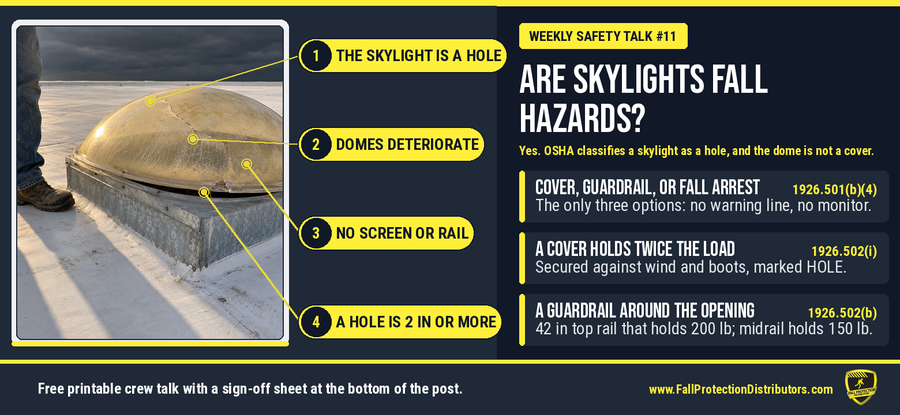
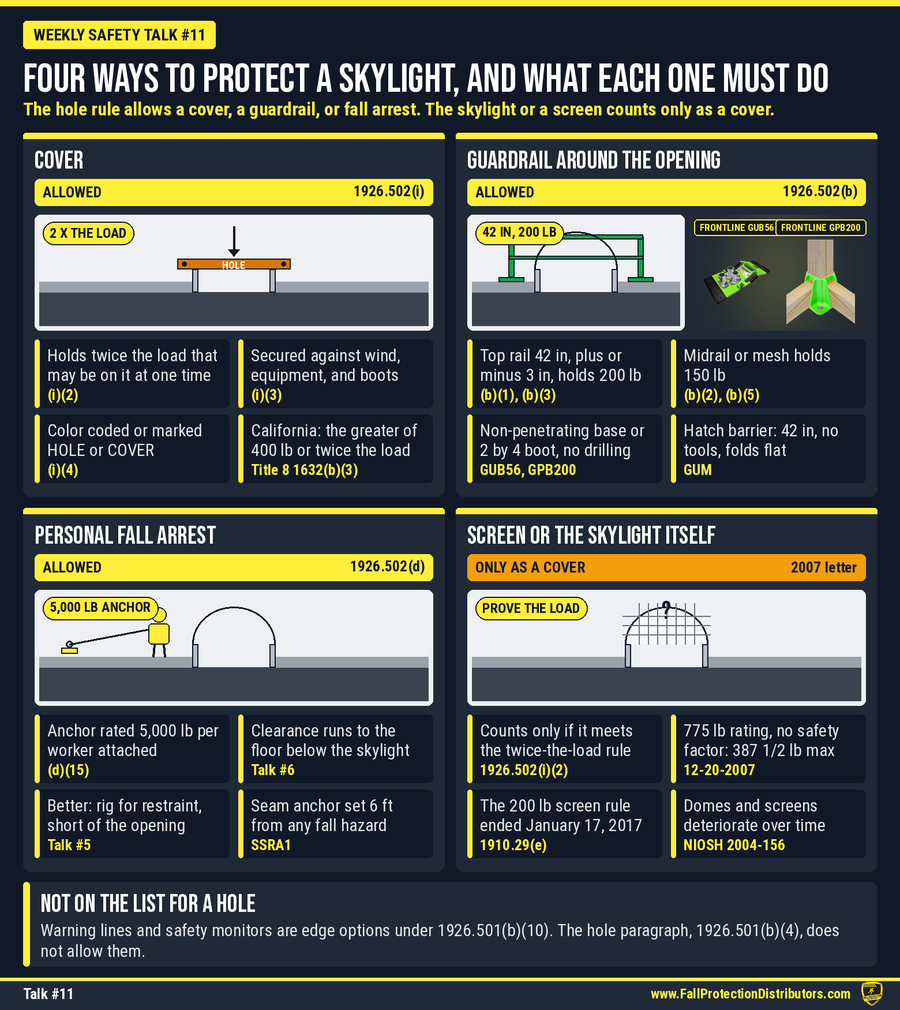
Yes. Under federal OSHA rules, a skylight is a hole in the roof, and the plastic dome or fiberglass panel over it does not change that. In construction, each employee must be protected from falling through holes, including skylights, more than 6 feet above a lower level by a personal fall arrest system, a cover, or a guardrail system erected around the hole (29 CFR 1926.501(b)(4)(i)). In general industry, the trigger is 4 feet, and the options are a cover, a guardrail system, a travel restraint system, or a personal fall arrest system (29 CFR 1910.28(b)(3)(i)).
A cover must support twice the weight of the workers, equipment, and materials that may be on it at any one time, must be secured, and must be marked (29 CFR 1926.502(i)). The old 200-pound skylight screen rule has been gone since January 17, 2017. This talk covers the safety regulations, the definitions, and the fall calculations. It explains guardrail and fall-arrest options and who is responsible on a multi-employer site.
This is Talk #11 in our Weekly Safety Talk series. Fall protection under 1926.501 has been the most-cited OSHA standard for 15 straight fiscal years, with 5,914 citations in the preliminary fiscal year 2025 count (OSHA top 10). CPWR counted 165 workers who died after falling through a skylight or hole from 2011 through 2016 (CPWR), and NIOSH recorded 23 deaths through skylights in 2001 alone (NIOSH Alert 2004-156). Talk #10 covered warning lines at the roof edge; none of those edge options apply to a skylight, and this talk explains why.
The Rule That Treats a Skylight as a Hole: 1926.501(b)(4)
"Each employee on walking/working surfaces shall be protected from falling through holes (including skylights) more than 6 feet (1.8 m) above lower levels, by personal fall arrest systems, covers, or guardrail systems erected around such holes." (29 CFR 1926.501(b)(4)(i))
Each employee must be protected from tripping in or stepping into or through holes, including skylights, by covers (1926.501(b)(4)(ii)), and each employee must be protected from objects falling through holes, including skylights, by covers (1926.501(b)(4)(iii)). The first duty applies at any height, and the third one protects the people working on the floor below.
A hole is "a gap or void 2 inches (5.1 cm) or more in its least dimension, in a floor, roof, or other walking/working surface" (29 CFR 1926.500(b)). OSHA explained the difference in an August 14, 2000, interpretation letter: a fall hazard at the perimeter of a walking/working surface creates a side or edge, and a fall hazard through the surface creates a hole. When OSHA rewrote the general industry rule in 2016, the preamble settled the question for skylights with screens: "Although skylights may be covered by screens or other material, for the purposes of this definition and the final rule, OSHA classifies skylights as holes."
Therefore, a worker on a roof with an unguarded skylight is not protected by distance from the edge or by the monitor at the hatch. OSHA has also closed the door on the timing argument. In a September 5, 2006, letter about newly cut holes, the agency wrote: "Case law has established that brevity of exposure to a hazard is not a defense to a failure to protect against the hazard." The duty under 1926.501(b)(4) must be complied with immediately. A cover that comes off for ten minutes while the curb is flashed is an open hole for ten minutes.
Skylight Cover Requirements Under 1926.502(i)
Once the hole is identified, 29 CFR 1926.502(i) sets out what may cover it.
| Requirement | What it means on the roof | Cite |
|---|---|---|
| Twice the load, at any one time | Add up the heaviest combination of workers, tools, and material that could be on the cover at once, then double it. A 250-pound roofer carrying a 50-pound bundle is 300 pounds on the cover, so the cover must hold 600 pounds without failure. | 1926.502(i)(2) |
| Twice the axle load in roadways | A cover a vehicle can drive over must hold twice the maximum axle load of the largest vehicle expected to cross it. | 1926.502(i)(1) |
| Secured when installed | Fastened or held so the wind, a cart, or a boot cannot slide it off the opening. | 1926.502(i)(3) |
| Color-coded or marked | Paint a warning color or mark it with the word HOLE or the word COVER so nobody stacks material on it or pulls it to use as a work surface. | 1926.502(i)(4) |
| General industry version | The cover supports, without failure, at least twice the maximum intended load, and it is secured against accidental displacement. No marking rule in 1910.29(e). | 1910.29(e)(1) and (2) |
The strength rule is the one that catches skylights:
"All other covers shall be capable of supporting, without failure, at least twice the weight of employees, equipment, and materials that may be imposed on the cover at any one time." (29 CFR 1926.502(i)(2))
Let's run the calculations like an inspector does. The load is the weight of employees, equipment, and materials that may be imposed on the cover at any one time, which means the worst realistic case, not the average. One 250-pound roofer carrying a 50-pound bundle weighs 300 pounds, so the cover needs to support 600 pounds without failure. Two roofers stepping onto the same cover while handing off a roll, with 100 pounds of material already on it, total 600 pounds, so the cover needs 1,200 pounds.
Can the skylight itself be the cover? A roofing contractor asked OSHA in 2006 about a skylight; its manufacturer called it fall-protection compliant and rated to hold 775 pounds. The December 20, 2007, answer is OSHA's clearest statement on the subject. First, OSHA does not approve or endorse products, so a manufacturer's OSHA-compliant claim means only that the manufacturer is making that claim. Second, "if the skylight itself meets the cover criteria in 1926.502(i)(2), as a matter of enforcement policy, OSHA will treat the skylight itself as a cover." Third, because the 775-pound rating stated no safety factor, "the maximum weight that would be permitted under 1926.502(i)(2) on the skylight would be 387½ pounds." The employer then had to show that the weight imposed at any one time stayed under that figure, and if there were doubts about the rating, to use a compliant cover, a personal fall arrest system, or guardrails instead.
The same logic now governs skylight screens. The old general industry rule, 1910.23(a)(4) and (e)(8), required every skylight floor opening to be guarded by a standard skylight screen or a fixed standard railing. It defined the screen as one "capable of withstanding a load of at least 200 pounds applied perpendicularly at any one area on the screen." That text was removed when the Walking-Working Surfaces rule took effect on January 17, 2017. Today, a screen is a cover, and 1910.29(e) requires a cover to support, without failure, at least twice the maximum intended load and to be secured. A screen sold on its 200-pound rating does not meet the current rule for a 250-pound worker, and it never met the construction rule. NIOSH adds the part the catalogs leave out: "Since both skylights and screens are subject to deterioration over time, manufacturers should indicate how long skylights and screens can be expected to maintain their load capacity." An acrylic dome that was sound when the building went up is not the same fifteen years later.
Guardrails Around the Opening: 1926.502(b)
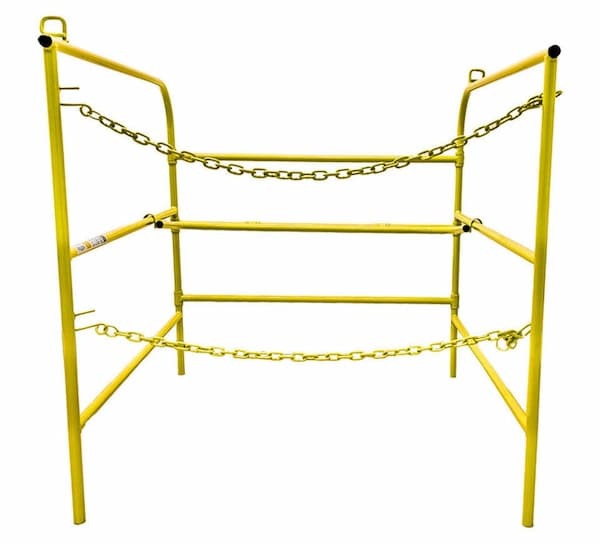
A guardrail takes the load question off the table, because nobody is standing on the skylight. The rail goes around all exposed sides of the opening and meets the standard guardrail criteria in 29 CFR 1926.502(b): a top rail 42 inches high, plus or minus 3 inches, that withstands a force of at least 200 pounds applied within 2 inches of the top edge in any outward or downward direction (1926.502(b)(1) and (b)(3)); a midrail, screen, mesh, or equivalent member between the top rail and the roof that withstands 150 pounds (1926.502(b)(2) and (b)(5)); and no rail that deflects below 39 inches under the test load. General industry guardrails follow 1910.29(b) with the same 42-inch and 200-pound figures.
On a membrane or standing-seam roof, the challenge is supporting the posts without drilling the deck. A non-penetrating base such as the Frontline GUB56 holds the post by weight alone: a 56-pound ASTM-rated steel base with two extended rubber supports and a non-marring footprint, built to the OSHA guardrail criteria of 1910 and 1926, that one worker can carry and reset as the work moves. Four bases and the rails make a free-standing square around a skylight that stays in place for the life of the job and comes down without a patch. For a crew that prefers to build with lumber on hand, the Frontline GPB200 boot base takes a 2-by-4 post and has toe-board slots, so a wood guardrail around a roof hole goes up in minutes. For a roof hatch or a small opening, a folding four-sided barrier such as the Frontline GUM guardrail sets up with no tools at the 42-inch height in a 32-inch or 42-inch footprint. Our skylight and opening protection and guardrail pages carry the full line.
Personal Fall Arrest Over a Skylight: Clearance Decides
A personal fall arrest system is the third option in 1926.501(b)(4)(i), and it is the one most roofing crews already own. The anchor must support 5,000 pounds per employee attached or be designed by a qualified person with a two-to-one safety factor (1926.502(d)(15)), as covered in Talk #4. The new factor with a skylight is the lower level. If the dome breaks, the fall does not stop at the roof; it continues to the lower level of the building, so the clearance calculation in Talk #6 runs to that floor, and a 6-foot lanyard that was fine at a 30-foot eave is also fine over a skylight 24 feet above a slab, while a crew working over a mezzanine 9 feet down is not. Run the numbers in our fall clearance calculator before the first worker clips in.
Better practice is restraint. Rig the lanyard length so the worker cannot reach the skylight, and the dome is never tested. Talk #5 covers that choice. On a standing-seam metal roof, the SSRA1 grips the seam without penetrations and relocates in about two minutes, and it must be installed at least 6 feet from the end of any panel and at least 6 feet from any fall hazard in all directions, which includes every skylight on that roof. Good practice in fall arrest is the same as in restraint: set up the work so you never put yourself in a position to get over the edge, or onto the dome, in the first place.
Common Skylight Mistakes To Avoid
Avoid these errors:
- Trusting the dome. A crew sweeps, tears off, and stacks material around unguarded skylights because the domes look like part of the roof. In the June 6, 2017, Washington case (FACE report 71-188-2019s), a 47-year-old roofer clearing debris from a warehouse roof with 97 unprotected skylights caught his foot on a skylight frame, fell against the plastic dome, and went through it 30 feet to a concrete floor. The investigators also found that a safety monitor and warning line should not have been used where unprotected skylights were present.
- Stepping on a skylight during removal. OSHA's March 31, 2023, news release describes a 59-year-old roofer at a Florida airport hangar who stepped onto a skylight being prepared for removal on October 25, 2022; it collapsed, and he fell 25 feet to a concrete floor. OSHA proposed $53,797 in penalties for four serious violations, including the failure to require fall protection for the 13-member crew.
- A warning line around the skylights. Warning lines and safety monitors are edge options under 1926.501(b)(10). The roof hole guidelines do not list them. A crew inside the warning line with an open skylight in the work area has no protection for the hole.
- The 200-pound screen. Screens built and sold to the old 1910.23 figure still appear on job sites. The current rule requires twice the load, and these screens don't comply.
- Plywood covers. An unsecured, unmarked sheet is a cover that fails 1926.502(i)(3) and (i)(4) before anyone asks what it holds. Secure it, mark it HOLE or COVER, and know its rating.
- Pulling a cover for a quick task. The 2006 letter answers this: the duty applies immediately, and brevity of exposure is not a defense. Guard the opening or tie off before the cover comes off.
- Relying on the GC. The 2004 letter says a subcontractor that relies on the general contractor to cover holes must verify the GC follows through, and it retains the duty to protect its own workers if the GC does not.
- Snow, debris, and fiberglass panels. NIOSH cases include an unmarked 3-foot by 10-foot corrugated fiberglass panel on a metal pole barn roof that broke under a snow load and a worker. Inspect metal roofs for translucent panels between the metal panels, mark them, guard them, or replace them.
Let's Run the Numbers for a Warehouse Re-Roof Crew
Let's run the numbers for a crew re-roofing a 120-foot by 200-foot low-slope standing-seam warehouse roof, 24 feet above a concrete slab, with twelve 4-foot by 8-foot domed skylights, one roof hatch, and a crew of six. The edges get a warning line and a safety monitor under 1926.501(b)(10); the skylights and the hatch get their own plan under 1926.501(b)(4), because the edge plan does nothing for them.
Start with the load question. The heaviest realistic load on any one skylight is two roofers handing off a roll, 250 pounds each, with 100 pounds of material already set down, for a total of 600 pounds, so a cover counts only if it holds 1,200 pounds without failure. The existing domes are twelve years old, have no load rating the owner can provide, and, under the 2007 letter, cannot be treated as covers. That leaves three choices per skylight: a tested cover secured to the curb and marked HOLE, a guardrail around the curb, or the crew tied off.
The crew guards the four skylights in the tear-off lane with free-standing rail, four GUB56 bases and rails per skylight, because material moves past those openings all day and nobody has to think about a cover rating. The eight skylights outside the lane get purpose-built covers that are rated above 1,200 pounds, secured to the curbs, and marked HOLE; the foreman records the rating in the fall protection plan. The hatch gets the GUM barrier the day the crew arrives. The two roofers who flash the skylight curbs work inside the rails or, where a cover is lifted, clip into SSRA1 anchors set in the field of the roof at least 6 feet from the curb, rigged for restraint so the lanyard stops short of the opening.
Before the first roll, the foreman walks the crew through all twelve skylights and the hatch, names the protection on each one, and writes it into the plan. As conditions change, so does the safety plan: a cover that comes off for flashing goes back on, secured, before the worker walks away.
Who Is Responsible for Covering a Skylight?
On a job with several contractors, the answer is usually more than one employer. OSHA applied its multi-employer citation policy, CPL 02-00-124, to floor holes in a November 17, 2004, interpretation letter. The employer that creates the hole, the employer whose workers are exposed to it, the employer that agreed to correct it, and the employer that controls the site each carry a duty under 1926.501(b)(4). The letter is direct about the subcontractor that relies on the general contractor to cover holes: the sub must check that the GC follows through promptly and adequately, and if the GC does not, "the sub retains the responsibility under §1926.501 to implement measures within its ability to protect its employees." Who pays for the covers is a contract question; who protects the workers is not.
Building owners sit outside that policy unless they control the work. Still, NIOSH recommends that owners install screens, guards, or guardrails over existing skylights and mark fiberglass panels, and the Washington investigators in the 2017 case recommended the same. A roofing contractor bidding a re-roof should count the skylights, ask for their load ratings, and price the protection into the job, because the exposing employer on the roof is the one OSHA will find there.
Do State Rules Change the Skylight Answer?
Three state plans tighten the federal rule. Washington sets its construction trigger at 4 feet, and its cover rule mirrors the federal text: twice the weight of employees, equipment, and materials; secured against wind, equipment, or employees; and temporary covers color-coded or marked as a hole or cover (WAC 296-880-40015). In California: a cover must safely support the greater of 400 pounds or twice the load on any one square foot, must be secured, and must carry a sign in letters at least one inch high reading Opening, Do Not Remove (Title 8 section 1632(b) for construction, section 3212(b) for existing buildings). California also sets the only setback in the country: "Any employee approaching within 6 feet of any skylight shall be protected from falling through the skylight or skylight opening" by a screen above the skylight, a screen below it, a guardrail, a personal fall protection system, a cover including the skylight itself that meets the cover rule, or a skylight net that absorbs a 400-pound load dropped from 42 inches (section 3212(e)). Oregon requires covers on holes, including skylights, regardless of height, and adds a note written for exactly this talk: "Smoke domes or skylight fixtures are not considered covers for the purpose of this section unless they meet the strength requirements of 1926.502(i)." (OAR 437-003-1501(3)). Our state-by-state regulations database covers all 50 states plus the Canadian provinces, and Talk #1 covers the trigger heights.
| Question | Federal construction, 1926.501(b)(4) | Federal general industry, 1910.28(b)(3) | Washington, California, Oregon |
|---|---|---|---|
| Trigger height | More than 6 feet above a lower level | 4 feet or more above a lower level | Washington: 4 feet (WAC 296-880). Oregon: covers on holes regardless of height (OAR 437-003-1501(3)). |
| Permitted systems | Personal fall arrest system, cover, or guardrail | Cover, guardrail, travel restraint, or personal fall arrest system | California adds skylight screens and skylight nets (Title 8 section 3212(e)) |
| Cover strength | Twice the weight of employees, equipment, and materials at any one time | Twice the maximum intended load | Washington: twice the load (WAC 296-880-40015). California: the greater of 400 pounds or twice the load, on any one square foot (sections 1632(b)(3) and 3212(b)). Oregon: 1926.502(i). |
| Marking | Color coded, or marked HOLE or COVER | None required | Washington: temporary covers color coded or marked hole or cover. California: a sign in letters at least one inch high reading Opening, Do Not Remove. |
| Setback from the skylight | None stated; exposure is the test | None stated | California: any employee approaching within 6 feet of a skylight must be protected (section 3212(e)) |
| The skylight as its own cover | Only if it meets 1926.502(i)(2) (OSHA letter, December 20, 2007) | Only if it meets 1910.29(e) | Oregon: a smoke dome or skylight fixture is not a cover unless it meets 1926.502(i). California: covers, including the skylight itself, must meet section 3212(b). |
Skylight Violations Are Costly
Citations after a skylight inspection are predictable: an unguarded skylight in the work area, an unrated cover, an unsecured or unmarked cover, an improper warning line, and a crew failing to use PFAS while a cover was off. In 2026, a serious violation runs up to $16,550, and a willful or repeat violation up to $165,514 (OSHA penalties). The Florida case above drew $53,797 in proposed penalties and cost a man his life. The equipment that prevents the citation costs less than the citation: a non-penetrating guardrail base runs a few hundred dollars, a 4-pack of 2-by-4 boots costs a fraction of that, and a folding hatch barrier is a one-time purchase that travels job to job. Investing ten minutes on the skylight count during the safety planning phase prevents these risks.
Frequently Asked Questions
Are skylights considered holes by OSHA?
Yes. The construction standard names them directly: each employee must be protected from falling through holes, including skylights, more than 6 feet above a lower level (29 CFR 1926.501(b)(4)(i)). A hole is any gap or void 2 inches or more in its least dimension in a floor, roof, or other walking/working surface (1926.500(b)). When OSHA rewrote the general industry rule in 2016, the preamble said that although skylights may be covered by screens or other material, OSHA classifies skylights as holes.
Do skylights need fall protection?
Yes, whenever a worker is on the roof around them, and the fall through the skylight would be more than 6 feet in construction (29 CFR 1926.501(b)(4)(i)) or 4 feet or more in general industry (1910.28(b)(3)(i)). OSHA accepts three methods: a cover that holds twice the load, is secured, and is marked HOLE or COVER; a guardrail around the opening; or a personal fall arrest system. In general industry, travel restraint is also allowed. The skylight counts only if the employer can show it supports twice the maximum load that could be placed on it.
Can you walk on a skylight?
No. A standard plastic dome or corrugated fiberglass panel is built to let in light and shed weather, not to carry a worker, and NIOSH notes that both skylights and screens deteriorate over time. In a 2017 Washington case, a roofer sweeping debris stumbled against a plastic dome that broke under him, and he fell 30 feet to a concrete floor. Treat every skylight as an open hole until it is covered, guarded, or the crew is tied off.
What are the OSHA requirements for skylight screens?
There is no longer a separate screen rule. The old general industry rule at 1910.23(a)(4) and (e)(8), which required a screen to withstand a 200-pound load applied perpendicularly at any one area on the screen, was removed when the Walking-Working Surfaces rule took effect on January 17, 2017. A screen is now a cover, and a cover must support, without failure, at least twice the maximum intended load and be secured (1910.29(e)); in construction it is twice the weight of employees, equipment, and materials at any one time (1926.502(i)(2)). A 200-pound screen does not meet either rule for a 250-pound worker.
How much weight does a skylight cover have to hold?
Twice the weight of the employees, equipment, and materials that may be imposed on it at any one time (29 CFR 1926.502(i)(2)). The number depends on the crew, not on the product: one 250-pound worker with 50 pounds of tools means a 600-pound cover; two workers and a bundle of material can mean 1,200 pounds. California sets a floor of 400 pounds, or twice the load, whichever is greater, on any one square foot (Title 8 sections 1632(b)(3) and 3212(b)).
Can a skylight be its own cover?
Only when it meets the cover rule. In a December 20, 2007, interpretation letter, OSHA said that when a skylight meets the cover criteria in 1926.502(i)(2), the agency will, as a matter of enforcement policy, treat that skylight as a cover. In that letter, the skylight was rated to hold 775 pounds with no stated safety factor, so the maximum weight permitted on it was 387 1/2 pounds, and the employer had to show that the weight imposed at any one time stayed under that figure. A manufacturer calling a skylight OSHA compliant proves nothing; OSHA does not approve or endorse products.
Can a warning line protect a skylight?
No. Warning lines and safety monitors are options for unprotected edges of a low-slope roof during roofing work under 1926.501(b)(10), as covered in Talk #10. The hole paragraph, 1926.501(b)(4), lists only personal fall arrest systems, covers, and guardrail systems. A crew working inside a warning line with an unguarded skylight in the work area is exposed to the hole, and the Washington investigators in the 2017 case said so directly.
How far from a skylight do you need fall protection?
Federal OSHA sets no setback distance. The test is exposure: a worker on a walking/working surface who can fall through the skylight must be protected (29 CFR 1926.501(b)(4)(i)), and OSHA wrote in a September 5, 2006, letter that brevity of exposure to a hazard is not a defense. California puts a number on it: any employee approaching within 6 feet of a skylight must be protected by a screen, a net, a guardrail, a personal fall protection system, or a cover (Title 8 section 3212(e)).
What does OSHA require for a temporary roof hole cover?
Four things under 29 CFR 1926.502(i): it supports twice the weight of the workers, equipment, and materials that may be on it at any one time; a cover in a roadway supports twice the axle load of the largest vehicle; it is secured so wind, equipment, or employees cannot displace it; and it is color coded or marked with the word HOLE or the word COVER. A loose sheet of plywood dropped over a curb meets none of the last three.
Who is responsible for covering skylights on a job site?
Every employer whose workers are exposed. In a November 17, 2004, letter, OSHA applied its multi-employer citation policy to floor holes: the contractor that creates the hole, the contractor whose employees are exposed to it, the contractor that agreed to correct it, and the controlling contractor each carry a duty. The letter says a subcontractor that relies on the general contractor to cover holes must check that the GC follows through, and that the sub retains the responsibility under 1926.501 to implement measures within its ability to protect its employees.
Does OSHA require skylight protection in general industry?
Yes. 29 CFR 1910.28(b)(3)(i) requires the employer to protect each employee from falling through any hole, including skylights, that is 4 feet or more above a lower level by a cover, a guardrail system, a travel restraint system, or a personal fall arrest system. That rule covers the maintenance worker servicing a rooftop unit after the roofers leave, and it has applied since January 17, 2017.
Are corrugated fiberglass roof panels skylights?
They are holes with a translucent panel over them, and OSHA treats them the same way. NIOSH investigated a farmer who stepped onto a snow-covered 3-foot-by-10-foot corrugated fiberglass panel on a pole barn roof; the panel broke, and he fell about 16 feet onto the concrete floor. NIOSH recommends inspecting metal roofs for fiberglass panels set between the metal panels, marking them, guarding them, or replacing them with stronger material.
Toolbox Quiz: Test Your Crew
Five questions from this talk. Discuss these questions at the safety meeting, let the crew debate the answers, then score it. The one-page printable skylight crew talk has the hole rule, the cover checklist, and a crew sign-off block for your training records (29 CFR 1926.503(b) requires written certification), and it lets the foreman run this talk at any safety meeting. It's free, and you don't have to give us an email address to get it.
A skylight is a hole; the hole rule allows a cover, a guardrail, or a personal fall arrest system and nothing else; a cover holds twice the load, is secured, and is marked; the skylight or screen counts as a cover only when the employer can prove the load; and every employer with workers on that roof carries the duty. Teach it to every new hire in this order. If you have a question about the skylights on your own roof, send it through our contact page; we read every one, and answers may become future talks.
Work safe up there.